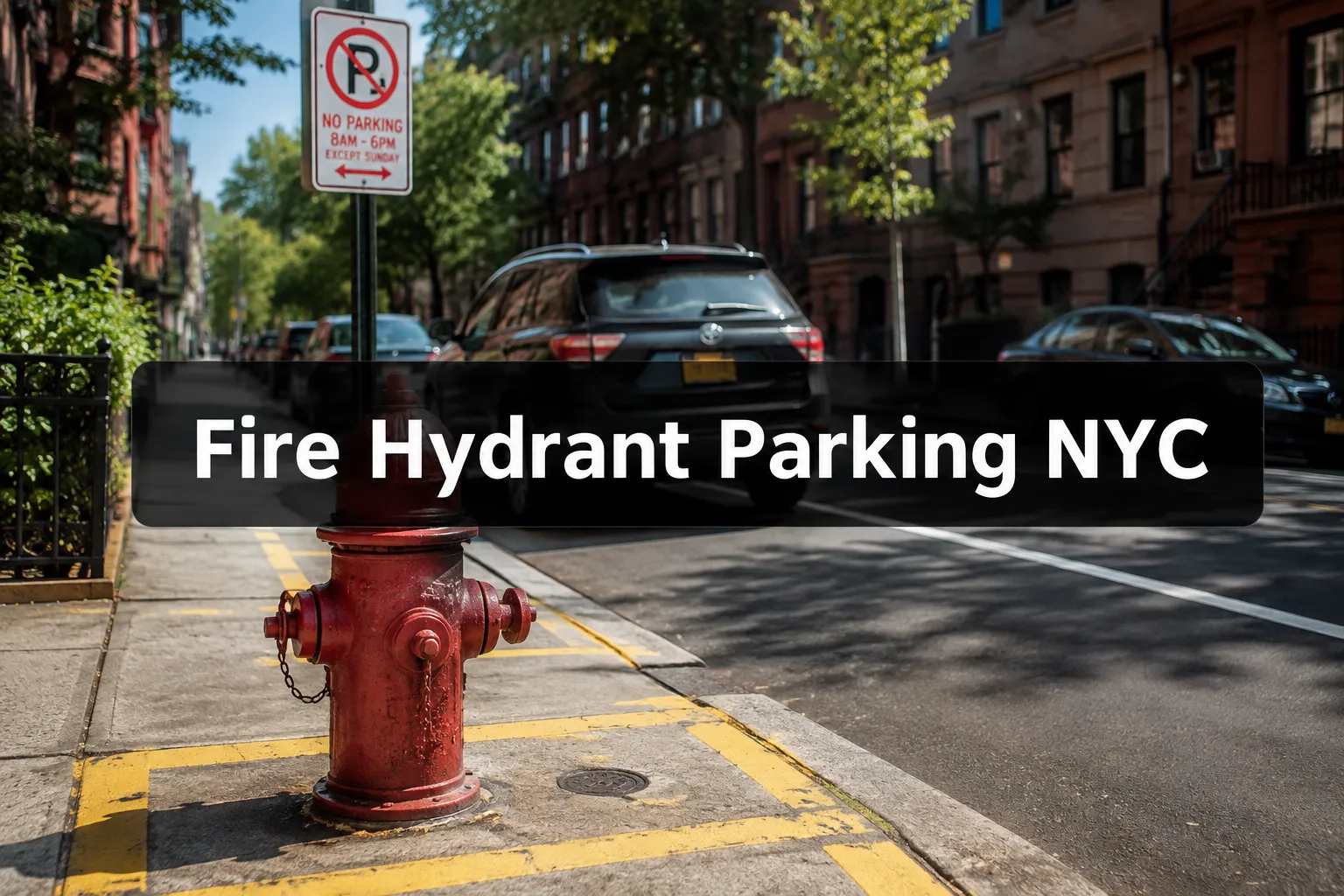
Etiqueta: nyc parking tickets

  • How Close to a Fire Hydrant Can You Park NYC: Official 2026 Rules

    How Close to a Fire Hydrant Can You Park NYC: Official 2026 Rules

    NYC issues over 10 million parking tickets annually, and fire hydrant violations rank among the most common, and most expensive, mistakes drivers make. Understanding exactly how close to a fire hydrant can you park NYC is not optional; it’s essential to avoid $115 fines and potential towing.

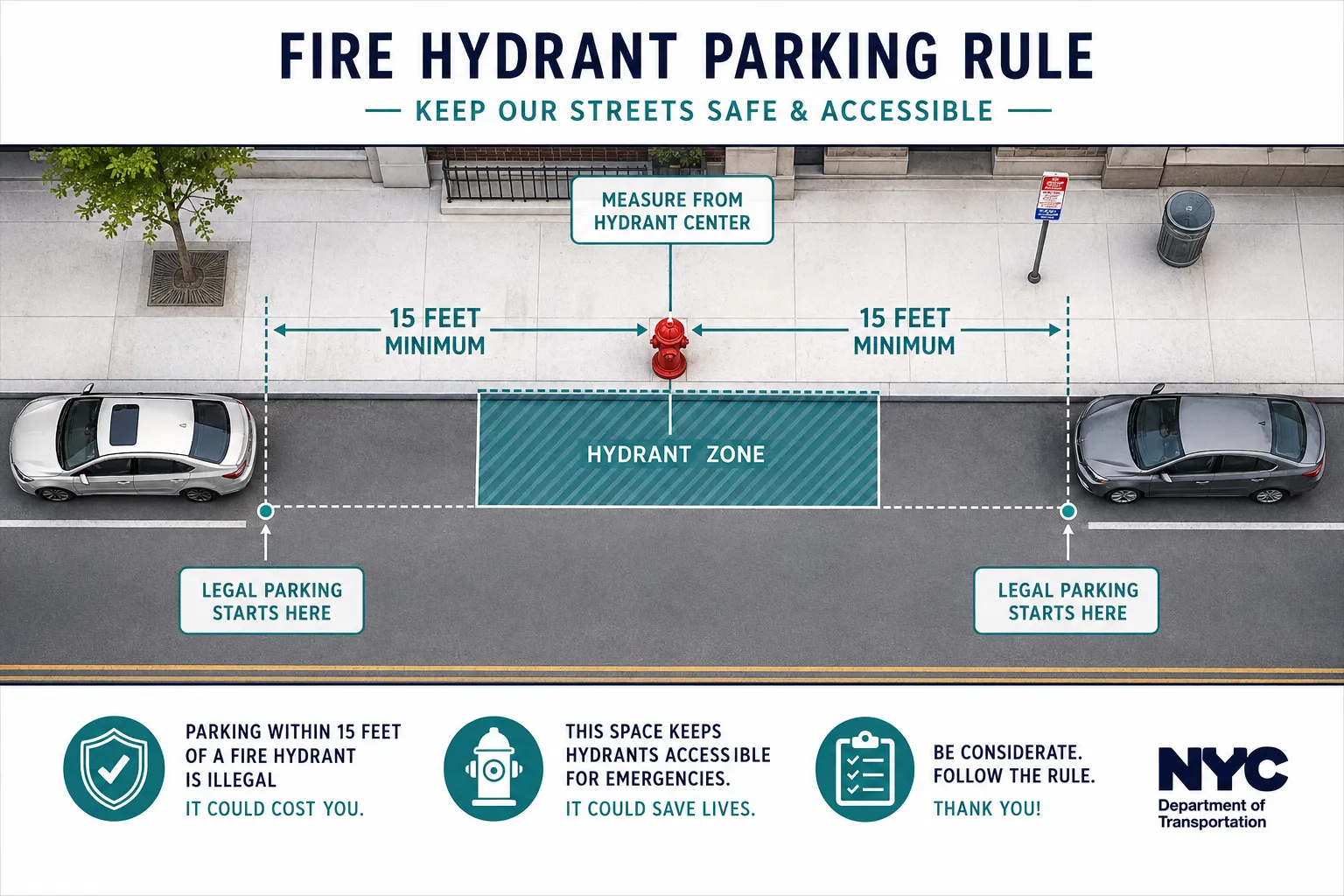
    The official rule is absolute: 15 feet minimum distance from any fire hydrant, measured from the hydrant itself to the nearest part of your vehicle, on both sides of the hydrant, 24/7. This applies across all five boroughs and overrides painted curb markings, which are often faded or misleading.[1][2]

    Key Takeaways

    • NYC law prohibits parking within 15 feet of a fire hydrant on either side, before or after the hydrant, citywide, including floating parking lanes next to protected bike lanes.
    • The 15-foot buffer equals approximately 4.6 meters, roughly one to one-and-a-half car lengths, or five to six walking paces.
    • A limited daylight «standing» exception allows passenger cars to remain at a hydrant only if the driver stays in the operator’s seat, engine running, ready to move instantly, not true parking.
    • Violation code 40 carries a standard fine of approximately $115 in 2026, and enforcement is strict regardless of curb paint condition.
    • Measure distance from the hydrant center to your vehicle’s nearest point (typically front or rear bumper corner), not from painted curb lines.

    Official NYC Fire Hydrant Parking Distance: The 15-Foot Rule

    NYC Traffic Rules §4-08 establishes the legal standard: stopping, standing, or parking within fifteen feet of a fire hydrant is prohibited.[5] This distance applies to both the approach side and the departure side of the hydrant, drivers must leave at least 15 feet clear before the hydrant and at least 15 feet after it.[3][10]
    Official NYC Fire Hydrant Parking Distance: The 15-Foot Rule

    The NYC Department of Transportation’s 2026 parking regulations page, updated in late August, explicitly confirms the 15-foot rule remains in effect citywide, including newer street designs such as protected bike lanes with floating parking lanes.[2] The rule has been codified since at least January 2025 and has not been modified in subsequent updates through mid-2026.[5][2]

    Measure from the hydrant itself, not curb paint. Many drivers mistakenly rely on yellow painted curb zones around hydrants to judge legal parking boundaries. Official guidance warns that painted curbs are not the legal standard, the 15-foot measurement always controls, even where paint is missing, faded, or inaccurate.[1][8] Calculate distance from the hydrant’s physical location to the closest part of your vehicle, typically the front or rear bumper corner.[8][7]

    For quick street-level estimation, 15 feet equals roughly:

    • 4.6 meters (metric)
    • One to one-and-a-half car lengths (depending on vehicle size)
    • Five to six normal walking paces (adult stride)[8][7]

    The rule applies 24 hours a day, seven days a week, with only a narrow daylight exception discussed below.[6][3]

    Understanding the Daylight Standing Exception (Not a Parking Permit)

    NYC Traffic Rules §4-08 includes a specific exception that confuses many drivers: a passenger car may stand (not park) directly next to a fire hydrant during daylight hours, sunrise to sunset, under strict conditions.[5][6]

    All four conditions must be met simultaneously:

    1. Standing is otherwise permitted at that location.
    2. The driver remains in the operator’s seat at all times.
    3. The engine is running and ready for immediate operation.
    4. The vehicle is moved instantly upon approach of fire apparatus or instruction from police, fire, or traffic officials.[5][3]

    Practical enforcement guidance stresses this is not permission to park and leave your car, even briefly.[6][10][12] If you exit the vehicle, lock the doors, or walk away, even for 30 seconds, you are parked, not standing, and the 15-foot rule applies in full.[6][3] Ticket-defense experts report that many hydrant violations occur when drivers misinterpret this exception and step out «just for a minute» within the buffer zone.[10][12]

    For practical purposes, treat the 15-foot rule as a strict no-parking zone 24/7. Any unattended vehicle within that buffer is subject to violation code 40, regardless of time of day.[6][12][3]

    How to Measure 15 Feet Accurately on NYC Streets

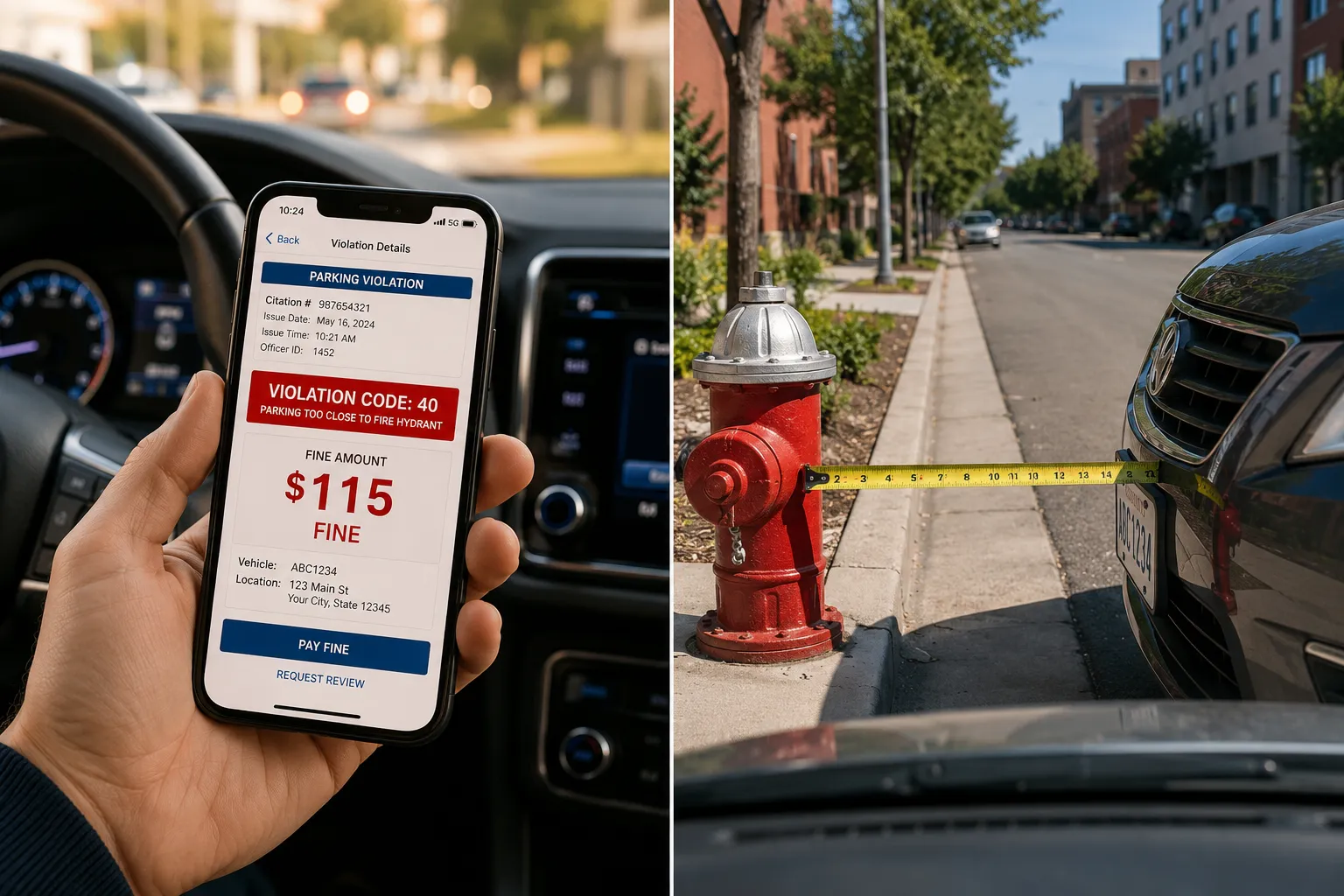
    Enforcement measures from the hydrant center to the nearest part of your vehicle,not to your tires, not to the car’s center, and not from painted lines.[8][7] The nearest point is usually the front bumper corner (when parking ahead of a hydrant) or the rear bumper corner (when parking behind a hydrant).[8]

    Quick measurement methods:

    • Walking paces: Take five to six normal adult strides from the hydrant to your bumper. If you reach your car in fewer than five paces, you’re too close.[8][7]
    • Car-length rule: Leave at least one full car length (preferably one and a half) between the hydrant and your vehicle.[8]
    • Tape measure (most accurate): Carry a small measuring tape or use a smartphone app to confirm 15 feet (180 inches or 4.6 meters) before committing to a spot.[8][7]

    Both sides matter equally. The 15-foot buffer extends in both directions along the curb. Drivers often assume the space immediately after a hydrant (in the direction of traffic) is safer or less enforced, it is not.[3][10] Enforcement applies symmetrically on both the approach and departure sides.[10][13]

    When evaluating a curb space, also check for other distance restrictions that commonly overlap with hydrant zones:

    • 20 feet from crosswalk areas (measured from the nearest edge of the crosswalk)
    • 30 feet from stop signs or traffic signals on the approach side[11]

    If a potential parking spot is near a hydrant and also close to a crosswalk or stop sign, you must satisfy all applicable distance rules simultaneously.[11]
    How to Measure 15 Feet Accurately on NYC Streets

    Fire Hydrant Parking Violations: Fines, Enforcement, and Real-Time Status

    Parking within 15 feet of a fire hydrant is classified as NYC parking violation code 40.[9][6] As of 2026, the standard fine for this violation is approximately $115.[9][12] Hydrant tickets are among the most common and rigorously enforced parking infractions citywide, with traffic enforcement agents and NYPD officers issuing them frequently.[9][12][6]

    Why enforcement is strict: Firefighters require unobstructed access and clearance to connect hoses and operate equipment during emergencies. Even partial obstruction, such as parking close enough that hoses must be routed awkwardly, can delay response times, which is why the city maintains low tolerance for any vehicle in the hydrant zone.[3][14][6]

    Check Real-Time Status and Suspension Calendars: While the 15-foot hydrant rule itself does not suspend for holidays or street cleaning, Alternate Side Parking regulations do. If you’re navigating complex parking rules in neighborhoods like Park Slope, Astoria, Williamsburg, DUMBO, or Greenpoint, use real-time suspension calendars to confirm whether Alternate Side Parking is in effect today. This helps you avoid layering a hydrant violation on top of an ASP ticket.

    Unfair parking citations and disputes: If you believe you received a hydrant ticket in error, for example, if you have photographic evidence showing your vehicle was more than 15 feet away, consult resources on Tickets & Disputes for step-by-step guidance on contesting the citation. Document the scene with photos showing the hydrant, your vehicle position, and measurements before moving your car.

    Towing & Impounds: Vehicles parked illegally at hydrants are subject to towing, especially in high-traffic or emergency-response corridors. If your car has been towed, visit Towing & Impounds resources immediately to locate your vehicle and understand recovery procedures.

    Off-Street Parking Alternatives Across NYC Boroughs

    When street parking near fire hydrants or in congested neighborhoods becomes too risky or time-consuming, off-street parking garages and lots offer predictable, legal alternatives. Explore the NYC Parking Directory to find facilities across all five boroughs, compare rates, and secure spots in advance.

    Borough-specific garage options:

    Parking Education Hub: For comprehensive guides on garage savings, rate comparisons, and strategies to reduce parking costs, visit the Parking Garages & Savings section of the Parking Education Hub.

    Conclusion

    Understanding how close to a fire hydrant can you park NYC is straightforward: 15 feet minimum, measured from the hydrant to your vehicle’s nearest point, on both sides, at all times. Do not rely on curb paint, do not assume the daylight exception applies if you leave the vehicle, and do not risk a $115 fine by guessing distances.

    Actionable next steps:

    • Measure accurately: Use walking paces (five to six strides) or a car-length estimate (one to one-and-a-half lengths) before committing to a curb spot.
    • Check Real-Time Status: Confirm Alternate Side Parking suspensions and street cleaning schedules in your neighborhood to layer compliance across all parking rules.
    • Explore Off-Street Options: When street parking is too uncertain, locate and compare garages via the NYC Parking Directory.
    • Fight Unfair Citations: If you receive an incorrect hydrant ticket, document the scene and consult Tickets & Disputes resources immediately.
    • Stay Informed: Bookmark suspension calendars and real-time alerts to avoid fines and towing across all NYC boroughs.

    Avoid fines and towing by treating the 15-foot hydrant rule as non-negotiable. Locate your vehicle with confidence, check status in real time, and use the Parking Education Hub to navigate NYC’s complex parking landscape successfully in 2026.

    References

    [1] Article – https://portal.311.nyc.gov/article/?kanumber=KA-01026 [2] Parking Regulations – https://www.nyc.gov/html/dot/html/motorist/parking-regulations.shtml [3] Nyc Fire Hydrant Parking Distance – https://www.spotlink.app/nyc-fire-hydrant-parking-distance [5] 0 0 0 63770 – https://codelibrary.amlegal.com/codes/newyorkcity/latest/NYCrules/0-0-0-63770 [6] No Nonsense Guide To Nyc Fire Hydrant Rule – https://newyorkparkingticket.com/no-nonsense-guide-to-nyc-fire-hydrant-rule/ [7] In New York City How Far From A Fire Hydrant Can You Legally Park A Hire Car – https://holacarrentals.com/blogs/car-rental-united-states/in-new-york-city-how-far-from-a-fire-hydrant-can-you-legally-park-a-hire-car [8] How Close Can You Legally Park To A Fire Hydrant In New York And How Do You Measure It Quickly – https://holacarrentals.com/blogs/car-rental-united-states/how-close-can-you-legally-park-to-a-fire-hydrant-in-new-york-and-how-do-you-measure-it-quickly [9] Hydrant Parking Nyc – https://www.spotlink.app/hydrant-parking-nyc [10] Can You Park Near Fire Hydrant Nyc – https://www.spotlink.app/blog/can-you-park-near-fire-hydrant-nyc [12] No Nonsense Guide To Nyc Fire Hydrant Rule – https://newyorkparkingticket.com/no-nonsense-guide-to-nyc-fire-hydrant-rule/ [13] Can You Park Near Fire Hydrant Nyc – https://www.spotlink.app/blog/can-you-park-near-fire-hydrant-nyc [14] Nyc Fire Hydrant Parking Distance – https://www.spotlink.app/nyc-fire-hydrant-parking-distance
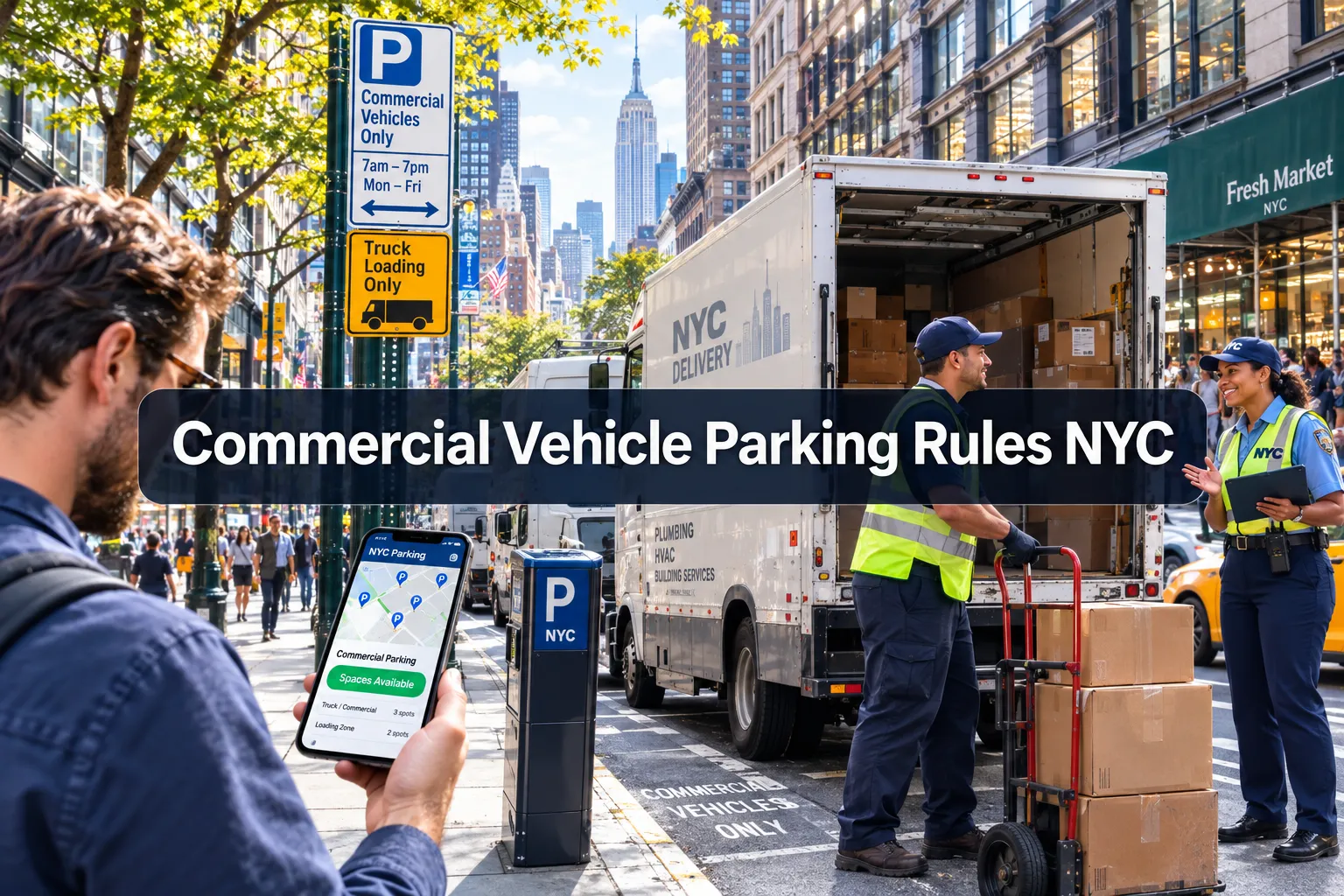
  • Commercial Vehicle Parking Rules NYC: Official 2026 Guide to Avoiding Fines and Towing

    Commercial Vehicle Parking Rules NYC: Official 2026 Guide to Avoiding Fines and Towing

    NYC issues over 10 million parking tickets annually, and commercial vehicle violations account for a substantial share. One wrong move, parking your work van overnight on a residential block or exceeding the three-hour limit, can cost you $115 or more, plus towing fees that spiral into the hundreds. Understanding commercial vehicle parking rules NYC is not optional for delivery drivers, contractors, and fleet operators working in the five boroughs in 2026.

    This guide breaks down the official regulations, real-time enforcement tools, and new pilot programs that govern where and when you can legally park a commercial vehicle in New York City. Whether you drive a box truck, a cargo van, or a tractor-trailer, these rules determine whether you wake up to a clear windshield or a citation, and knowing them can save you thousands in fines and lost time.

    Key Takeaways

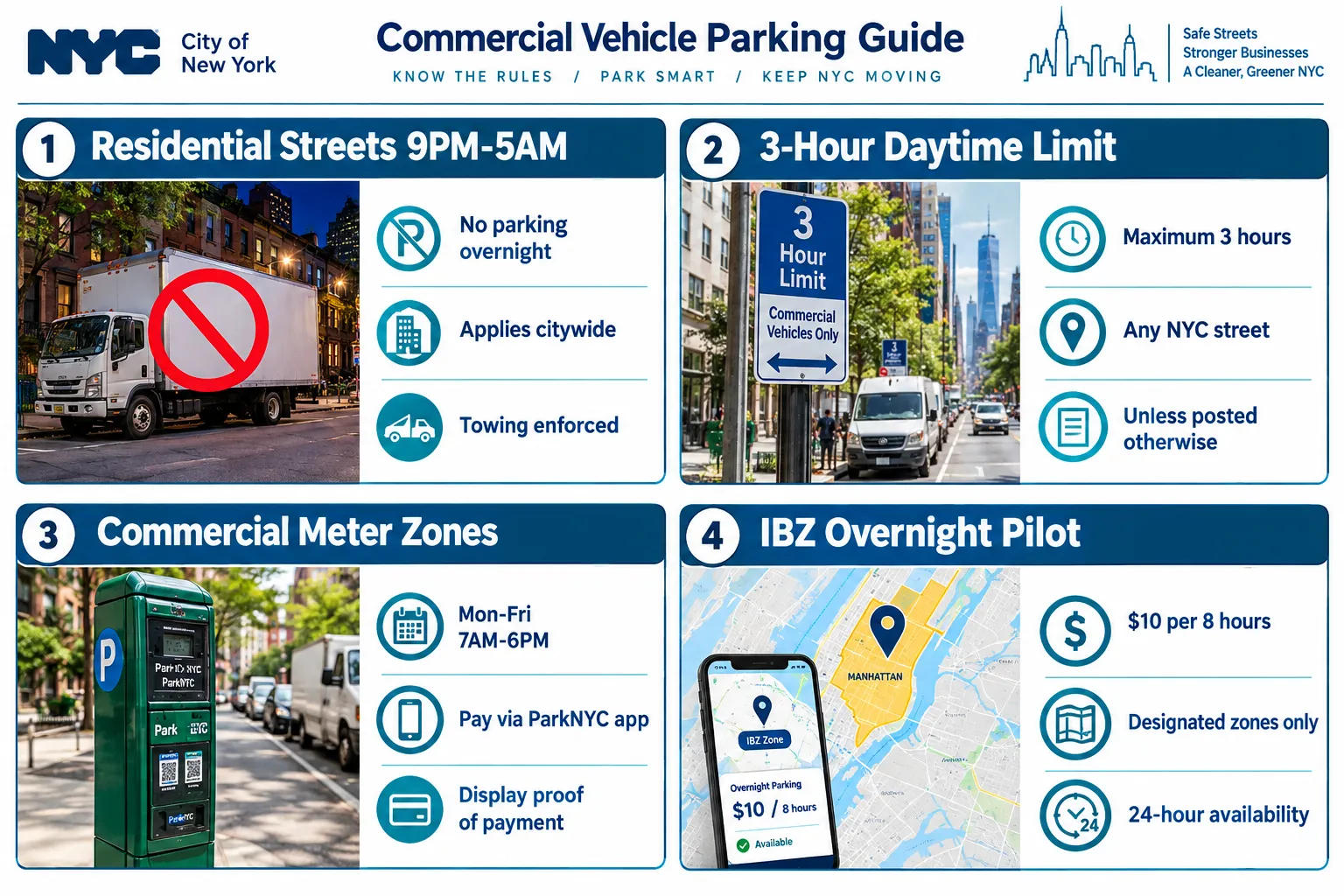
    • Commercial vehicles may not park on any NYC street for more than three hours unless signs permit otherwise, and overnight parking on residential streets (9 p.m. to 5 a.m.) is prohibited citywide.
    • New metered overnight truck parking zones in Industrial Business Zones (IBZs) across Brooklyn, the Bronx, and Queens allow 8-hour sessions for $10 via the ParkNYC app, operating 24 hours Monday through Saturday.
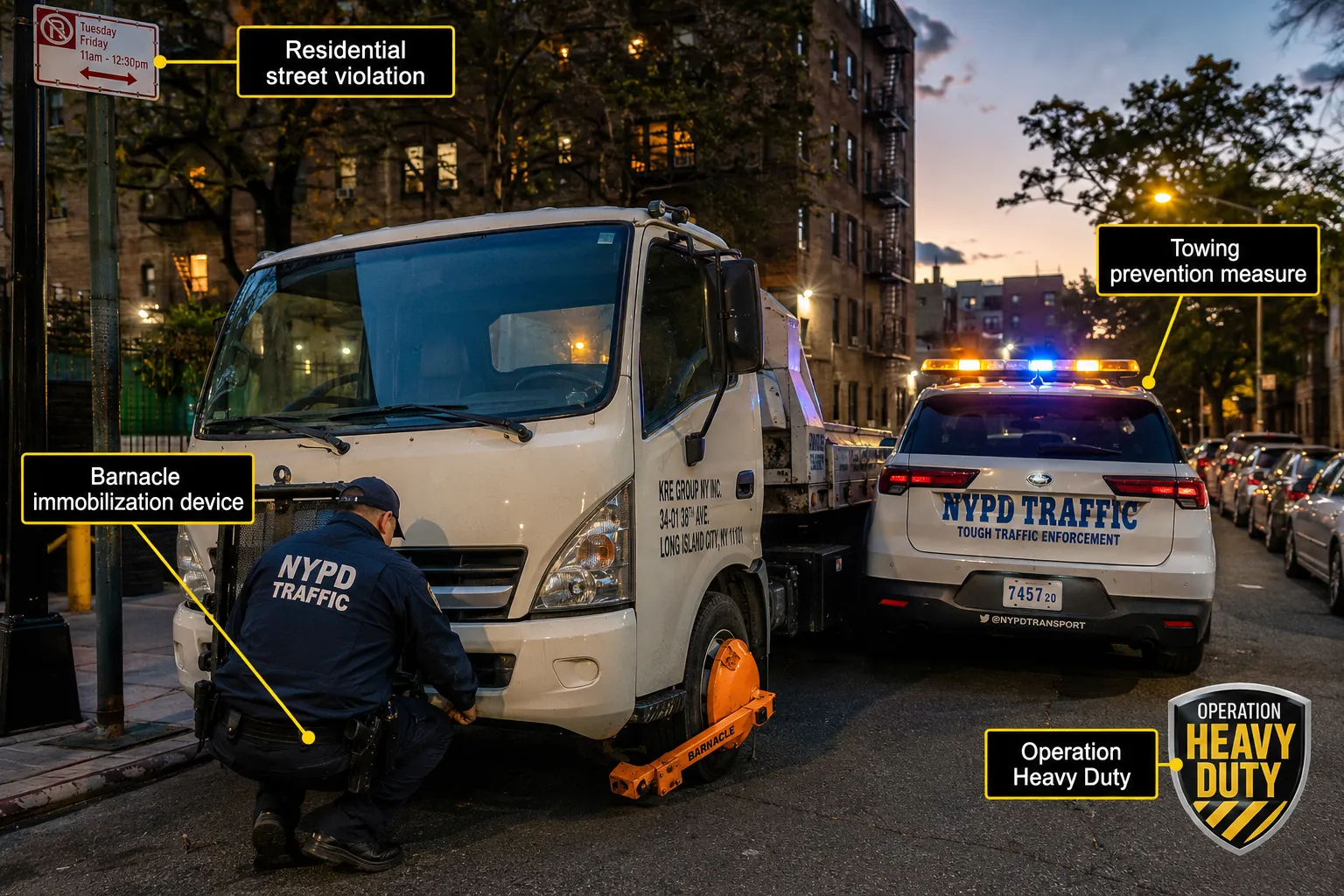
    • NYPD enforcement has intensified with Operation Heavy Duty and deployment of the Barnacle windshield boot, targeting illegal overnight and residential truck parking.
    • More than 500 new curbside commercial loading zones have been installed citywide to reduce double-parking, while automated camera enforcement on MTA buses captures violations in real time.
    • Check real-time Alternate Side Parking status and suspension calendars to coordinate commercial deliveries and avoid street-sweeping tickets during ASP windows.

    Understanding NYC’s Core Commercial Vehicle Parking Restrictions

    NYC Administrative Code §19-170 establishes two foundational rules that apply to every commercial vehicle in the city. First, commercial vehicles may not park anywhere in NYC for more than three hours when parking is not otherwise restricted. Second, commercial vehicles are prohibited from parking on residential streets between 9 p.m. and 5 a.m.,a ban that remains in force across all five boroughs as of 2026.[1][2]

    These provisions form the backbone of enforcement. A «commercial vehicle» under NYC Traffic Rules §4-08 includes any vehicle designed, maintained, or used primarily for the transportation of property, or any vehicle with commercial plates. Box trucks, cargo vans, tractor-trailers, and even pickup trucks with commercial registration fall under these restrictions.[4]

    Key restrictions at a glance:

    • Three-hour limit: Applies citywide on any street where parking is not otherwise prohibited. Exceeding three hours triggers a violation even if you paid a meter or parked legally at the start.
    • Overnight residential ban: From 9 p.m. to 5 a.m., no commercial vehicle may park on a residential street. Enforcement is active every night, and violations carry fines starting at $115 plus potential towing.
    • Midtown Manhattan rules: Between 14th and 60th Streets, from 1st to 12th Avenues, commercial vehicles must park parallel within 12 inches of the curb and may not occupy more than 10 feet of roadway width.[4]
    • No street storage: NYC prohibits using public streets as storage for unaltered commercial vehicles, meaning you cannot leave a truck parked in one spot indefinitely, even during permitted hours.
    Understanding NYC's Core Commercial Vehicle Parking Restrictions

    These rules remain unchanged from their December 2024 codification and are cited by NYPD and the Department of Finance when issuing summonses.[1][4] Drivers who rely on street parking for work vehicles must plan around the three-hour cap and find off-street or designated zones for overnight storage.

    For general guidance on Alternate Side Parking rules in NYC, including how ASP interacts with commercial vehicle restrictions, consult our comprehensive ASP guide.

    Where Commercial Vehicles Can Park Legally: Meters, Loading Zones, and IBZ Pilots

    NYC has expanded legal parking options for commercial vehicles in 2026 through a combination of metered zones, dedicated loading areas, and pilot programs in Industrial Business Zones.

    Commercial Meter Zones and Pay-by-App Spaces

    In «No Standing Commercial Vehicles Only» metered zones, commercial vehicles can park Monday through Friday from 7 a.m. to 6 p.m. for up to three hours per block after paying at a meter or via the ParkNYC mobile app and displaying proof of payment.[5][6] These zones are marked with green or white «Commercial Vehicles Only» signs and are typically located in commercial corridors.

    NYC DOT has also launched pay-by-app-only commercial meters on specific corridors, including Sixth Avenue between West 14th and West 23rd Streets in Manhattan. Drivers must use the ParkNYC app to pay; coin or card payment at physical meters is not accepted in these pilot areas.[3]

    Overnight Truck Parking Pilot in Industrial Business Zones

    Launched in March 2025, the Overnight Truck Parking Pilot created approximately 45 metered commercial vehicle spaces across three IBZ corridors:[3][7][8]

    • Flatlands/Fairfield, Brooklyn: Flatlands Avenue between Erskine Street and Fountain Avenue
    • Hunts Point, Bronx: Ryawa Avenue between Manida Street and Halleck Street
    • Maspeth, Queens: 56th Road between 43rd Street and 49th Street

    Truck operators pay $10 for each 8-hour session via the ParkNYC app. Parking is available 24 hours a day, Monday through Saturday, with no payment required on Sundays. The pilot runs for one year and aims to reduce illegal overnight truck parking on residential streets.[3][7][8]

    If you’re seeking off-street parking in the Bronx, explore garage options such as MPG Parking or Quik Park to avoid street restrictions entirely.

    City Council-Mandated IBZ Overnight Truck Parking Program

    Separate from the metered pilot, NYC Council legislation (Intro 99-A/99-B, adopted in 2025) requires DOT to establish curbside overnight truck parking areas within each IBZ, with parking allowed for up to 10 continuous hours between 8 p.m. and 6 a.m.[9][4] Non-commercial vehicles are prohibited in these zones during overnight hours. This program carries a five-year sunset and is designed to transform the initial pilot into a broader, time-limited policy across industrial areas citywide.[9]

    Industry coverage notes that the Council-mandated overnight curbside program focuses on «overnight-only» spaces inactive between 8 a.m. and 6 p.m., distinct from the 24-hour metered pilot.[7][9] However, a 2025 analysis by THE CITY found that the pilot did not cover several neighborhoods most heavily impacted by illegal truck parking, including parts of southeast Queens, fueling calls for expansion.[3]

    New Curbside Loading Zones

    NYC DOT has installed more than 500 new curbside loading zones citywide to address double-parking and blocked bus and bike lanes.[5][10] These zones reflect community feedback on freight activity hot spots and provide legal short-term parking for commercial deliveries. Loading zones are typically time-limited (15 to 30 minutes) and marked with «Loading Zone» signs; drivers must move vehicles promptly after unloading.

    For parking in Queens, including neighborhoods like Astoria and Flushing, check garage availability to supplement street options during peak delivery hours.

    Enforcement Escalation: Operation Heavy Duty, the Barnacle Boot, and Automated Cameras

    NYPD and NYC DOT have ramped up enforcement of commercial vehicle parking rules NYC since 2024, deploying new tools and operations to deter illegal overnight and residential truck parking.

    Operation Heavy Duty Enforcement

    Launched in 2024 and continuing through 2026, Operation Heavy Duty targets illegally parked trucks in Queens and other boroughs. NYPD reports issuing hundreds of summonses and conducting dozens of truck tows under this initiative.[9] Enforcement focuses on residential streets during the 9 p.m. to 5 a.m. ban and on trucks exceeding the three-hour daytime limit.

    The Barnacle Windshield Boot

    NYPD has deployed the Barnacle, a large orange suction-cup device that immobilizes vehicles by covering the windshield, to enforce commercial vehicle violations.[9] The Barnacle is applied to trucks with excessive unpaid fines or those parked illegally overnight on residential streets. Removal requires payment of outstanding fines and a release fee, and attempting to remove the device without authorization can result in additional penalties.

    The Barnacle Windshield Boot

    This tool signals a policy shift away from informal tolerance toward strict enforcement of the overnight residential ban.[2][9]

    Automated Camera Enforcement (ACE) Program

    NYC DOT’s Automated Camera Enforcement (ACE) program uses cameras mounted on over 1,000 MTA buses to capture double-parking violations and bus lane obstructions, many involving commercial vehicles, and forward them to DOT for processing.[7][10] Violations are issued automatically, and fines are mailed to the registered owner. The program has expanded significantly in 2025-2026, increasing the likelihood that illegal parking will be detected even in the absence of a traffic agent.

    Stipulated Fine Program Adjustments

    The Department of Finance’s Annual Parking Tickets and Camera Violations report (Local Law 6 report for FY25) documents changes to the Stipulated Fine Program, which allows commercial fleets to enroll and pay reduced fines for certain violations.[10] However, Streetsblog NYC highlighted that reduced stipulated fines for double-parking (dropping from $80 to $65 for enrolled firms) and bus lane parking might unintentionally encourage double-parking by commercial vehicles rather than curb it.[1]

    Drivers and fleet managers should weigh the cost of fines against the cost of securing legal off-street parking in Manhattan or other boroughs to avoid repeat violations and escalating penalties.

    Real-Time Alternate Side Parking Status and Commercial Vehicle Coordination

    Alternate Side Parking (ASP) rules intersect with commercial vehicle parking rules NYC in critical ways. During ASP windows, typically 8 a.m. to 11 a.m. or 11:30 a.m. to 2 p.m. on designated days, streets are cleared for sweeping, and parking is prohibited on the affected side. Commercial vehicles parked during ASP enforcement are ticketed and may be towed, just like passenger cars.

    Check real-time ASP status to coordinate deliveries and avoid violations. Park Rules Live provides live ASP suspension alerts for neighborhoods across NYC, including Astoria, Williamsburg, Park Slope, DUMBO, and Greenpoint. Use these tools to confirm whether ASP is suspended due to holidays or emergency declarations before parking a commercial vehicle on a residential block.

    Key ASP coordination tips for commercial drivers:

    • Plan around ASP windows: Schedule deliveries and pickups outside ASP enforcement hours to avoid moving your vehicle mid-shift.
    • Use suspension calendars: Official holiday suspension calendars list days when ASP is not in effect, allowing you to park legally on both sides of the street.
    • Monitor real-time alerts: Weather emergencies, snow operations, and special events can trigger ASP suspensions. Check Park Rules Live’s real-time status tracker for up-to-the-minute updates.
    • Understand block-specific schedules: ASP schedules vary by block. Read posted signs carefully and confirm the schedule for the exact block where you plan to park.

    For cities beyond NYC, including Yonkers, Buffalo, and Binghamton, consult city-specific ASP guides to coordinate commercial parking with local street-cleaning rules.

    Proposed Legislation and Future Expansions

    NYC lawmakers continue to introduce bills aimed at curbing illegal truck parking and expanding legal options for commercial vehicles. Proposed measures in 2025-2026 include:[3]

    • 90-minute citywide parking limit for large commercial vehicles such as trailers and semis, further restricting long-term street parking.
    • Requirements for DOT to establish overnight parking areas for large commercial vehicles within IBZs, operating from 8 p.m. to 6 a.m., building on the existing pilot.
    • Mandates for at least three off-street truck parking facilities citywide by early 2026, to be acquired and managed by a designated city agency.

    These proposals reflect ongoing tension between the need for commercial vehicle access and community complaints about illegal truck parking. Drivers should monitor legislative updates and adjust parking strategies as new rules take effect.

    Avoiding Fines, Towing, and Unfair Parking Citations

    Avoid fines and towing by following these best practices:

    1. Never park a commercial vehicle on a residential street overnight. The 9 p.m. to 5 a.m. ban is enforced citywide, and violations carry fines starting at $115 plus towing fees.
    2. Respect the three-hour limit. Even if you paid a meter or parked legally at the start, exceeding three hours triggers a violation. Set a timer and move your vehicle before the limit expires.
    3. Use designated IBZ overnight zones. If you need overnight parking, use the metered pilot zones in Flatlands, Hunts Point, or Maspeth, or explore off-street parking options in your borough.
    4. Pay meters and display proof. In commercial meter zones, always pay via the ParkNYC app or at the meter and display your receipt or confirmation on the dashboard.
    5. Check ASP status before parking. Use real-time suspension calendars and alerts to confirm whether ASP is in effect on the block where you plan to park.
    6. Fight unfair parking citations. If you receive a ticket you believe is incorrect, use the NYC Parking Education Hub resources on tickets and disputes to challenge the citation. Document your parking location, time, and any relevant signs with photos.

    For additional support on tickets and disputes, consult guides on contesting unfair parking citations and recovering towed vehicles through the city’s impound system.

    Conclusion

    Navigating commercial vehicle parking rules NYC in 2026 requires vigilance, planning, and real-time information. The three-hour daytime limit and overnight residential ban remain strictly enforced, while new metered IBZ zones and expanded loading areas offer legal alternatives for drivers willing to pay and plan ahead. NYPD’s Operation Heavy Duty, the Barnacle boot, and automated camera enforcement have raised the stakes for violations, making compliance essential to avoid fines and towing.

    Take action now:

    • Check real-time ASP status on Park Rules Live before parking on any residential block.
    • Explore off-street parking in Brooklyn, Manhattan, the Bronx, Queens, and Staten Island to secure legal overnight storage.
    • Use the ParkNYC app to pay for metered commercial zones and IBZ overnight pilot spaces.
    • Set reminders to move your vehicle before the three-hour limit expires.
    • Monitor suspension calendars and real-time alerts to coordinate deliveries around ASP enforcement.

    By understanding the rules, leveraging official tools, and staying informed on enforcement trends, commercial drivers can avoid costly citations, protect their vehicles from towing and impounds, and keep their operations running smoothly in the nation’s most complex parking environment.

    References

    [1] A Fine Mess City To Expand Encouragement For Truckers To Double Park – https://nyc.streetsblog.org/2024/10/22/a-fine-mess-city-to-expand-encouragement-for-truckers-to-double-park

    [2] New York City Creates Pilot Program For Three Truck Parking Lots – https://www.truckersnews.com/news/article/15740890/new-york-city-creates-pilot-program-for-three-truck-parking-lots

    [3] Pols Aim To Put Brakes On Illegal Truck Parking – https://queenseagle.com/all/2024/10/15/pols-aim-to-put-brakes-on-illegal-truck-parking

    [4] New York City Passes Bill To Expand Overnight Truck Parking – https://landline.media/new-york-city-passes-bill-to-expand-overnight-truck-parking/

    [5] Nyc Dot Loading Zones – https://www.nyc.gov/html/dot/html/pr2024/nyc-dot-loading-zones.shtml

    [6] 0099 2024+ – https://intro.nyc/0099-2024+

    [7] Nyc Advances Commonsense Solution To Address Truck Parking – https://landline.media/magazine/nyc-advances-commonsense-solution-to-address-truck-parking/

    [8] Mondays Headlines You Aint Goin Nowhere Edition – https://nyc.streetsblog.org/2024/04/08/mondays-headlines-you-aint-goin-nowhere-edition

    [9] Mayor Eric Adams Nypd Launch Crackdown On Commercial Vehicles Parking Illegally In Queens – https://www.cbsnews.com/newyork/news/mayor-eric-adams-nypd-launch-crackdown-on-commercial-vehicles-parking-illegally-in-queens/

    [10] Legislationdetail – https://legistar.council.nyc.gov/LegislationDetail.aspx?GUID=E10D907C-092A-4BFF-8FB5-BACB2CB71AE7&ID=6509477

  • How to Fight a Parking Ticket in NYC: Official 2026 Dispute Guide

    How to Fight a Parking Ticket in NYC: Official 2026 Dispute Guide

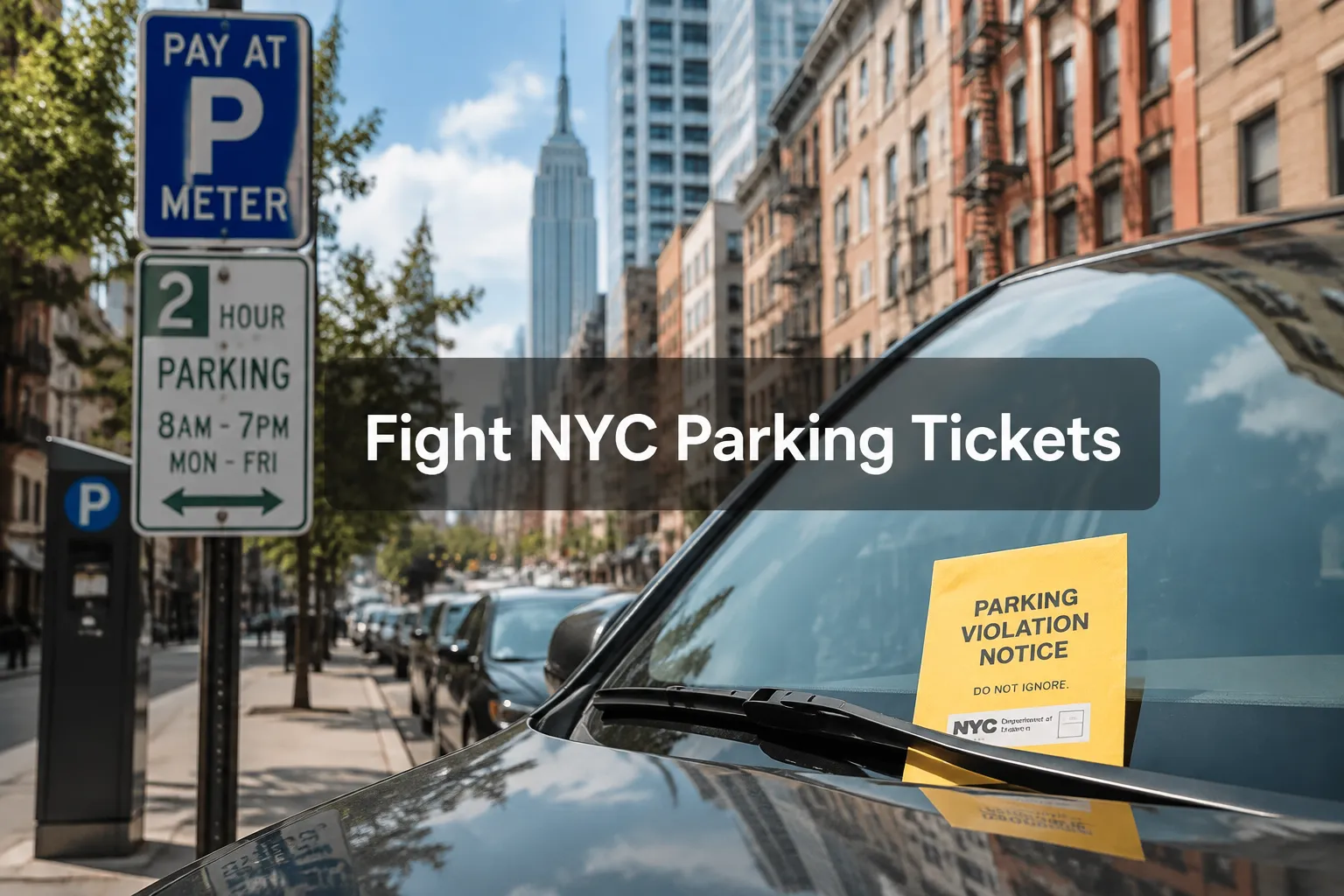
    New York City issued over 10 million parking tickets in 2025, generating more than $500 million in revenue. Yet thousands of those citations contained errors, unclear signage, or impossible-to-comply restrictions. If you received an unfair parking citation, you have exactly 30 days to challenge it before penalties double and your options narrow. Understanding how to fight a parking ticket in NYC through the official dispute process can save hundreds of dollars and protect your driving record from unjust violations.

    Key Takeaways

    • Request a hearing within 30 days of the ticket date to avoid late penalties and preserve all dispute rights
    • Use the NYC Department of Finance online portal, Pay or Dispute app, mail, or in-person hearing for fastest resolution
    • Gather time-stamped photos of signs, meters, street conditions, and vehicle registration as primary evidence
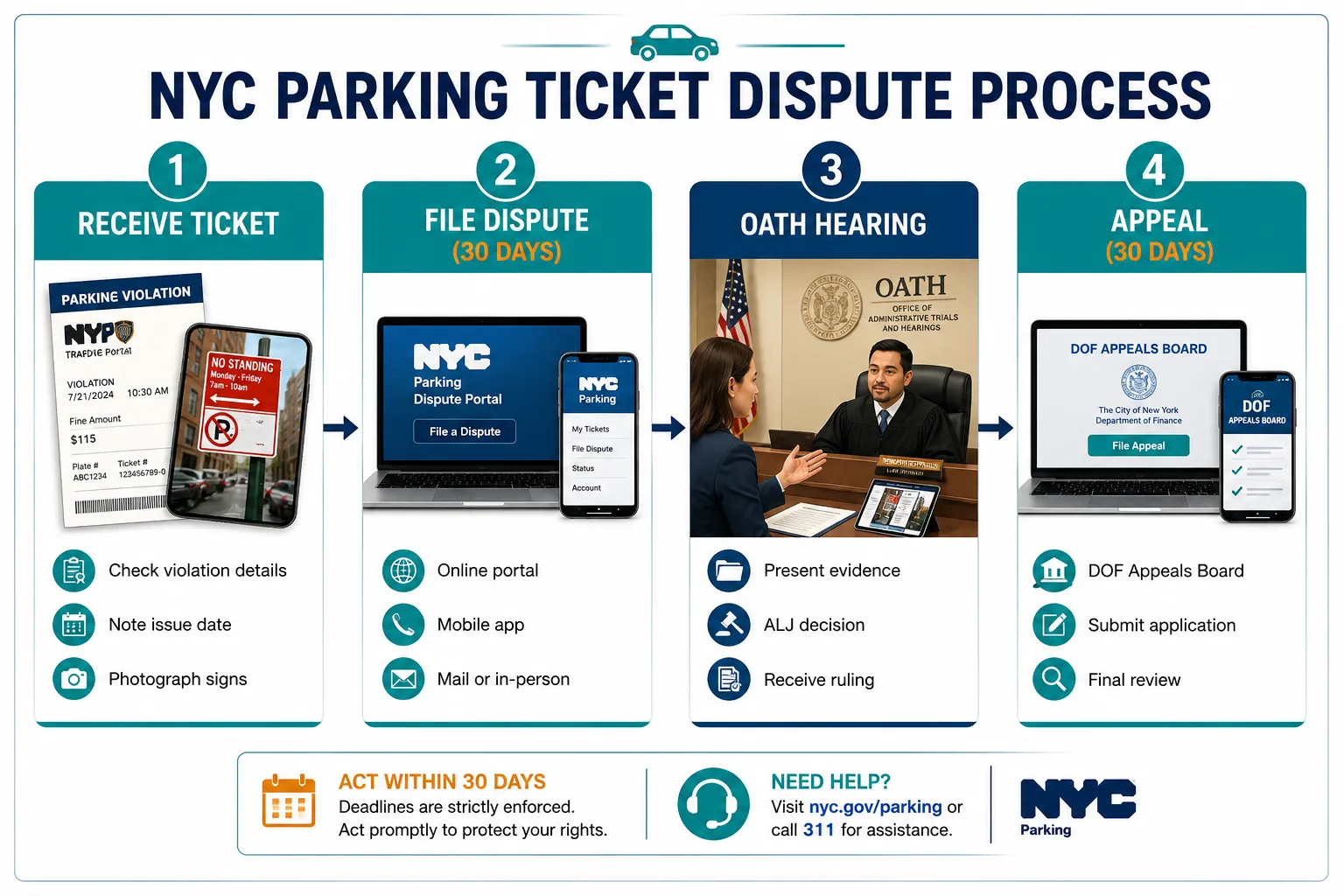
    • OATH Administrative Law Judges hear all parking ticket disputes; appeal unfavorable decisions to the DOF Appeals Board within 30 days
    • Document sign errors, conflicting regulations, meter malfunctions, and impossibility of compliance as strongest defenses

    Understanding NYC Parking Ticket Dispute Deadlines

    Understanding NYC Parking Ticket Dispute Deadlines

    The 30-day deadline controls everything in NYC parking ticket disputes. From the violation date (or notice of liability date if you weren’t present), you have exactly 30 calendar days to request a hearing with the Department of Finance.[6][8] Missing this window triggers automatic late penalties, typically doubling the fine, and eliminates your ability to present a defense.

    Critical Timeline Structure:

    • Days 1-30: File dispute online, via Pay or Dispute app, by mail, or in-person at any DOF Finance Business Center
    • Hearing phase: OATH schedules and conducts your hearing (timing varies by method and volume)
    • Decision issued: Administrative Law Judge rules guilty or not guilty
    • Days 1-30 post-decision: File appeal with DOF Appeals Board if found guilty[1][4]

    The Department of Finance explicitly warns against disputing tickets online if you believe they’ve already been paid or dismissed, verify status first through the official portal.[8][12] For moving violations handled by the Traffic Violations Bureau (TVB), a separate 30-day appeal process applies using form AA-33 and a $10 fee, but those are distinct from parking citations.[3]

    Check the real-time Alternate Side Parking status to confirm whether street cleaning was actually in effect on your violation date, suspension calendars often provide immediate grounds for dismissal.

    How to Fight a Parking Ticket in NYC: Four Official Methods

    The NYC Department of Finance offers four distinct channels to dispute parking tickets, each with specific advantages for different situations.[6][13]

    Online Dispute Portal (Fastest)

    Access the official DOF dispute system at nyc.gov/finance. Enter your violation number, license plate, and state. The portal, updated August 25, 2026, walks you through submitting your defense statement and uploading supporting evidence, photos, registration copies, maps, and witness statements.[8] This method provides the fastest processing and automatic confirmation of submission.

    Pay or Dispute Mobile App

    Download the official NYC Pay or Dispute app for iOS or Android. Scan or enter your ticket details, photograph evidence directly from your phone, and submit your dispute in under five minutes. The app integrates with the same OATH hearing system as the web portal and sends status notifications.[6]

    Mail Submission

    Complete the dispute form on the back of your parking ticket or download the official form from nyc.gov/finance. Include a detailed written statement explaining why the ticket is invalid, attach copies (never originals) of supporting documents, and mail to the address printed on your ticket. Allow extra time for processing, mail disputes take longer than digital submissions.[6]

    In-Person Hearings

    Walk into any DOF Finance Business Center Monday, Friday, 8:30 a.m. to 4:30 p.m., without an appointment. In-person hearings operate first-come, first-served. Bring your ticket, valid driver’s license, vehicle registration, title or rental agreement, and all evidence.[11][13] You may bring an eligible representative to speak on your behalf. In-person hearings offer immediate interaction with an Administrative Law Judge and real-time clarification of questions.

    Locate convenient off-street parking near Finance Business Centers to avoid additional violations while attending your hearing.

    Building a Winning Defense: Evidence and Documentation

    Building a Winning Defense: Evidence and Documentation

    Administrative Law Judges at OATH evaluate parking ticket disputes based on photographic evidence, official records, and witness testimony. Strong defenses focus on four categories of error.[2][5][9][10]

    Ticket Errors and Inaccuracies

    Examine every field on your citation:

    • License plate number: Wrong plate, incorrect state, transposed digits
    • Vehicle description: Wrong make, model, color, or body type
    • Location: Incorrect street name, block number, or cross street
    • Date and time: Violation recorded on wrong date or impossible time
    • Violation code: Citation references inapplicable regulation

    Even minor clerical errors can invalidate a ticket if they prevent proper identification of the vehicle or violation.[7][9]

    Signage Defects and Confusion

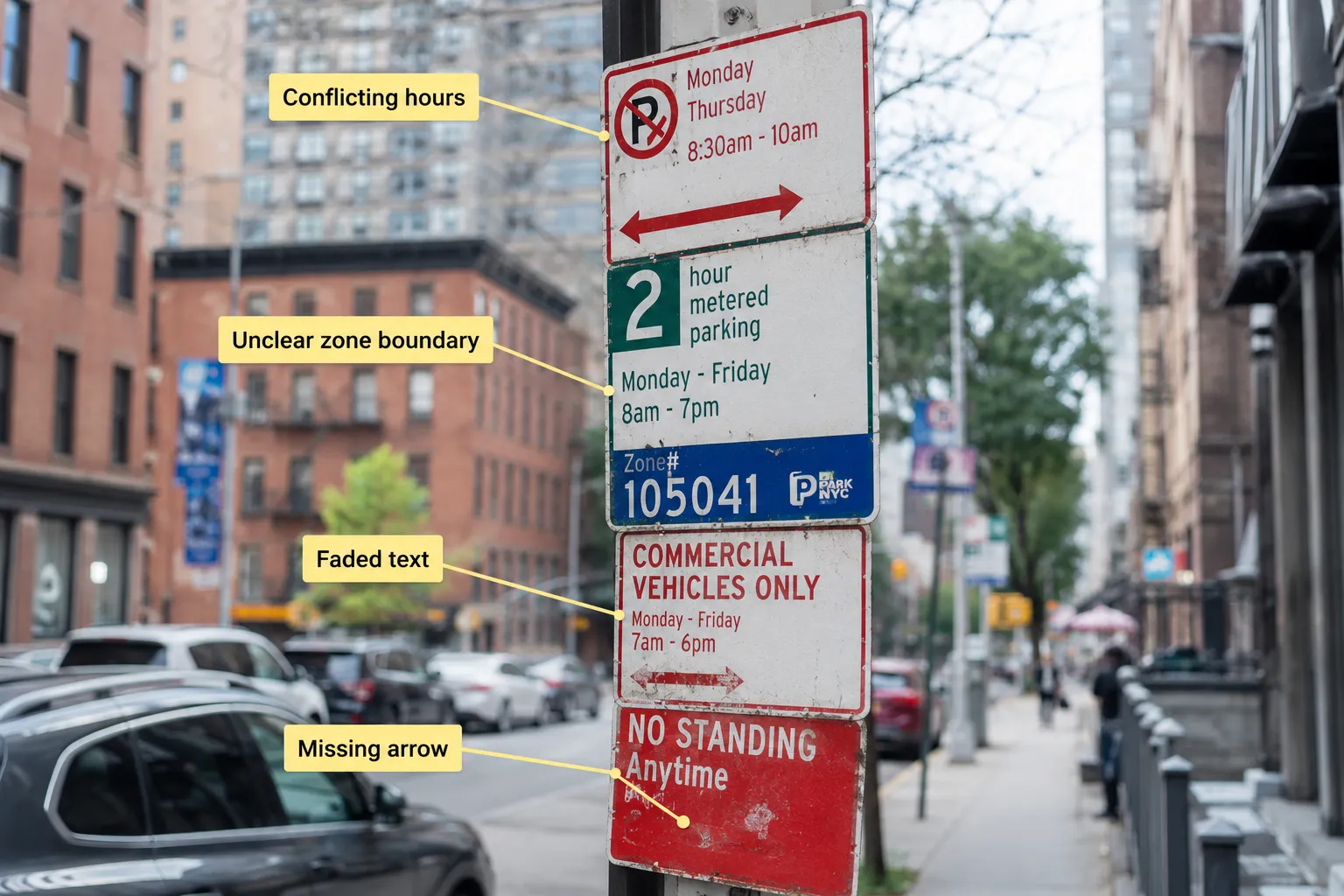
    Photograph the exact location where your vehicle was parked, capturing:

    • Missing signs: No posted restriction where citation claims one exists
    • Obscured signs: Trees, graffiti, damage, or fading rendering text unreadable
    • Conflicting regulations: Overlapping meter hours, street cleaning times, and commercial restrictions creating impossible-to-follow rules
    • Incorrect placement: Signs positioned beyond legal visibility distance or facing wrong direction

    Include wide-angle shots showing the full block context and close-ups of specific sign text. Time-stamp all photos and note the exact address.[2][5][10]

    Meter Malfunctions and Payment Proof

    If cited for expired meter or failure to pay:

    • Receipt or app confirmation: ParkNYC, ParkMobile, or meter receipt showing valid payment covering the violation time
    • Meter malfunction: Photos of broken meter display, card reader errors, or «out of service» status
    • Payment system failure: Bank statement proving attempted payment that didn’t register

    The best parking apps in NYC provide timestamped digital receipts that serve as primary evidence in meter disputes.

    Impossibility and Necessity Defenses

    Document circumstances that made compliance impossible:

    • Medical emergency: Hospital records, ambulance reports, or physician statements
    • Vehicle breakdown: Tow truck receipts, mechanic invoices, or roadside assistance logs
    • Street cleaning suspension: Official suspension calendar showing ASP was not in effect on violation date
    • Authorized parking: Placard, permit, or official authorization for the location and time

    Alternate Side Parking suspensions are particularly common grounds for dismissal. Verify the official status for your violation date through NYC ASP suspension calendars before submitting your defense.

    The OATH Hearing Process and What to Expect

    The Office of Administrative Trials and Hearings (OATH) conducts all NYC parking ticket hearings, even though the Department of Finance manages the financial and portal systems.[6][7][15] Understanding this separation clarifies the adjudication process.

    When you dispute a ticket through any of the four methods, your case transfers to OATH for review. An Administrative Law Judge (ALJ) examines your written defense and evidence for online/mail disputes, or conducts a live hearing for in-person submissions.[7][15]

    Online and Mail Hearings:

    The ALJ reviews your submitted statement, photographs, documents, and any response from the issuing agency. No live appearance required. The judge issues a written decision based solely on the evidence in the record. Processing time varies from weeks to months depending on case volume.

    In-Person Hearings:

    Present your case directly to the ALJ at a Finance Business Center. Explain why the ticket is invalid, present physical evidence, and answer the judge’s questions. The hearing typically lasts 10-20 minutes. The ALJ may issue an immediate oral decision or mail a written ruling within days.[11][13]

    Prepare a clear, chronological narrative: «On [date], I parked at [location] at [time]. The posted signs showed [description]. I paid the meter through [method] as shown in [receipt]. The ticket claims [violation], but [your evidence] proves this is incorrect.»

    For double parking ticket disputes, specific defenses apply based on loading zone access, commercial vehicle status, and duration of stop.

    How to Appeal a Parking Ticket Decision in NYC

    If the OATH Administrative Law Judge finds you guilty, you have 30 calendar days from the hearing decision date to file a Parking/Camera Violations Appeal Application with the DOF Appeals Board.[1][4] This internal appeal is your second opportunity to challenge the citation before moving to court.

    DOF Appeals Board Process

    Download the official appeal form from nyc.gov/finance or request one by mail. The application requires:

    • Original ticket information: Violation number, plate, date, location
    • Hearing decision details: Date of decision, ALJ name, case number
    • Grounds for appeal: Specific legal or factual errors in the ALJ’s ruling
    • Supporting evidence: New evidence not available at the original hearing, or demonstration that existing evidence was misinterpreted

    Mail the completed application to the address on the form. The Appeals Board reviews the case record, your appeal statement, and any agency response. The Board can affirm the guilty finding, reverse it to not guilty, or remand the case for a new hearing.[1][5]

    You must pay the fine before filing an appeal, but the amount will be refunded if your appeal succeeds.[5][10] The Appeals Board typically issues decisions within 60-90 days of submission.

    Judicial Review: Article 78 and Civil Court

    If the DOF Appeals Board denies your appeal, two judicial options remain:

    Article 78 Proceeding (Supreme Court):

    File a petition in New York State Supreme Court (typically 60 Centre Street, Room 116, Manhattan) within four months of the final agency determination. Article 78 review challenges whether the agency acted arbitrarily, capriciously, or contrary to law. This is a legal proceeding requiring formal court filings and often benefits from attorney representation.[4][7]

    NYC Civil Court Review:

    After an OATH decision, you may also seek review in NYC Civil Court. This option provides an alternative judicial forum for challenging the administrative ruling.[7]

    Both judicial reviews focus on legal errors rather than re-examining factual evidence. Courts defer to agency fact-finding unless the record shows no rational basis for the decision.

    Requesting a Hearing Transcript

    For in-person hearings, request an official transcript of the proceeding to support your appeal. DOF will inform you of the transcript cost within seven business days. Pay by check within 10 business days if you decide to proceed. Transcripts provide the verbatim record needed to identify legal errors or misstatements in the ALJ’s ruling.[6]

    Common Defenses That Win NYC Parking Ticket Disputes

    Certain defenses consistently succeed before OATH Administrative Law Judges based on 2026 case patterns and expert guidance.[2][5][9][10]

    Sign Visibility and Clarity:

    Regulations require parking restriction signs to be clearly visible from the driver’s position. Photos showing obstructed, damaged, or missing signs frequently result in dismissals. Include measurements of sign placement and angles demonstrating poor visibility.

    Conflicting Regulations:

    When multiple signs create contradictory rules, such as overlapping meter hours and street cleaning times, the ambiguity favors the driver. Document all signs on the block and explain the impossibility of simultaneous compliance.

    Alternate Side Parking Suspensions:

    Official suspension calendars override street cleaning signs. If ASP was suspended on your violation date due to holidays, weather, or city declaration, the ticket is invalid regardless of posted signs. Cross-reference Yonkers ASP status, Mount Vernon ASP rules, and other municipal calendars for violations outside NYC proper.

    Meter Payment Proof:

    Digital payment confirmations from ParkNYC, ParkMobile, or credit card receipts showing valid payment during the violation time provide conclusive evidence. Include transaction IDs and timestamps.

    Registration and Placard Authority:

    Valid disabled parking placards, press credentials, diplomatic plates, or official government vehicle registration authorize parking in restricted zones. Present current, unexpired documentation matching the violation date.

    Impossibility Due to Emergency:

    Medical emergencies, vehicle breakdowns, or public safety necessities that made legal parking impossible provide affirmative defenses. Support claims with hospital records, tow receipts, or police reports.

    Explore parking garages and off-street options to avoid future street parking disputes in high-enforcement zones.

    Resources and Assistance for NYC Parking Ticket Disputes

    Office of the Parking Summons Advocate (OPSA)

    OPSA helps motorists navigate the summons and hearing process, particularly when facing hardship or confusion. The office explains DOF and OATH procedures, identifies potential ticket errors, and provides guidance on evidence and defenses. OPSA does not act as your attorney or represent you at hearings, but offers valuable procedural assistance.[14]

    DOF Finance Business Centers

    Walk-in locations across all five boroughs provide in-person hearing access, dispute form assistance, and payment services. Centers operate Monday, Friday, 8:30 a.m. to 4:30 p.m., first-come, first-served. No appointment necessary.[11][13]

    Find convenient parking in Brooklyn, parking in Queens, and parking in the Bronx near Finance Business Centers to avoid additional violations during your visit.

    Online Dispute Tools and Guides

    The official NYC.gov portal provides step-by-step dispute instructions, evidence upload capabilities, and case status tracking. The NYC Serv interface, updated June 30, 2026, streamlines the entire dispute process into a single submission flow.[12]

    Private services and AI-driven platforms offer standardized appeal letter templates, evidence checklists, and case strategy guidance. These resources help organize submissions for maximum impact before OATH judges.[7][15]

    Parking Education Hub Resources

    Access comprehensive guides on Alternate Side Parking rules, suspension calendars, and municipal parking regulations across New York State. Real-time status trackers prevent violations before they occur, eliminating the need for disputes.

    Conclusion

    Fighting a parking ticket in NYC requires immediate action, organized evidence, and strategic presentation. File your dispute within 30 days through the DOF online portal, mobile app, mail, or in-person hearing to preserve all rights and avoid doubled penalties. Document sign errors, meter malfunctions, conflicting regulations, and ASP suspensions with time-stamped photos and official records. Present your case clearly to OATH Administrative Law Judges, and if found guilty, appeal to the DOF Appeals Board within 30 days of the decision.

    Check real-time Alternate Side Parking status before parking to avoid citations. Locate off-street parking in high-enforcement zones. Understand municipal suspension calendars and official regulations. Build evidence immediately after receiving any citation, photos, receipts, and documentation become harder to obtain as time passes.

    Explore the Parking Education Hub for dispute guides, garage rate comparisons, and towing recovery assistance. Verify ASP status across Albany, Rochester, Buffalo, and other New York municipalities. Access official city schedules and real-time alerts to avoid fines and towing before violations occur.