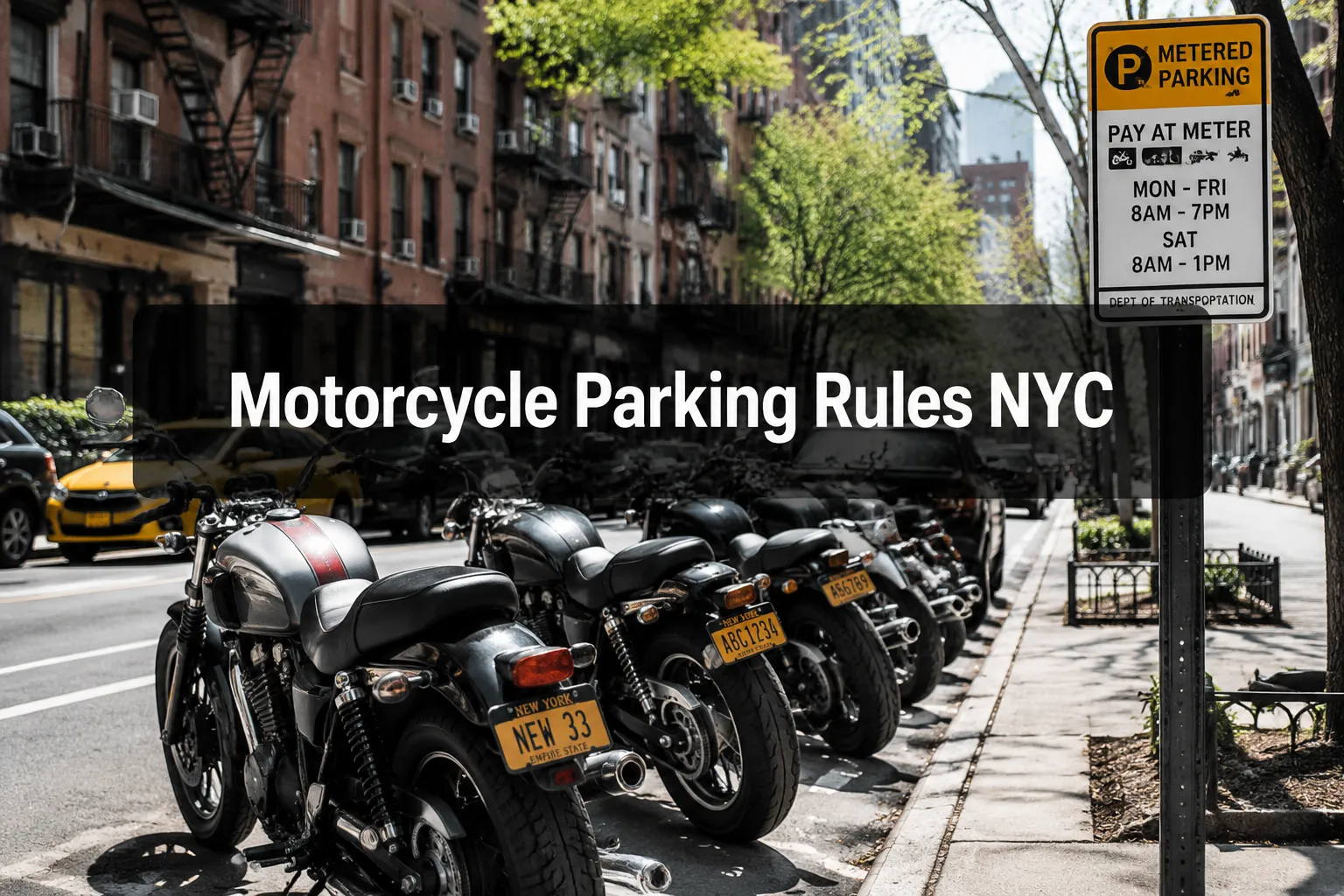
Etiqueta: nyc parking regulations

  • Motorcycle Parking Rules NYC: Official 2026 Guide to Avoid Fines and Towing

    Motorcycle Parking Rules NYC: Official 2026 Guide to Avoid Fines and Towing

    New York City issued over 180,000 parking violations to motorcycles in 2025 alone. Most riders didn’t know they were breaking the law. The motorcycle parking rules NYC enforces in 2026 are strict, specific, and actively ticketed. Understand the official regulations now to avoid costly citations and impounds.

    Key Takeaways

    • Motorcycles follow the same parking rules as cars in NYC, including metered parking, alternate side parking, and no-standing zones
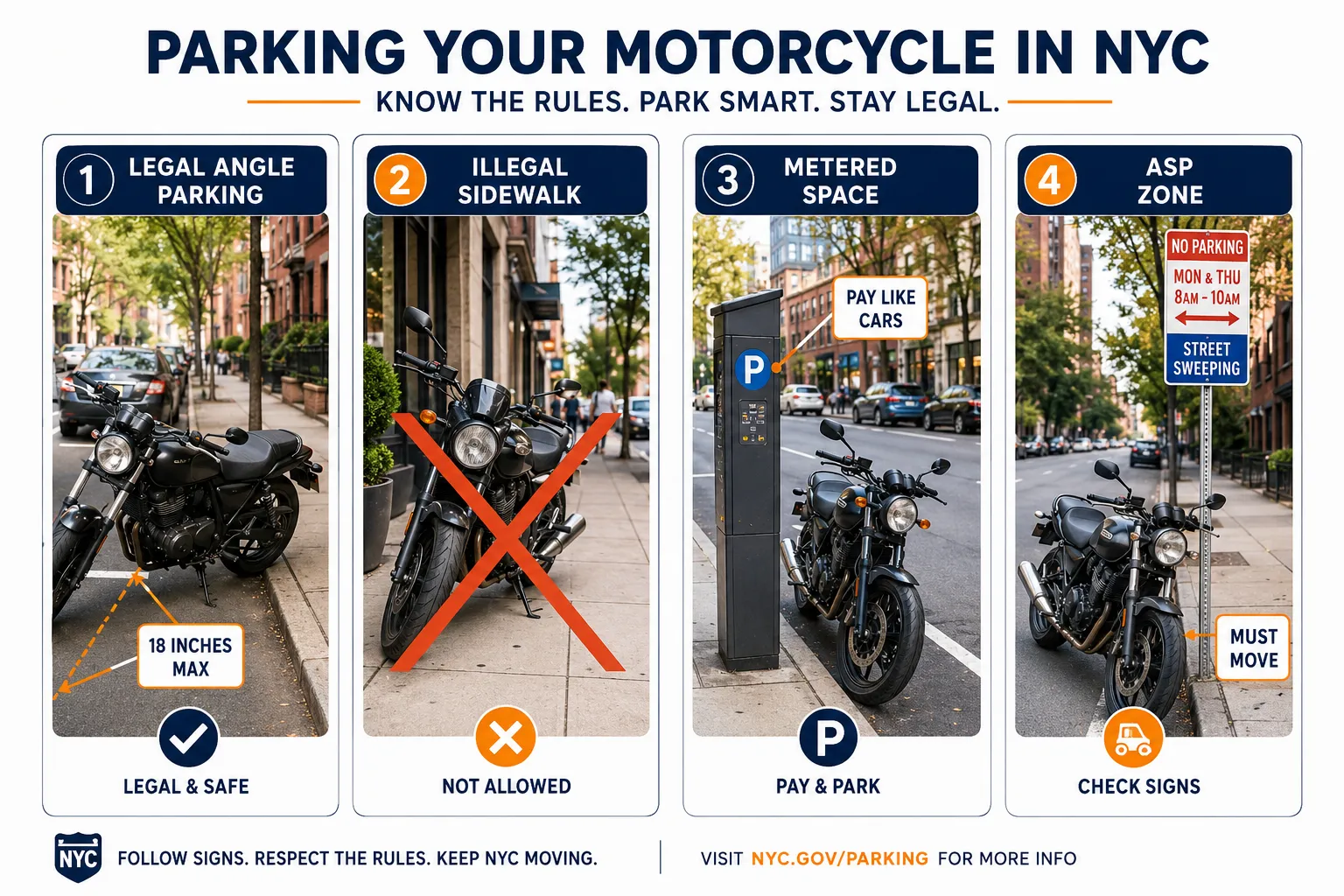
    • Legal angle parking to the curb is permitted within 18 inches maximum distance from the curb face
    • Sidewalk parking is illegal and results in immediate tickets; license plates must remain visible at all times
    • Payment methods for metered spaces include ParkNYC app, meters, and parking cards, motorcycles pay the same rates as cars
    • Alternate side parking enforcement applies to motorcycles and is a leading cause of violations and towing in 2026

    Understanding Core Motorcycle Parking Rules NYC Enforces
    Understanding Core Motorcycle Parking Rules NYC Enforces

    Motorcycles must obey the same parking regulations as passenger vehicles throughout all five boroughs. The NYC Department of Transportation clarifies that motorcycles are subject to identical restrictions on standing, stopping, and parking [1]. This means no-parking zones, fire hydrant clearances, crosswalk restrictions, and bus stop prohibitions all apply equally.

    Angle Parking Is Legal, With Limits

    NYC explicitly permits motorcycles to park at an angle to the curb, a practice that maximizes street space. The legal requirement: your motorcycle must remain within 18 inches of the curb face [2]. Exceed this distance and enforcement agents will issue a violation. Position your front or rear wheel close to the curb and ensure the bike doesn’t protrude into the travel lane.

    Sidewalk Parking Results in Immediate Tickets

    Parking any part of your motorcycle on the sidewalk is illegal citywide [4]. Enforcement is consistent and fines are issued without warnings. Riders frequently assume small scooters or mopeds can use sidewalk space, they cannot. Keep both wheels in the roadway or designated parking area.

    License Plate Visibility Requirements

    Your motorcycle’s license plate must remain visible from the rear at all times when parked [5]. Covering, obscuring, or angling your plate to avoid detection violates state vehicle and traffic law. Motorcycles without visible plates or VIN numbers face towing and impound [6].

    Metered Parking and Payment Methods for Motorcycles

    Motorcycles occupy metered parking spaces under the same rules and rates as cars. As of August 2026, the NYC DOT updated guidance confirming motorcycles must pay at meters, use the ParkNYC mobile app, or purchase parking cards [3]. Rates vary by neighborhood and time of day, ranging from $1.50 to $7.50 per hour in Manhattan’s busiest districts.

    How to Pay for Metered Motorcycle Parking

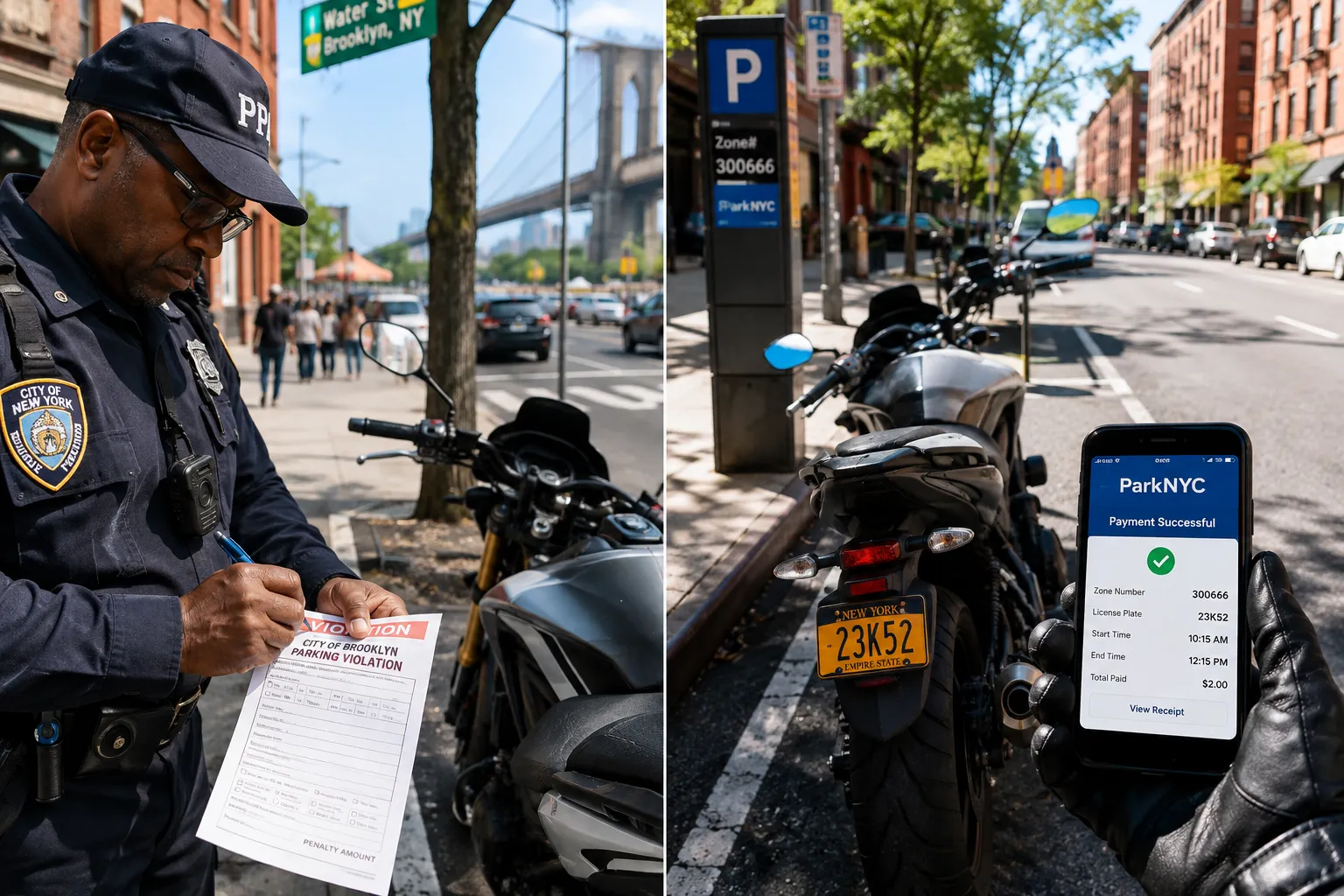
    • ParkNYC App: Enter your license plate and zone number; payment starts immediately
    • Parking Meters: Insert coins or credit card; display receipt on your motorcycle if required by signage
    • Parking Cards: Purchase prepaid cards at DOT Business Centers and authorized retailers

    Multiple motorcycles may share a single metered space if all riders pay the meter for the full duration [5]. However, each motorcycle must display proof of payment if the meter requires it, and all bikes must fit within the marked space boundaries.

    Motorcycle Parking Rules NYC: Alternate Side Parking Enforcement
    Motorcycle Parking Rules NYC: Alternate Side Parking Enforcement

    Alternate Side Parking regulations apply to motorcycles with the same force as cars. Street sweeping schedules run year-round in most neighborhoods, and motorcycles parked on the restricted side during posted hours will be ticketed and towed [6]. In 2026, ASP remains one of the top causes of motorcycle violations citywide.

    Check Real-Time Status Before You Park

    Suspensions occur on holidays and during emergencies, but enforcement resumes quickly. Use live lookup tools to check the current alternate side parking status before leaving your motorcycle on any residential street. Neighborhoods like Astoria, Park Slope, Greenpoint, Williamsburg, and DUMBO enforce ASP strictly.

    For a comprehensive breakdown of how ASP works across the city, explore our complete guide to alternate side parking rules in NYC.

    Suspension Calendars and Alerts

    Official suspension calendars list all city holidays and weather-related exemptions. Sign up for real-time alerts to receive notifications when ASP is suspended or reinstated. Missing a single suspension can cost you a $45 ticket and towing fees exceeding $200.

    Off-Street Parking: Garages, Lots, and Municipal Facilities

    Private garages and parking lots set their own policies for motorcycles. Many facilities in Manhattan, Brooklyn, and the Bronx accept motorcycles at reduced daily or monthly rates, while others prohibit two-wheeled vehicles entirely due to insurance or layout constraints [5].

    Finding Motorcycle-Friendly Garages

    Search the NYC Parking Directory to locate facilities that accommodate motorcycles. Borough-specific directories for Manhattan, Brooklyn, Queens, Bronx, and Staten Island list rates, hours, and vehicle restrictions.

    NYCHA Facilities and Permit Rules

    New York City Housing Authority parking areas require permits displayed on the motorcycle’s windshield or fairing [8]. Permits must remain visible and unobstructed. Motorcycles parked in NYCHA lots without valid permits face towing and impound.

    Common Violations and Fines for Motorcycle Parking

    Enforcement agents issue violations for the same infractions that apply to cars, plus motorcycle-specific errors. The most frequent tickets in 2026 include:

    Violation Fine Amount Notes
    Sidewalk parking $115 Immediate towing risk
    Exceeding 18-inch curb distance $65 Measured from curb face
    Blocked license plate $65 Includes dirt, covers, or angle obstruction
    Metered space non-payment $35,$65 Varies by zone
    Alternate side parking $45 Plus towing and storage fees
    Fire hydrant (within 15 feet) $115 No exceptions
    Double parking $115 Blocking travel or parking lane

    Fines increase for repeat violations within 12 months. Unpaid tickets accrue interest and late fees, and three or more unpaid violations can result in booting or towing [4].

    Fighting Unfair Parking Citations

    Dispute unjust tickets through NYC’s online hearing system or by mail. Common grounds for dismissal include:

    • Incorrect plate number or vehicle description on the summons
    • Photographic evidence showing compliance with posted signage
    • Proof of meter payment or valid parking permit
    • ASP suspension in effect on the violation date

    Submit evidence within 30 days of the ticket issue date. The Parking Education Hub provides step-by-step guides for filing disputes and gathering supporting documentation. Successful challenges result in dismissal and refund of any payments made.

    Practical Best Practices to Avoid Fines and Towing

    Position Your Motorcycle for Visibility

    Park at an angle that keeps your license plate visible from the street. Position the bike so passing enforcement vehicles can read your plate without stopping. Avoid parking behind large vehicles or in shadowed areas where your plate may be obscured.

    Share Metered Spaces Legally

    Two or more motorcycles can share a single metered parking space if all riders pay for the full duration [5]. Coordinate payment using the ParkNYC app and ensure all bikes fit within the painted lines. Overhanging into adjacent spaces or the travel lane will result in tickets.

    Monitor Alternate Side Parking Schedules

    Set recurring reminders for your neighborhood’s ASP days. Use real-time status tools to confirm enforcement before leaving your motorcycle overnight. Move your bike to the correct side of the street before the posted start time, enforcement begins at the minute listed on the sign.

    Avoid High-Risk Zones

    Bike lanes, bus stops, crosswalks, and within 15 feet of fire hydrants are strictly enforced no-parking zones. Double parking, even briefly, results in $115 fines and towing. Plan your route to include legal parking options rather than risking a quick stop in a prohibited area.

    Towing and Impounds: Recovery Process

    Motorcycles towed for parking violations are transported to NYPD or private impound facilities. Recovery requires:

    1. Paying all outstanding fines and penalties online or at the impound office
    2. Providing proof of ownership (registration and valid ID)
    3. Paying towing and storage fees (typically $185 towing + $20/day storage)

    Locate your towed motorcycle using the city’s online tow lookup tool. Enter your license plate number to find the impound location and hours. Delays in recovery increase storage fees daily.

    Secure Parking Initiatives and Future Developments

    NYC is expanding secure bike parking infrastructure, but current programs focus on bicycles rather than motorcycles. Proposed bike locker installations across 500 locations in 2026 are designed for pedal bikes, with dimensions too small for most motorcycles [7][10]. Advocacy groups continue to push for dedicated motorcycle parking zones and secure facilities, but no large-scale municipal program exists as of mid-2026.

    Riders seeking secure off-street options should explore private garages and lots that offer monthly contracts with security features. Compare rates and amenities using parking directories and garage-specific pages.

    Conclusion

    The motorcycle parking rules NYC enforces in 2026 are clear, strict, and actively ticketed. Follow the same regulations as cars, park within 18 inches of the curb, avoid sidewalks, pay meters, and obey alternate side parking schedules. Check real-time ASP status before parking overnight, keep your license plate visible, and dispute unfair citations promptly.

    Take Action Now:

    Stay informed. Park legally. Avoid costly violations.

    References

    [1] Trafrule – https://www.nyc.gov/html/dot/downloads/pdf/trafrule.pdf [2] Article – https://portal.311.nyc.gov/article/?kanumber=KA-01026 [3] Parking Rates – https://www.nyc.gov/html/dot/html/motorist/parking-rates.shtml [4] Motorcycle In Nyc – https://parkingtickets.org/ny-new-york/motorcycle-in-nyc/ [5] How To Park A Motorcycle Scooter In Nyc – http://www.nymstf.org/issues/parking-2/how-to-park-a-motorcycle-scooter-in-nyc/ [6] Parking Motorcycle Nyc 2 – https://newyorkparkingticket.com/parking-motorcycle-nyc-2/ [7] Nycs Plan For 500 Unsightly Bike Lockers Leaves Locals Wheelie Annoyed As Cost Could Be 26m – https://nypost.com/2026/07/27/us-news/nycs-plan-for-500-unsightly-bike-lockers-leaves-locals-wheelie-annoyed-as-cost-could-be-26m/ [8] Parking – https://www.nyc.gov/site/nycha/residents/parking.page [10] Locked In Mamdani Proposes 25 Million For Long Awaited Secure Bike Parking – https://nyc.streetsblog.org/2026/03/05/locked-in-mamdani-proposes-25-million-for-long-awaited-secure-bike-parking/
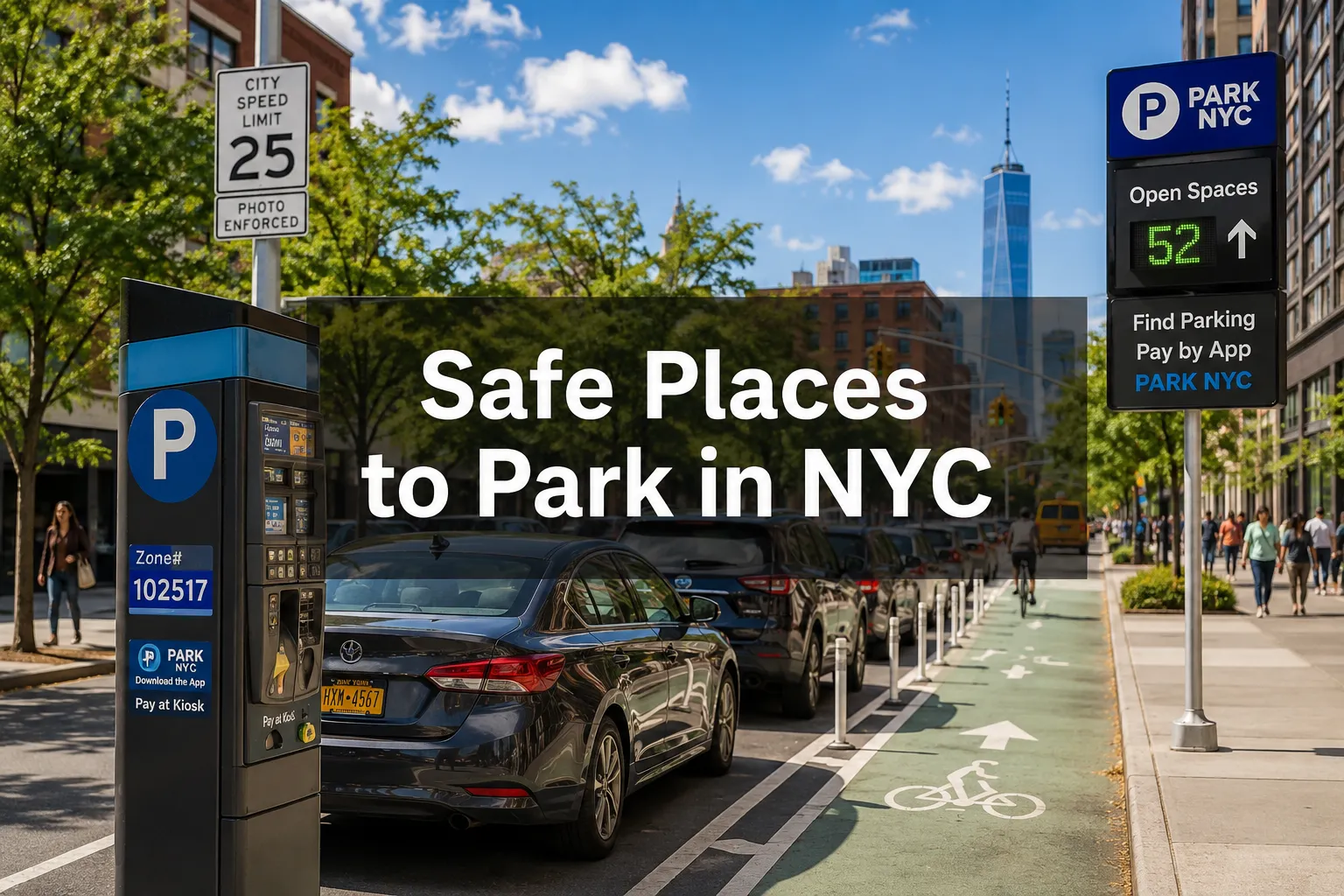
  • Safe Places to Park in NYC: Official Guide to Avoiding Fines and Towing in 2026

    Safe Places to Park in NYC: Official Guide to Avoiding Fines and Towing in 2026

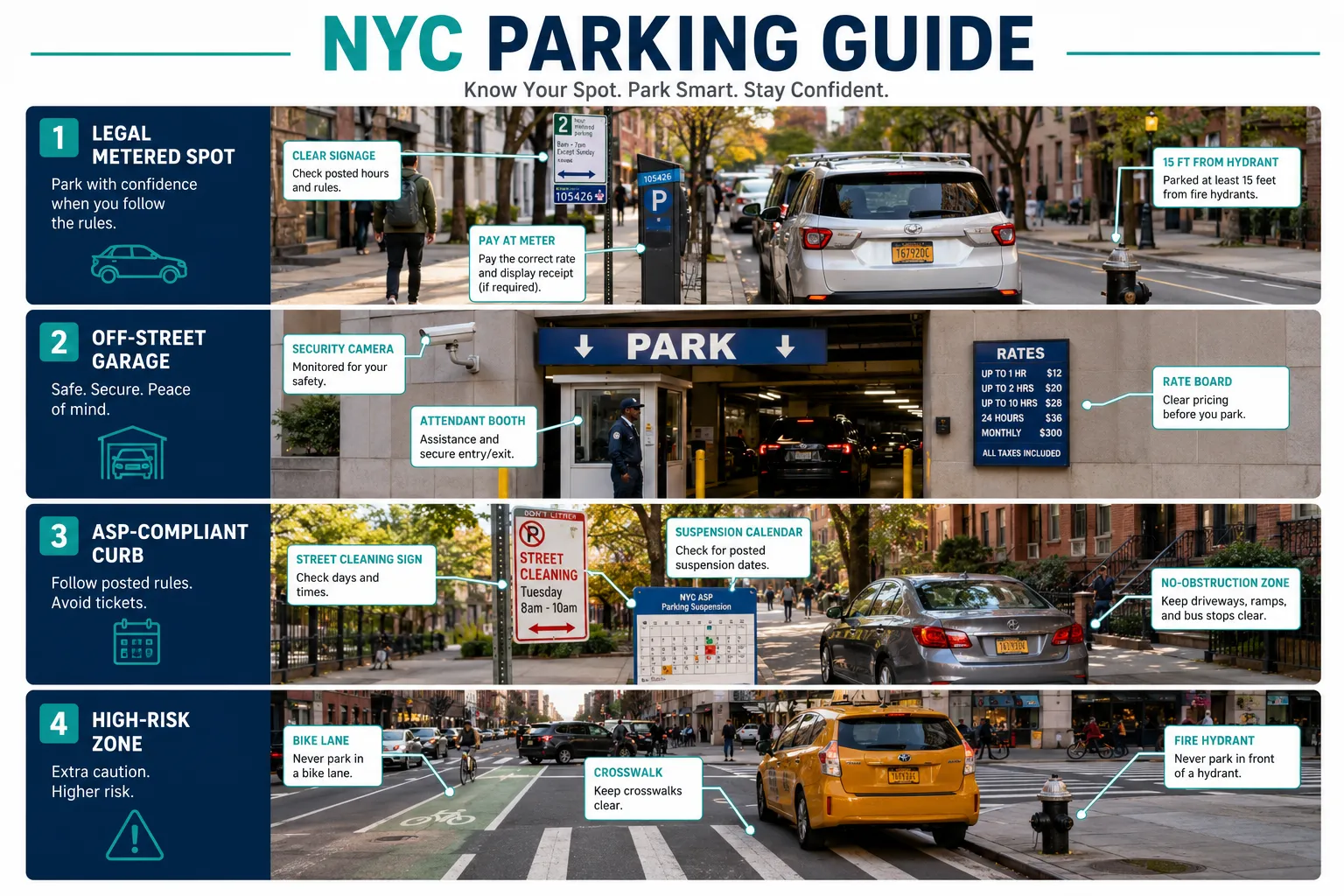
    New York City towed more vehicles for illegal parking in 2026 than any year on record, with drivers losing an average of $400 per incident between fines, towing fees, and impound storage. Every single block in NYC is a designated tow-away zone, meaning one misread sign or overlooked rule can cost you hundreds and hours of recovery time[8]. Finding truly safe places to park in NYC isn’t about luck, it’s about understanding official regulations, tracking real-time Alternate Side Parking status, and choosing locations that minimize citation risk.

    Key Takeaways

    • All of NYC is a tow-away zone; safe parking requires strict adherence to posted signs, ASP schedules, and state law
    • The 15-foot fire hydrant rule remains the most violated safety regulation, with painted curbs offering no legal protection
    • Real-time ASP suspension tracking is essential; street cleaning violations account for thousands of tickets monthly
    • Off-street garages and legal metered spaces offer the lowest-risk parking, while cone-reserved spots and bike lanes carry immediate citation exposure
    • Enforcement is shifting from NYPD to DOT in 2026, with increased focus on safety-critical violations like blocking bike lanes and crosswalks

    Understanding What Makes Parking «Safe» in NYC

    Safe places to park in NYC are defined by legality first, security second. The NYC Department of Transportation emphasizes that all five boroughs operate as tow-away zones, meaning any vehicle parked illegally, with expired registration, or missing inspection stickers can be towed immediately without warning[8].

    «Safe» parking means:

    • Full compliance with posted signage: Every sign on the block applies to your spot
    • Adherence to Alternate Side Parking rules: Active ASP windows trigger $65 fines and potential towing
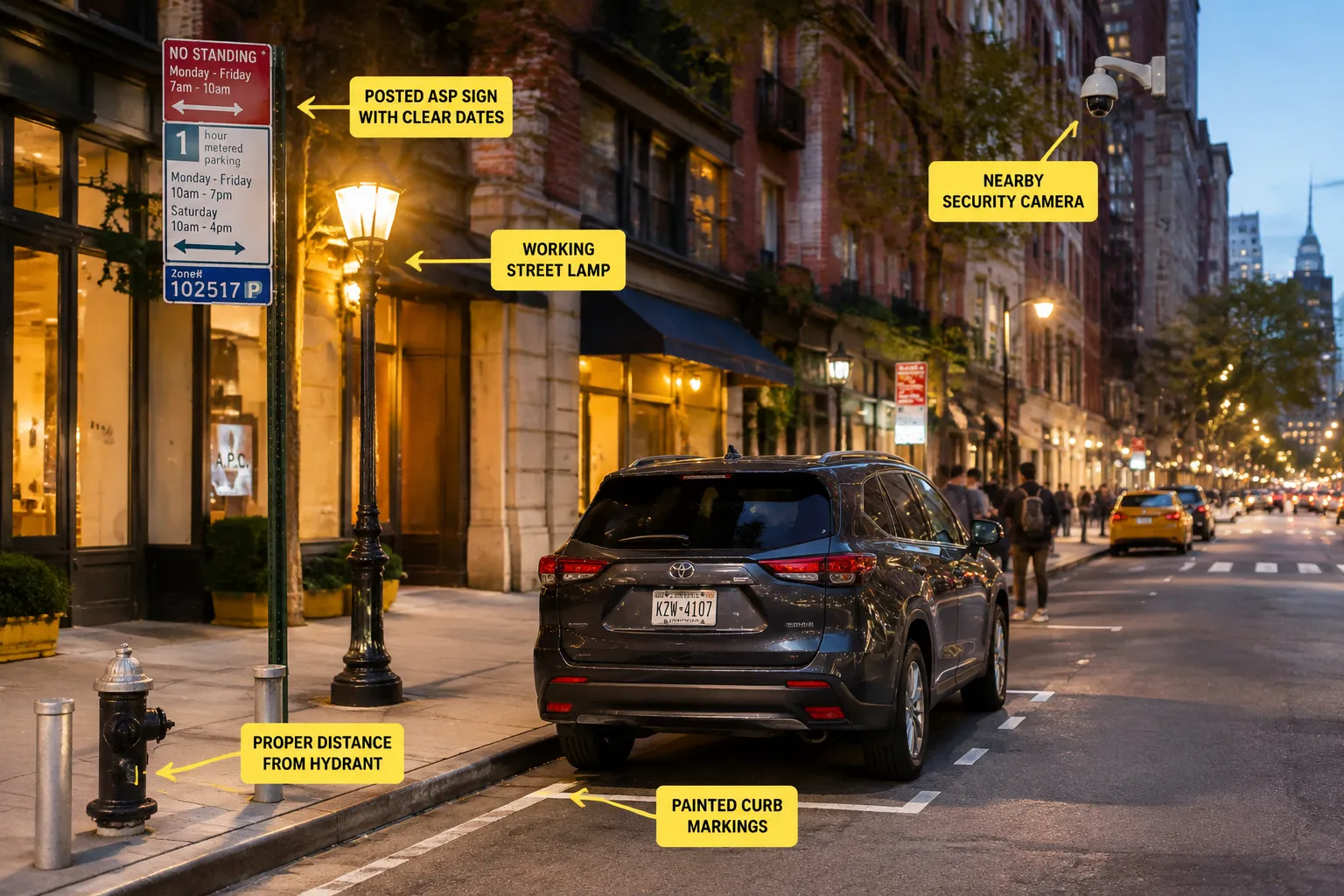
    • Respect for safety zones: 15 feet from hydrants, no blocking crosswalks, bus stops, or bike lanes
    • Valid registration and inspection: Vehicles with temporary plates or expired documents attract scrutiny[4]

    The 2026 parking regulations updated in August make clear that double parking of passenger vehicles is illegal at all times, including during street cleaning operations[8]. Painted curbs near fire hydrants are not reliable legal indicators, drivers must estimate or measure the 15-foot distance themselves, as violations carry $115 fines[5][8].

    Understanding What Makes Parking "Safe" in NYC

    Top Safe Places to Park in NYC: Borough-by-Borough Breakdown

    Manhattan: Metered Spots and Managed Garages

    Manhattan has fewer than 190,000 free street parking spots, creating intense competition and enforcement pressure[11]. The safest parking options prioritize:

    Legal Metered Spaces: Use the ParkNYC app to extend sessions and avoid overstay violations. Metered spots with clear signage and digital payment options reduce misunderstanding risk[5][10].

    Managed Off-Street Facilities: Professional garages like MPG: Manhattan Parking and Public Parking – 1440 Amsterdam Garage offer attended security, surveillance, and zero citation risk.

    Upper Manhattan Residential Blocks: Areas with straightforward ASP schedules (Monday/Thursday or Tuesday/Friday patterns) and minimal commercial traffic offer safer street parking when ASP is suspended.

    Avoid: Blocks with DIY cone «reservations,» which trigger illegal obstruction summonses for both the cone placer and any driver who parks improperly around them[7][10].

    Brooklyn: Neighborhood-Specific ASP Compliance

    Brooklyn parking requires hyper-local ASP tracking. Safe places to park in NYC’s most populous borough include:

    Park Slope During Suspensions: Check real-time ASP status for Park Slope before committing to curbside parking. Suspensions for holidays and snow operations create multi-day safe windows[2][9].

    Greenpoint Commercial Meters: Well-marked metered spots near commercial corridors offer clear signage and frequent turnover. Track Greenpoint ASP status to avoid cleaning-day conflicts.

    Managed Lots: Facilities like Park Here Corporation and Stable Car Parking Incorporated eliminate street-rule complexity.

    Brooklyn saw the highest volume of tickets tied to illegal cone-placement «parking scams» in January 2026, making blocks with visible spot-saving attempts high-risk zones[7].

    Bronx: Off-Street Facilities and Residential Compliance

    The Bronx parking landscape offers more off-street options than Manhattan, reducing citation exposure:

    Established Garages: Quik Park, Estrella Parking, and Zoom Parking Corporation provide secure, legal parking with no ASP concerns.

    24-Hour Facilities: Parking 24 Hours Parkchester and Sherman Parking serve overnight and extended-stay needs.

    Residential Streets with Clear ASP: Outer Bronx neighborhoods with simple two-day ASP schedules and low commercial density offer safer street parking when suspensions are active.

    Queens: Airport Proximity and Neighborhood Meters

    Queens parking varies dramatically by neighborhood:

    Flushing Commercial Districts: Parking in Flushing includes metered spots and managed facilities like Skyview Parking Lot near transit hubs.

    Astoria Metered Zones: Astoria parking offers well-marked meters and facilities like Astoria Parking Management. Check Astoria ASP status before street parking.

    Airport-Adjacent Lots: Jamaica JFK Discount Parking and similar facilities serve travelers needing extended safe storage.

    Staten Island: Residential and Commercial Balance

    Staten Island parking combines suburban-style availability with NYC enforcement standards. Managed facilities like Huguenot Parking offer secure options, while residential blocks with infrequent ASP schedules provide safer street parking during suspensions.

    Staten Island: Residential and Commercial Balance

    Alternate Side Parking: The Key to Safe Street Parking

    Alternate Side Parking violations account for thousands of monthly tickets because drivers fail to track suspension calendars and active cleaning windows[2][14]. Safe places to park in NYC require real-time ASP monitoring.

    How ASP Suspensions Create Safe Parking Windows

    The official 2026 ASP calendar lists scheduled suspensions for holidays and religious observances[2]. Additional suspensions occur for:

    • Snow operations: February 2026 saw multiple emergency ASP suspensions through February 8 and February 10 to facilitate plowing[14][15]
    • Major holidays: Independence Day 2026 suspended ASP for July 3-4, creating a two-day safe window[2][9]
    • Emergency declarations: Weather and municipal events trigger unscheduled suspensions

    During suspensions, drivers do not need to move vehicles for street cleaning. However, all other rules, hydrant distances, crosswalk clearances, bus lane restrictions, remain fully enforceable[8][9].

    Real-Time ASP Status Tools

    Check status before parking:

    • Official DOT suspension announcements: Posted at nyc.gov/dot and via 311 alerts
    • Neighborhood-specific trackers: Monitor local ASP status for precise compliance
    • Mobile alerts: Set phone reminders for ASP windows and meter expirations[5][10]

    Explore the Parking Education Hub for comprehensive guides on suspension calendars and citation avoidance.

    High-Risk Parking Zones to Avoid

    Certain locations guarantee citations or towing, regardless of posted signs:

    Safety-Critical Violations

    • Within 15 feet of fire hydrants: $115 fine; painted curbs are not legal indicators[5][8]
    • Blocking bike lanes: Increasingly enforced as DOT assumes parking oversight[1][13]
    • Bus stops and bus lanes: $115 fine plus potential towing[5]
    • Crosswalks and intersections: $115 fine; blocks pedestrian access[8]

    Illegal Spot-Saving and Obstruction Zones

    January 2026 investigations revealed record ticket volumes tied to illegal cone placement[7]. Blocks with visible DIY «reserved» spots using cones, chairs, or barriers are high-risk because:

    • Placing objects on the street is illegal obstruction
    • Parking around improperly placed items can trigger summonses
    • Enforcement targets both the obstruction placer and any driver benefiting from it[7][10]

    Travel Lanes and Double Parking

    Double parking of passenger vehicles is illegal at all times, including during ASP operations[8]. Parking in travel lanes often results in immediate towing plus fines[5].

    Enforcement Shifts and 2026 Policy Changes

    DOT Takeover of Parking Enforcement

    Multiple NYC community boards voted in March and April 2026 to shift parking enforcement from NYPD back to DOT, arguing that police have not prioritized street safety[1][13]. If implemented citywide, expect:

    • Increased focus on safety violations: Blocking bike lanes, bus lanes, and crosswalks will attract more citations
    • Systematic enforcement: DOT may deploy automated systems and dedicated enforcement teams
    • Higher fine collection rates: Specialized parking enforcement historically issues more citations than NYPD patrol

    Shame Stickers for Repeat Violators

    The City Council reauthorized neon adhesive «shame stickers» in July 2026 for chronic bad parkers[12]. These stickers target:

    • Vehicles repeatedly violating ASP rules
    • Cars blocking street sweepers
    • Drivers with multiple unpaid citations

    The policy aims to deter repeat violations in high-turnover cleaning zones.

    Enhanced Plate Verification

    City Council measure Int 0550-2026 requires NYPD to verify license plates and VINs for vehicles with temporary plates or outstanding summonses, publishing quarterly enforcement reports[4]. This scrutiny makes parking with legitimate, properly registered plates in well-marked legal spaces more critical than ever.

    Practical Strategies for Finding Safe Places to Park in NYC

    Walk the Entire Block

    Many tickets result from missing one sign on the block[5][10]. Before committing to a spot:

    • Read every sign from corner to corner
    • Note overlapping restrictions (metered + ASP + time limits)
    • Verify hydrant distances by walking 15 feet (approximately 5 adult paces)

    Use Digital Payment and Alerts

    The ParkNYC app allows meter extensions without returning to your vehicle, reducing overstay violations[5][10]. Set phone alarms for:

    • Meter expirations
    • ASP window starts
    • Street cleaning schedules

    Subscribe to Official Calendars

    Official suspension calendars and 311 alerts provide advance notice of safe parking windows[2][6]. Subscribe to:

    • DOT ASP suspension announcements
    • Borough-specific parking newsletters
    • Neighborhood community board alerts

    Choose Off-Street When Possible

    Professional garages eliminate citation risk, ASP complexity, and security concerns. Compare rates through the NYC Parking Directory to find cost-effective managed facilities.

    Understand Typical Fine Levels

    Common violations carry predictable penalties[5]:

    • Expired meter: $50-$65
    • ASP violation: $65
    • Hydrant, bus stop, bike lane, crosswalk: $115
    • Travel lane parking: Fine plus towing (typically $400+ total)

    From a risk perspective, parking near hydrants, bus stops, or in ambiguous travel lanes is financially high-risk, while clearly signed legal meters and garages are comparatively safer choices.

    Resources for Tickets, Disputes, and Towing Recovery

    Fighting Unfair Parking Citations

    If you receive an unfair citation, the Tickets & Disputes resource hub provides:

    • Step-by-step dispute filing guides
    • Evidence collection checklists
    • Common defense strategies for ASP, meter, and signage violations

    Towed Vehicle Recovery

    If your vehicle is towed, act immediately to minimize storage fees. The Towing & Impounds guide covers:

    • Locating your towed vehicle through official NYC systems
    • Required documentation for release
    • Contesting wrongful tows
    • Calculating total recovery costs

    ASP Education and Alerts

    The ASP Articles collection provides:

    • Detailed explanations of suspension calendars
    • Neighborhood-specific ASP schedules
    • Historical suspension patterns for planning
    • Real-time status checking procedures

    Citywide Parking Guides

    Explore New York City parking articles for comprehensive coverage of municipal rules, policy changes, and enforcement trends across all five boroughs.

    Conclusion

    Safe places to park in NYC in 2026 are defined by strict legal compliance, real-time ASP tracking, and strategic location selection. With all five boroughs operating as tow-away zones and enforcement shifting toward DOT oversight, drivers must prioritize:

    Immediate Actions:

    1. Check real-time ASP status before parking on any residential block
    2. Verify 15-foot distances from hydrants and avoid all safety-critical zones
    3. Use legal metered spots with ParkNYC app payment to reduce overstay risk
    4. Choose managed off-street garages for extended stays and overnight parking
    5. Subscribe to official suspension calendars and 311 alerts for advance notice

    Avoid High-Risk Zones:

    • Blocks with DIY cone «reservations» and illegal obstructions
    • Bike lanes, bus stops, crosswalks, and travel lanes
    • Areas within 15 feet of fire hydrants, regardless of painted curbs

    Leverage Official Resources:

    Explore the Parking Education Hub at Park Rules Live for real-time ASP status, suspension calendars, garage rate comparisons, and citation dispute guides. Access neighborhood-specific trackers for Brooklyn, Williamsburg, DUMBO, and dozens of other NYC neighborhoods to avoid fines and towing.

    Understand the rules. Check the status. Locate safe, legal parking. Avoid unfair parking citations and impounds by staying informed with official, real-time information.

    References

    [1] Parking Enforcement Nypd To Dot – https://clearplates.com/insights/parking-enforcement-nypd-to-dot [2] Asp Calendar 2026 – https://www.nyc.gov/html/dot/downloads/pdf/asp-calendar-2026.pdf [4] 0550 2026+ – https://intro.nyc/0550-2026+ [5] Nyc Parking Laws 2026 Guide To Rules Tickets And Street Signs – https://citychicliving.com/nyc-parking-laws-2026-guide-to-rules-tickets-and-street-signs/ [6] Alternate Side Parking – https://www.nyc.gov/html/dot/html/motorist/alternate-side-parking.shtml [7] Nyc Drivers Hit With Record Number Of Tickets In Parking Scam And This Borough Is Worst – https://nypost.com/2026/01/20/us-news/nyc-drivers-hit-with-record-number-of-tickets-in-parking-scam-and-this-borough-is-worst/ [8] Parking Regulations – https://www.nyc.gov/html/dot/html/motorist/parking-regulations.shtml [9] Nyc Parking Rules Fourth Of July – https://secretnyc.co/nyc-parking-rules-fourth-of-july/ [10] Avoid Parking Tickets Nyc The 2026 Survival Playbook – https://snagparking.app/avoid-parking-tickets-nyc-the-2026-survival-playbook/ [11] Parking wars in Manhattan – https://nypost.com/2026/03/15/us-news/parking-wars-in-manhattan/ [12] Shame stickers for chronic bad parkers – https://nypost.com/2026/07/10/us-news/shame-stickers-for-chronic-bad-parkers/ [13] Community boards vote to shift parking enforcement – https://clearplates.com/insights/parking-enforcement-nypd-to-dot [14] Suspension Of Alternate Side Parking Regulations Feb 23 26 – https://www.nyc.gov/html/dot/html/pr2026/suspension-of-alternate-side-parking-regulations-feb-23-26.shtml [15] Snow operations ASP suspensions – https://www.nyc.gov/html/dot/html/pr2026/suspension-of-alternate-side-parking-regulations-feb-23-26.shtml

  • Commercial Vehicle Parking Rules NYC: Official 2026 Guide to Avoiding Fines and Towing

    Commercial Vehicle Parking Rules NYC: Official 2026 Guide to Avoiding Fines and Towing

    NYC issues over 10 million parking tickets annually, and commercial vehicle violations account for a substantial share. One wrong move, parking your work van overnight on a residential block or exceeding the three-hour limit, can cost you $115 or more, plus towing fees that spiral into the hundreds. Understanding commercial vehicle parking rules NYC is not optional for delivery drivers, contractors, and fleet operators working in the five boroughs in 2026.

    This guide breaks down the official regulations, real-time enforcement tools, and new pilot programs that govern where and when you can legally park a commercial vehicle in New York City. Whether you drive a box truck, a cargo van, or a tractor-trailer, these rules determine whether you wake up to a clear windshield or a citation, and knowing them can save you thousands in fines and lost time.

    Key Takeaways

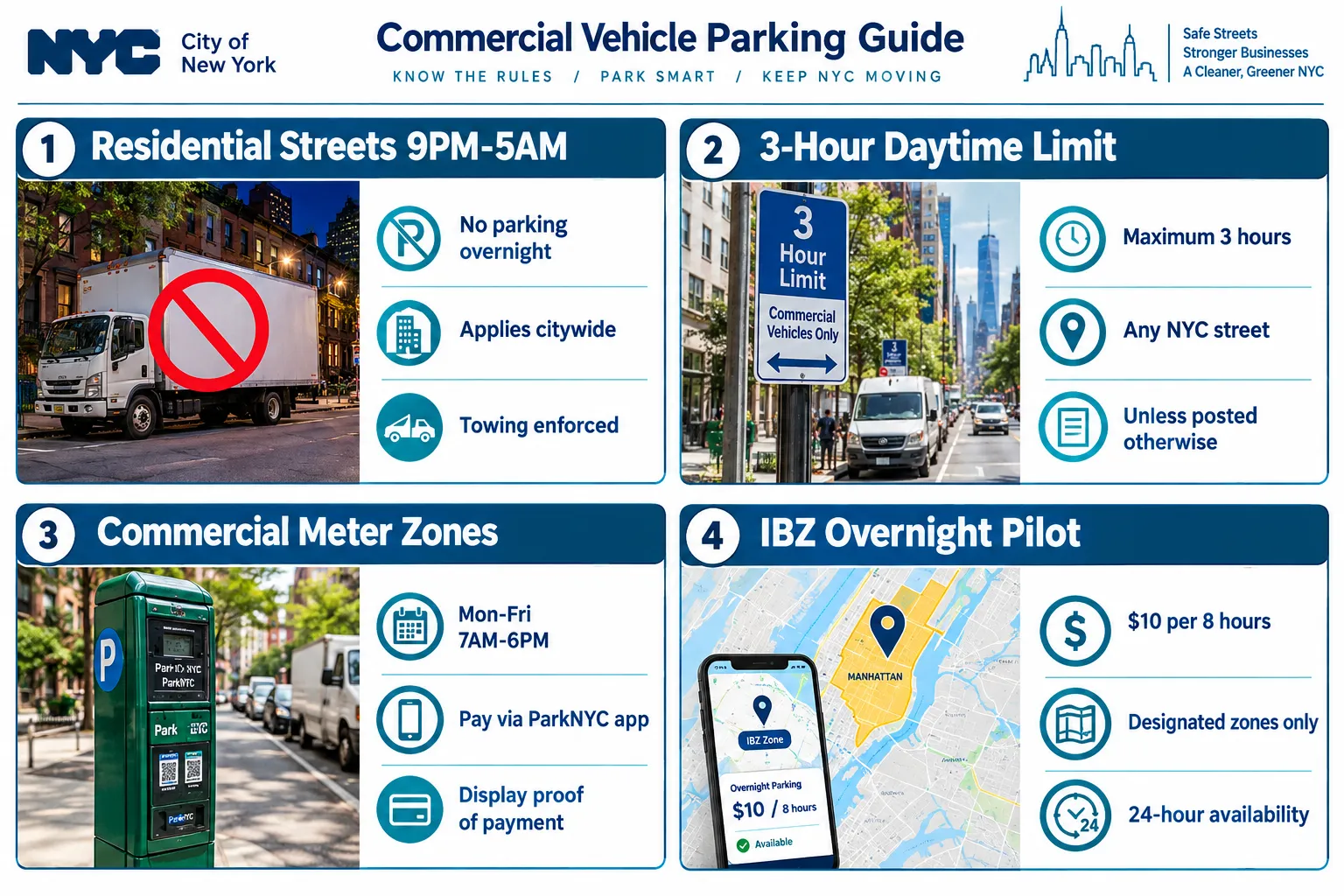
    • Commercial vehicles may not park on any NYC street for more than three hours unless signs permit otherwise, and overnight parking on residential streets (9 p.m. to 5 a.m.) is prohibited citywide.
    • New metered overnight truck parking zones in Industrial Business Zones (IBZs) across Brooklyn, the Bronx, and Queens allow 8-hour sessions for $10 via the ParkNYC app, operating 24 hours Monday through Saturday.
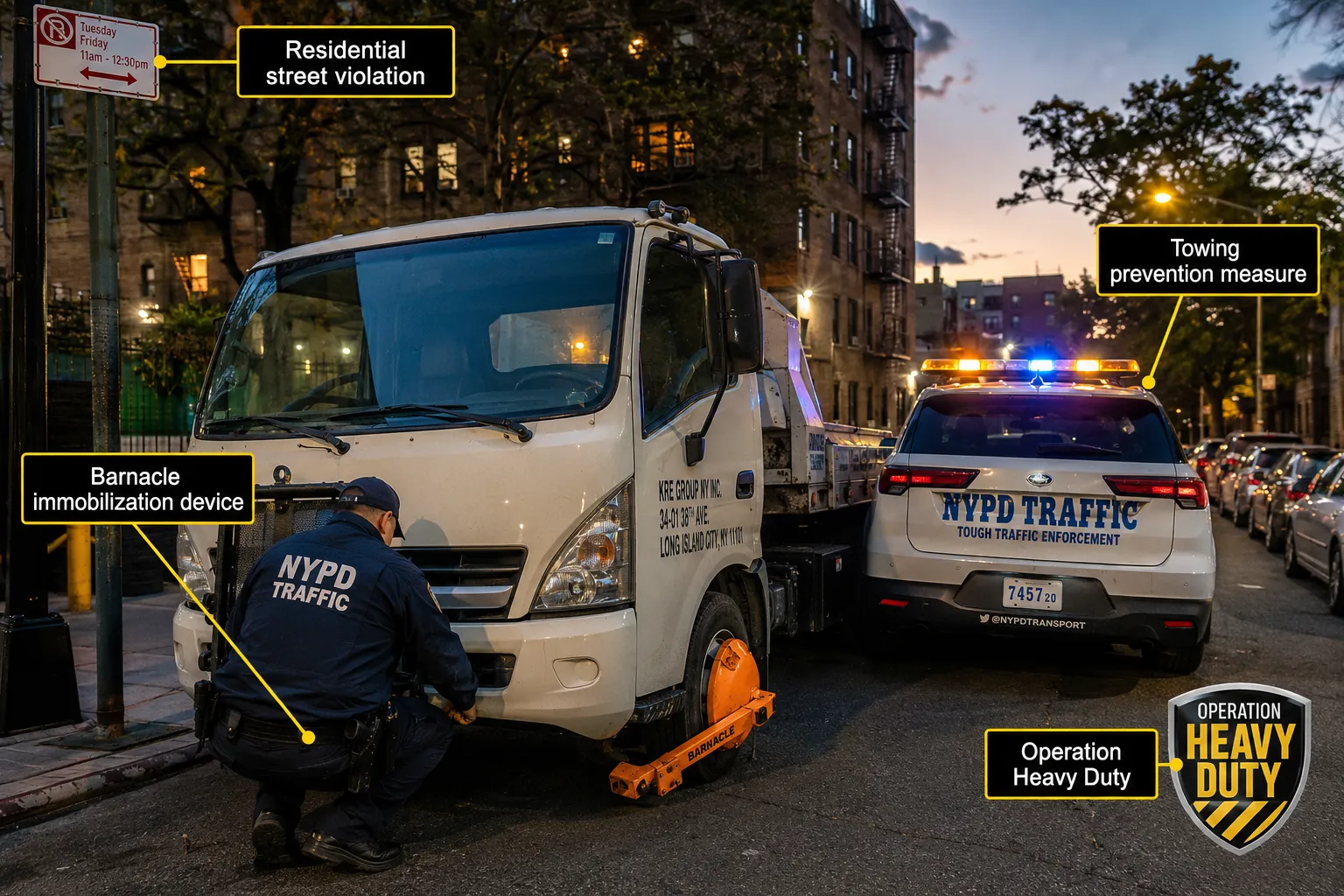
    • NYPD enforcement has intensified with Operation Heavy Duty and deployment of the Barnacle windshield boot, targeting illegal overnight and residential truck parking.
    • More than 500 new curbside commercial loading zones have been installed citywide to reduce double-parking, while automated camera enforcement on MTA buses captures violations in real time.
    • Check real-time Alternate Side Parking status and suspension calendars to coordinate commercial deliveries and avoid street-sweeping tickets during ASP windows.

    Understanding NYC’s Core Commercial Vehicle Parking Restrictions

    NYC Administrative Code §19-170 establishes two foundational rules that apply to every commercial vehicle in the city. First, commercial vehicles may not park anywhere in NYC for more than three hours when parking is not otherwise restricted. Second, commercial vehicles are prohibited from parking on residential streets between 9 p.m. and 5 a.m.,a ban that remains in force across all five boroughs as of 2026.[1][2]

    These provisions form the backbone of enforcement. A «commercial vehicle» under NYC Traffic Rules §4-08 includes any vehicle designed, maintained, or used primarily for the transportation of property, or any vehicle with commercial plates. Box trucks, cargo vans, tractor-trailers, and even pickup trucks with commercial registration fall under these restrictions.[4]

    Key restrictions at a glance:

    • Three-hour limit: Applies citywide on any street where parking is not otherwise prohibited. Exceeding three hours triggers a violation even if you paid a meter or parked legally at the start.
    • Overnight residential ban: From 9 p.m. to 5 a.m., no commercial vehicle may park on a residential street. Enforcement is active every night, and violations carry fines starting at $115 plus potential towing.
    • Midtown Manhattan rules: Between 14th and 60th Streets, from 1st to 12th Avenues, commercial vehicles must park parallel within 12 inches of the curb and may not occupy more than 10 feet of roadway width.[4]
    • No street storage: NYC prohibits using public streets as storage for unaltered commercial vehicles, meaning you cannot leave a truck parked in one spot indefinitely, even during permitted hours.
    Understanding NYC's Core Commercial Vehicle Parking Restrictions

    These rules remain unchanged from their December 2024 codification and are cited by NYPD and the Department of Finance when issuing summonses.[1][4] Drivers who rely on street parking for work vehicles must plan around the three-hour cap and find off-street or designated zones for overnight storage.

    For general guidance on Alternate Side Parking rules in NYC, including how ASP interacts with commercial vehicle restrictions, consult our comprehensive ASP guide.

    Where Commercial Vehicles Can Park Legally: Meters, Loading Zones, and IBZ Pilots

    NYC has expanded legal parking options for commercial vehicles in 2026 through a combination of metered zones, dedicated loading areas, and pilot programs in Industrial Business Zones.

    Commercial Meter Zones and Pay-by-App Spaces

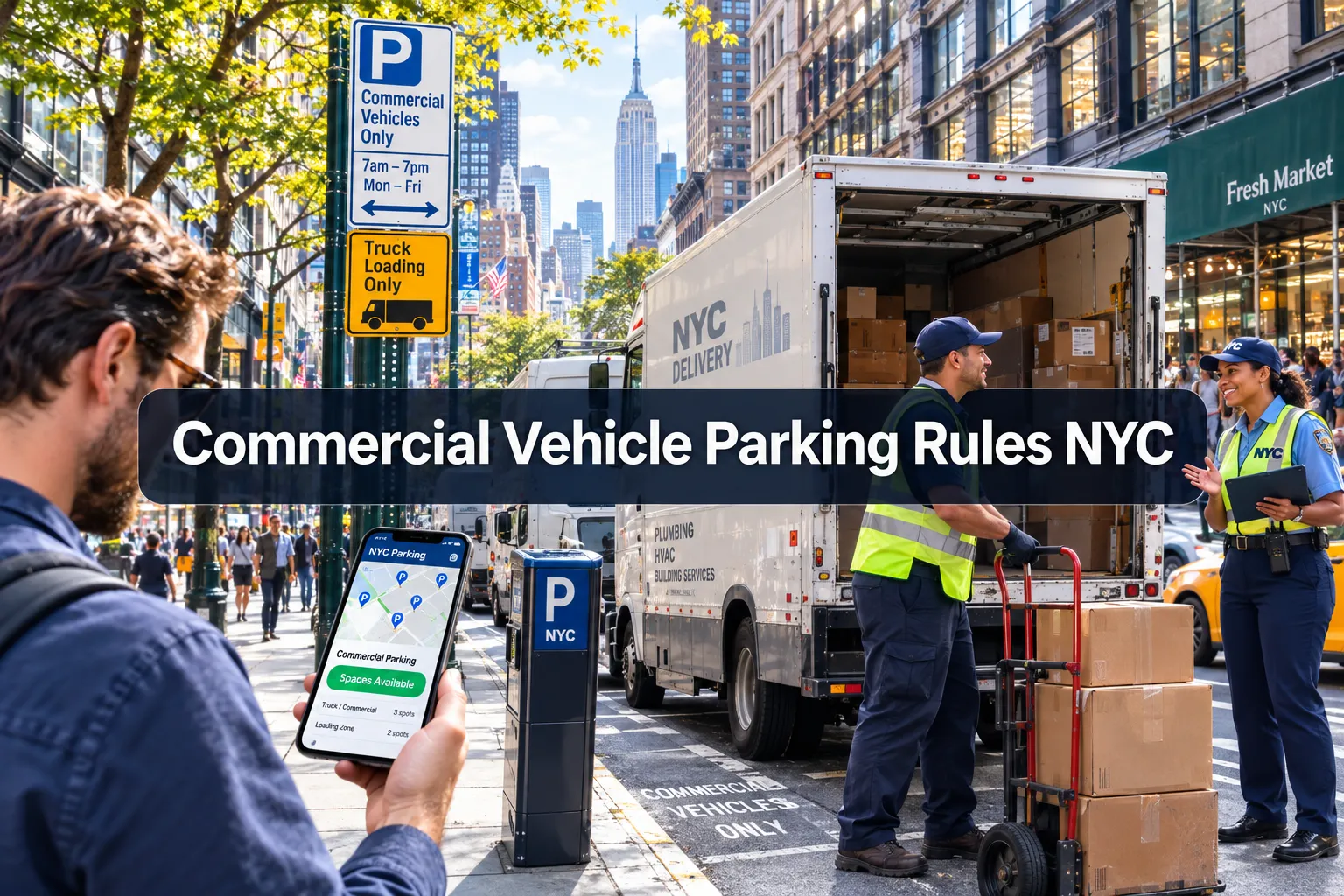
    In «No Standing Commercial Vehicles Only» metered zones, commercial vehicles can park Monday through Friday from 7 a.m. to 6 p.m. for up to three hours per block after paying at a meter or via the ParkNYC mobile app and displaying proof of payment.[5][6] These zones are marked with green or white «Commercial Vehicles Only» signs and are typically located in commercial corridors.

    NYC DOT has also launched pay-by-app-only commercial meters on specific corridors, including Sixth Avenue between West 14th and West 23rd Streets in Manhattan. Drivers must use the ParkNYC app to pay; coin or card payment at physical meters is not accepted in these pilot areas.[3]

    Overnight Truck Parking Pilot in Industrial Business Zones

    Launched in March 2025, the Overnight Truck Parking Pilot created approximately 45 metered commercial vehicle spaces across three IBZ corridors:[3][7][8]

    • Flatlands/Fairfield, Brooklyn: Flatlands Avenue between Erskine Street and Fountain Avenue
    • Hunts Point, Bronx: Ryawa Avenue between Manida Street and Halleck Street
    • Maspeth, Queens: 56th Road between 43rd Street and 49th Street

    Truck operators pay $10 for each 8-hour session via the ParkNYC app. Parking is available 24 hours a day, Monday through Saturday, with no payment required on Sundays. The pilot runs for one year and aims to reduce illegal overnight truck parking on residential streets.[3][7][8]

    If you’re seeking off-street parking in the Bronx, explore garage options such as MPG Parking or Quik Park to avoid street restrictions entirely.

    City Council-Mandated IBZ Overnight Truck Parking Program

    Separate from the metered pilot, NYC Council legislation (Intro 99-A/99-B, adopted in 2025) requires DOT to establish curbside overnight truck parking areas within each IBZ, with parking allowed for up to 10 continuous hours between 8 p.m. and 6 a.m.[9][4] Non-commercial vehicles are prohibited in these zones during overnight hours. This program carries a five-year sunset and is designed to transform the initial pilot into a broader, time-limited policy across industrial areas citywide.[9]

    Industry coverage notes that the Council-mandated overnight curbside program focuses on «overnight-only» spaces inactive between 8 a.m. and 6 p.m., distinct from the 24-hour metered pilot.[7][9] However, a 2025 analysis by THE CITY found that the pilot did not cover several neighborhoods most heavily impacted by illegal truck parking, including parts of southeast Queens, fueling calls for expansion.[3]

    New Curbside Loading Zones

    NYC DOT has installed more than 500 new curbside loading zones citywide to address double-parking and blocked bus and bike lanes.[5][10] These zones reflect community feedback on freight activity hot spots and provide legal short-term parking for commercial deliveries. Loading zones are typically time-limited (15 to 30 minutes) and marked with «Loading Zone» signs; drivers must move vehicles promptly after unloading.

    For parking in Queens, including neighborhoods like Astoria and Flushing, check garage availability to supplement street options during peak delivery hours.

    Enforcement Escalation: Operation Heavy Duty, the Barnacle Boot, and Automated Cameras

    NYPD and NYC DOT have ramped up enforcement of commercial vehicle parking rules NYC since 2024, deploying new tools and operations to deter illegal overnight and residential truck parking.

    Operation Heavy Duty Enforcement

    Launched in 2024 and continuing through 2026, Operation Heavy Duty targets illegally parked trucks in Queens and other boroughs. NYPD reports issuing hundreds of summonses and conducting dozens of truck tows under this initiative.[9] Enforcement focuses on residential streets during the 9 p.m. to 5 a.m. ban and on trucks exceeding the three-hour daytime limit.

    The Barnacle Windshield Boot

    NYPD has deployed the Barnacle, a large orange suction-cup device that immobilizes vehicles by covering the windshield, to enforce commercial vehicle violations.[9] The Barnacle is applied to trucks with excessive unpaid fines or those parked illegally overnight on residential streets. Removal requires payment of outstanding fines and a release fee, and attempting to remove the device without authorization can result in additional penalties.

    The Barnacle Windshield Boot

    This tool signals a policy shift away from informal tolerance toward strict enforcement of the overnight residential ban.[2][9]

    Automated Camera Enforcement (ACE) Program

    NYC DOT’s Automated Camera Enforcement (ACE) program uses cameras mounted on over 1,000 MTA buses to capture double-parking violations and bus lane obstructions, many involving commercial vehicles, and forward them to DOT for processing.[7][10] Violations are issued automatically, and fines are mailed to the registered owner. The program has expanded significantly in 2025-2026, increasing the likelihood that illegal parking will be detected even in the absence of a traffic agent.

    Stipulated Fine Program Adjustments

    The Department of Finance’s Annual Parking Tickets and Camera Violations report (Local Law 6 report for FY25) documents changes to the Stipulated Fine Program, which allows commercial fleets to enroll and pay reduced fines for certain violations.[10] However, Streetsblog NYC highlighted that reduced stipulated fines for double-parking (dropping from $80 to $65 for enrolled firms) and bus lane parking might unintentionally encourage double-parking by commercial vehicles rather than curb it.[1]

    Drivers and fleet managers should weigh the cost of fines against the cost of securing legal off-street parking in Manhattan or other boroughs to avoid repeat violations and escalating penalties.

    Real-Time Alternate Side Parking Status and Commercial Vehicle Coordination

    Alternate Side Parking (ASP) rules intersect with commercial vehicle parking rules NYC in critical ways. During ASP windows, typically 8 a.m. to 11 a.m. or 11:30 a.m. to 2 p.m. on designated days, streets are cleared for sweeping, and parking is prohibited on the affected side. Commercial vehicles parked during ASP enforcement are ticketed and may be towed, just like passenger cars.

    Check real-time ASP status to coordinate deliveries and avoid violations. Park Rules Live provides live ASP suspension alerts for neighborhoods across NYC, including Astoria, Williamsburg, Park Slope, DUMBO, and Greenpoint. Use these tools to confirm whether ASP is suspended due to holidays or emergency declarations before parking a commercial vehicle on a residential block.

    Key ASP coordination tips for commercial drivers:

    • Plan around ASP windows: Schedule deliveries and pickups outside ASP enforcement hours to avoid moving your vehicle mid-shift.
    • Use suspension calendars: Official holiday suspension calendars list days when ASP is not in effect, allowing you to park legally on both sides of the street.
    • Monitor real-time alerts: Weather emergencies, snow operations, and special events can trigger ASP suspensions. Check Park Rules Live’s real-time status tracker for up-to-the-minute updates.
    • Understand block-specific schedules: ASP schedules vary by block. Read posted signs carefully and confirm the schedule for the exact block where you plan to park.

    For cities beyond NYC, including Yonkers, Buffalo, and Binghamton, consult city-specific ASP guides to coordinate commercial parking with local street-cleaning rules.

    Proposed Legislation and Future Expansions

    NYC lawmakers continue to introduce bills aimed at curbing illegal truck parking and expanding legal options for commercial vehicles. Proposed measures in 2025-2026 include:[3]

    • 90-minute citywide parking limit for large commercial vehicles such as trailers and semis, further restricting long-term street parking.
    • Requirements for DOT to establish overnight parking areas for large commercial vehicles within IBZs, operating from 8 p.m. to 6 a.m., building on the existing pilot.
    • Mandates for at least three off-street truck parking facilities citywide by early 2026, to be acquired and managed by a designated city agency.

    These proposals reflect ongoing tension between the need for commercial vehicle access and community complaints about illegal truck parking. Drivers should monitor legislative updates and adjust parking strategies as new rules take effect.

    Avoiding Fines, Towing, and Unfair Parking Citations

    Avoid fines and towing by following these best practices:

    1. Never park a commercial vehicle on a residential street overnight. The 9 p.m. to 5 a.m. ban is enforced citywide, and violations carry fines starting at $115 plus towing fees.
    2. Respect the three-hour limit. Even if you paid a meter or parked legally at the start, exceeding three hours triggers a violation. Set a timer and move your vehicle before the limit expires.
    3. Use designated IBZ overnight zones. If you need overnight parking, use the metered pilot zones in Flatlands, Hunts Point, or Maspeth, or explore off-street parking options in your borough.
    4. Pay meters and display proof. In commercial meter zones, always pay via the ParkNYC app or at the meter and display your receipt or confirmation on the dashboard.
    5. Check ASP status before parking. Use real-time suspension calendars and alerts to confirm whether ASP is in effect on the block where you plan to park.
    6. Fight unfair parking citations. If you receive a ticket you believe is incorrect, use the NYC Parking Education Hub resources on tickets and disputes to challenge the citation. Document your parking location, time, and any relevant signs with photos.

    For additional support on tickets and disputes, consult guides on contesting unfair parking citations and recovering towed vehicles through the city’s impound system.

    Conclusion

    Navigating commercial vehicle parking rules NYC in 2026 requires vigilance, planning, and real-time information. The three-hour daytime limit and overnight residential ban remain strictly enforced, while new metered IBZ zones and expanded loading areas offer legal alternatives for drivers willing to pay and plan ahead. NYPD’s Operation Heavy Duty, the Barnacle boot, and automated camera enforcement have raised the stakes for violations, making compliance essential to avoid fines and towing.

    Take action now:

    • Check real-time ASP status on Park Rules Live before parking on any residential block.
    • Explore off-street parking in Brooklyn, Manhattan, the Bronx, Queens, and Staten Island to secure legal overnight storage.
    • Use the ParkNYC app to pay for metered commercial zones and IBZ overnight pilot spaces.
    • Set reminders to move your vehicle before the three-hour limit expires.
    • Monitor suspension calendars and real-time alerts to coordinate deliveries around ASP enforcement.

    By understanding the rules, leveraging official tools, and staying informed on enforcement trends, commercial drivers can avoid costly citations, protect their vehicles from towing and impounds, and keep their operations running smoothly in the nation’s most complex parking environment.

    References

    [1] A Fine Mess City To Expand Encouragement For Truckers To Double Park – https://nyc.streetsblog.org/2024/10/22/a-fine-mess-city-to-expand-encouragement-for-truckers-to-double-park

    [2] New York City Creates Pilot Program For Three Truck Parking Lots – https://www.truckersnews.com/news/article/15740890/new-york-city-creates-pilot-program-for-three-truck-parking-lots

    [3] Pols Aim To Put Brakes On Illegal Truck Parking – https://queenseagle.com/all/2024/10/15/pols-aim-to-put-brakes-on-illegal-truck-parking

    [4] New York City Passes Bill To Expand Overnight Truck Parking – https://landline.media/new-york-city-passes-bill-to-expand-overnight-truck-parking/

    [5] Nyc Dot Loading Zones – https://www.nyc.gov/html/dot/html/pr2024/nyc-dot-loading-zones.shtml

    [6] 0099 2024+ – https://intro.nyc/0099-2024+

    [7] Nyc Advances Commonsense Solution To Address Truck Parking – https://landline.media/magazine/nyc-advances-commonsense-solution-to-address-truck-parking/

    [8] Mondays Headlines You Aint Goin Nowhere Edition – https://nyc.streetsblog.org/2024/04/08/mondays-headlines-you-aint-goin-nowhere-edition

    [9] Mayor Eric Adams Nypd Launch Crackdown On Commercial Vehicles Parking Illegally In Queens – https://www.cbsnews.com/newyork/news/mayor-eric-adams-nypd-launch-crackdown-on-commercial-vehicles-parking-illegally-in-queens/

    [10] Legislationdetail – https://legistar.council.nyc.gov/LegislationDetail.aspx?GUID=E10D907C-092A-4BFF-8FB5-BACB2CB71AE7&ID=6509477