Etiqueta: nyc dof

  • How Much Parking Ticket NYC: Official 2026 Fine Amounts & Penalty Guide

    How Much Parking Ticket NYC: Official 2026 Fine Amounts & Penalty Guide

    New York City issued more than 10 million parking tickets in the past year, and each violation carries a precise dollar amount set by the Department of Finance. Understanding how much parking ticket NYC violations cost, and how penalties escalate, is essential to avoid fines and towing.

    This guide breaks down official 2026 fine amounts for every common parking violation, explains the Manhattan versus outer-borough pricing difference, and shows exactly when late penalties, interest, and enforcement actions kick in. Check status now to stay ahead of citations.

    Key Takeaways

    • NYC parking fines range from $35 to over $250 depending on violation type and borough, with Manhattan carrying higher fines for expired meters and double parking.
    • All posted fine amounts include a mandatory $15 New York State Criminal Justice surcharge, no separate payment required.
    • Unpaid tickets trigger escalating penalties: $10 on day 31, $30 on day 61, and $60 on day 91, plus daily interest after judgment around day 100.
    • Once judgment debt reaches $350 or more, NYC can boot or tow your vehicle and pursue aggressive collection actions.
    • Real-time Alternate Side Parking status checks and official suspension calendars help drivers avoid the most common $65 street-cleaning violations.

    How Much Parking Ticket NYC: Common Violation Fine Amounts in 2026

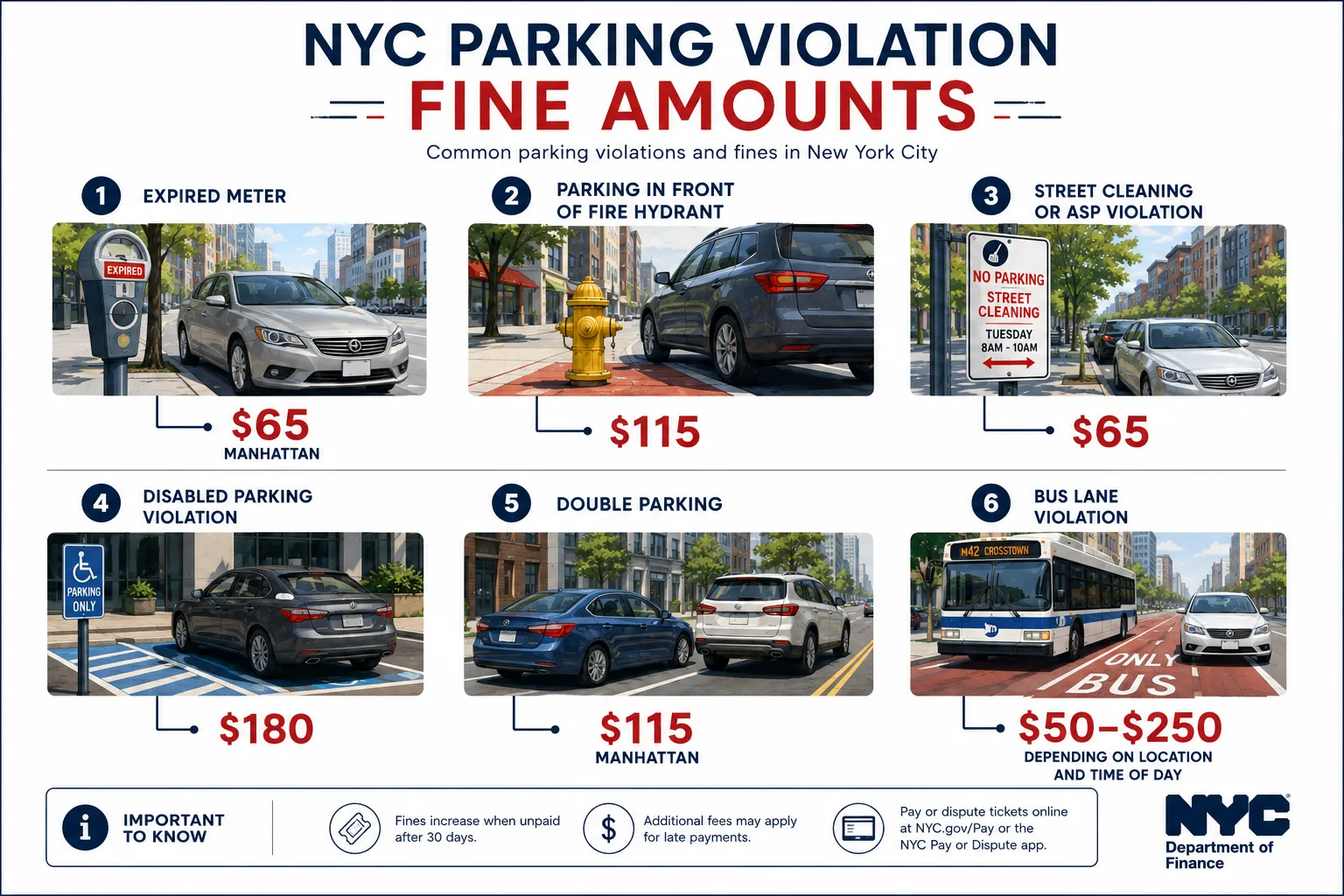
    NYC parking fines are set by violation code and vary by borough. The Department of Finance publishes the official schedule, last updated mid-2026, covering more than 100 distinct violations.[1][2][4][8]

    Most frequent violations and their 2026 fines:

    • Expired meter (muni-meter): $65 in Manhattan, $35 in Bronx, Brooklyn, Queens, and Staten Island[1][4][8]
    • Street cleaning / Alternate Side Parking: $65 citywide[1][4][8]
    • Fire hydrant (within 15 feet): $115[1][4][8]
    • Double parking: $115 in Manhattan, $65 in outer boroughs[1][4]
    • Bus stop / bus lane (standing): $115[1][4][8]
    • No standing / no stopping (general): $100 base fine under 2025 rule amendments[7][10][13]
    • Crosswalk or sidewalk parking: $115[1][4][8]
    • Disabled parking without permit: $180[1][4][8]
    • Misuse of disabled parking permit: $250+[1][4][8]
    How Much Parking Ticket NYC: Common Violation Fine Amounts in 2026

    All fines listed by NYC DOF already include the $15 New York State Criminal Justice surcharge, drivers pay the posted amount with no additional state fee.[2] This built-in surcharge applies to every parking ticket issued in the five boroughs.

    For commercial fleets and high-volume violators, DOF offers Stipulated Fine and Commercial Abatement Programs that provide discounted «program timely payment» rates when companies enroll and pay promptly.[5][11] Industry guidance emphasizes these programs as cost-saving tools for businesses operating citywide.

    Explore the official NYC Parking Directory to locate off-street parking options and compare garage rates across all boroughs, helping you avoid street violations entirely.

    Manhattan vs. Outer Boroughs: Why Fine Amounts Differ

    Manhattan parking fines are consistently higher than those in the Bronx, Brooklyn, Queens, and Staten Island for the same violation codes. The differential reflects congestion, parking scarcity, and enforcement intensity in the central business district.[1][4][8]

    Key examples of the Manhattan premium:

    Violation Type Manhattan Fine Outer Boroughs Fine
    Expired meter $65 $35
    Double parking $115 $65

    This two-tier structure means a driver who forgets to feed the meter in Midtown pays nearly double what the same lapse costs in Astoria or Park Slope. For repeat offenders and commercial operators, the Manhattan premium adds up quickly.[1][4][11]

    Check the real-time Alternate Side Parking status for NYC before parking on any street-cleaning day. ASP violations are $65 citywide and among the most frequently issued tickets, especially during the twice-weekly sweeping cycles.[1][4][8]

    Understanding these borough-specific fine schedules helps drivers budget accurately and prioritize off-street parking in high-cost zones. Review parking garages and savings articles to find competitive monthly and daily rates that eliminate citation risk.

    Unpaid Parking Tickets: Penalties, Interest, and Enforcement Timelines

    Ignoring a parking ticket triggers a cascade of additional charges and enforcement actions. The Office of the Parking Summons Advocate (OPSA) details the exact penalty schedule for 2026.[6]

    Penalty escalation timeline:

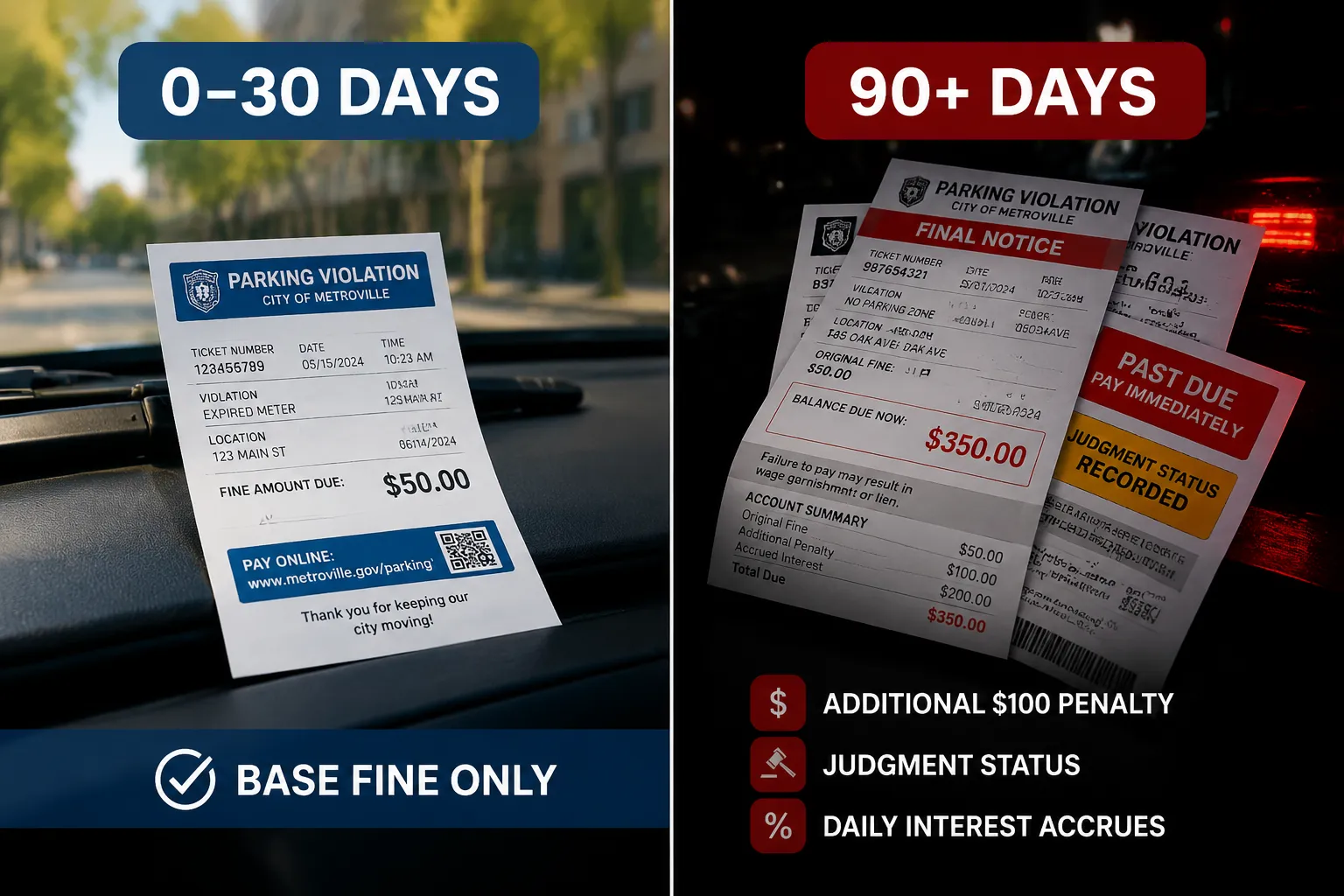
    • Day 0-30: Base fine only (no additional penalty)
    • Day 31: $10 penalty added to outstanding balance[6]
    • Day 61: Additional $30 penalty (total $40 in penalties)[6]
    • Day 91: Additional $60 penalty (total $100 in penalties)[6]
    • Day 100 (approximately): Ticket enters judgment; daily interest begins accruing on the full balance[6][3]
    Unpaid Parking Tickets: Penalties, Interest, and Enforcement Timelines

    For camera-based violations, including certain red-light and speed-camera tickets, a separate $25 penalty is added if the ticket remains unanswered after 30 days.[6][9][3] This camera penalty is distinct from the standard parking-ticket penalty schedule and applies before judgment.

    Once total judgment debt from unpaid tickets reaches $350 or more, NYC can boot or tow the vehicle and pursue other enforcement measures.[6] Judgment debt includes the original fine, all accrued penalties, and interest, making even a few ignored tickets a serious financial liability.

    Drivers facing unfair parking citations should consult the guide on how to fight a double parking ticket in NYC for step-by-step dispute instructions and evidence requirements. The Parking Education Hub provides templates and strategies to challenge incorrect violations before they enter judgment.

    Bus Lane, Disabled Parking, and High-Cost Violations

    Certain violation categories carry significantly higher fines due to safety, accessibility, and enforcement priorities.[1][4][8][11]

    High-cost violation categories in 2026:

    • Disabled parking without valid permit: $180[1][4][8]
    • Misuse of disabled parking permit: $250+[1][4][8]
    • Bus lane camera violations (escalating schedule): $50 first offense, rising to $250 per vehicle within a rolling 12-month period[11]
    • Blocking fire hydrant (within 15 feet): $115[1][4][8]
    • Commercial vehicle violations (repeat offenses): Subject to stipulated fine schedules and potential fleet sanctions[5][11]

    Bus-lane camera enforcement has become a major cost center for commercial fleets operating in Manhattan. The escalating fine structure, starting at $50 and climbing to $250 for repeat offenses within 12 months, means a single vehicle can rack up thousands in fines annually.[11] Fleet managers should review real-time bus-lane maps and adjust routes to avoid camera zones.

    Disabled parking violations are among the most expensive tickets NYC issues, reflecting the city’s commitment to accessibility compliance. Parking in a disabled bay without a valid permit costs $180, while fraudulent use of a permit can exceed $250 and trigger additional legal consequences.[1][4][8]

    For drivers seeking legitimate off-street options near high-enforcement zones, explore facilities like Stable Car Parking in Brooklyn, MPG Parking in the Bronx, and Astoria Parking Management in Queens to secure predictable daily or monthly rates.

    Alternate Side Parking Violations: The $65 Ticket You Can Avoid

    Alternate Side Parking (ASP) violations account for a substantial share of NYC’s annual parking-ticket volume. Street-cleaning rules require drivers to move vehicles twice weekly on most residential blocks, and failure to comply results in a $65 fine citywide.[1][4][8]

    How to avoid ASP tickets:

    • Check real-time status daily: ASP rules are suspended on most major holidays and occasionally for special events. Verify the live NYC Alternate Side Parking status before leaving your car overnight.
    • Review suspension calendars: Official city suspension calendars list all scheduled ASP holidays and rule changes for the year.
    • Set alerts: Real-time ASP alerts notify drivers the night before enforcement resumes, preventing surprise tickets after holiday weekends.
    • Understand neighborhood schedules: ASP times vary by block. Read posted signs carefully and note the exact hours when parking is prohibited.

    Learn the complete ruleset in the guide Know All About Alternate Side Parking Rules in NYC, which covers sign interpretation, grace periods, and common enforcement traps.

    For drivers in neighboring municipalities, check the live status pages for Yonkers, Mount Vernon, Buffalo, Rochester, and Albany to stay current with regional ASP rules and winter parking restrictions.

    Tickets & Disputes: Fighting Unfair Parking Citations

    Not every parking ticket is valid. Drivers have the right to dispute citations through NYC’s online hearing system, and many violations are dismissed when proper evidence is submitted.[6]

    Common grounds for dispute:

    • Incorrect license plate or vehicle description
    • Defective or missing parking signs at the violation location
    • Valid meter receipt or parking permit not noted by enforcement officer
    • Vehicle was legally parked during the cited time (photographic evidence required)
    • Medical emergency or other documented extenuating circumstance

    The Office of the Parking Summons Advocate (OPSA) provides free guidance on the dispute process, including how to request an in-person or virtual hearing and what documentation strengthens a case.[6] Submitting a dispute before the ticket enters judgment prevents penalties and interest from accruing during the review period.

    For detailed dispute strategies and templates, consult the Parking Education Hub resources on Tickets & Disputes. These guides walk drivers through evidence collection, hearing preparation, and appeal procedures for both standard parking violations and camera-based tickets.

    Towing & Impounds: What Happens When Judgment Debt Hits $350

    Unpaid parking tickets don’t just accumulate penalties, they can result in your vehicle being booted or towed. Once judgment debt reaches $350 or more, NYC enforcement agents can immobilize or impound the car.[6]

    Enforcement actions for judgment debt:

    • Booting: A steel clamp is attached to the wheel, preventing the vehicle from moving. Removal requires full payment of outstanding fines, penalties, interest, and a boot-removal fee.
    • Towing: The vehicle is towed to a city impound lot. Owners must pay all judgment debt plus towing and storage fees, often several hundred dollars, to recover the car.
    • Registration suspension: New York State DMV can suspend vehicle registration for unpaid parking-ticket debt, making it illegal to drive the car even if it’s not booted or towed.

    Towing and impound fees add substantial cost on top of the original fines. Daily storage charges accrue until the vehicle is claimed, and delays can push total recovery costs into the thousands.[6]

    To avoid these enforcement actions, pay or dispute tickets promptly. Use the official NYC parking-ticket lookup tool to check your vehicle’s outstanding balance and judgment status. If you’re already facing a boot or tow, contact OPSA immediately to explore payment plans or hardship relief options.[6]

    Conclusion

    Understanding how much parking ticket NYC violations cost in 2026, and how penalties escalate, empowers drivers to avoid fines and towing. NYC parking fines range from $35 for an expired meter in the outer boroughs to over $250 for disabled-parking permit misuse, with Manhattan carrying a premium for most violations. Every posted fine includes the $15 state surcharge, and unpaid tickets trigger $10, $30, and $60 penalties at 31, 61, and 91 days, plus daily interest after judgment.

    Take action now:

    • Check the real-time Alternate Side Parking status daily to avoid the most common $65 street-cleaning tickets.
    • Explore the NYC Parking Directory to locate off-street garages and lots with competitive rates across all five boroughs.
    • Dispute unfair citations immediately using the resources in the Parking Education Hub before penalties and interest accrue.
    • Set up real-time alerts and review official suspension calendars to stay ahead of rule changes and holiday suspensions.

    Avoid fines and towing by staying informed with official, real-time parking status and accurate fine schedules. Locate your nearest garage, check today’s ASP status, and protect your vehicle from costly citations and impounds.

    References

    [1] Fines – https://www.19pine.ai/parking-tickets/us/new-york/new-york-city/fines [2] Services Violation Codes – https://www.nyc.gov/site/finance/vehicles/services-violation-codes.page [3] Parking And Camera Tickets – https://www.nyc.gov/main/services/parking-and-camera-tickets [4] Nyc Parking Tickets – https://nyc-parks.com/nyc-parking-tickets [5] Stipulated Fines Fee Schedule – https://www.nyc.gov/assets/finance/downloads/pdf/tax_and_parking_program_operations/stipulated-fines-fee-schedule.pdf [6] Opsa – https://www.nyc.gov/site/finance/vehicles/opsa.page [7] 0 0 0 146073 – https://codelibrary.amlegal.com/codes/newyorkcity/latest/NYCrules/0-0-0-146073 [8] New York Parking Tickets – https://www.newyorksafetycouncil.com/articles/new-york-parking-tickets/ [9] Parking Brochure – https://www.nyc.gov/assets/finance/downloads/pdf/brochures/parking_brochure.pdf [10] Rule Pvfines902 – https://www.nyc.gov/assets/finance/downloads/pdf/01pdf/rule_pvfines902.pdf [11] Fleet data and commercial parking-ticket analysis (2026 industry reports and DOF commercial program materials)
  • How to Fight a Fire Hydrant Parking Ticket in NYC: Official 2026 Guide

    How to Fight a Fire Hydrant Parking Ticket in NYC: Official 2026 Guide

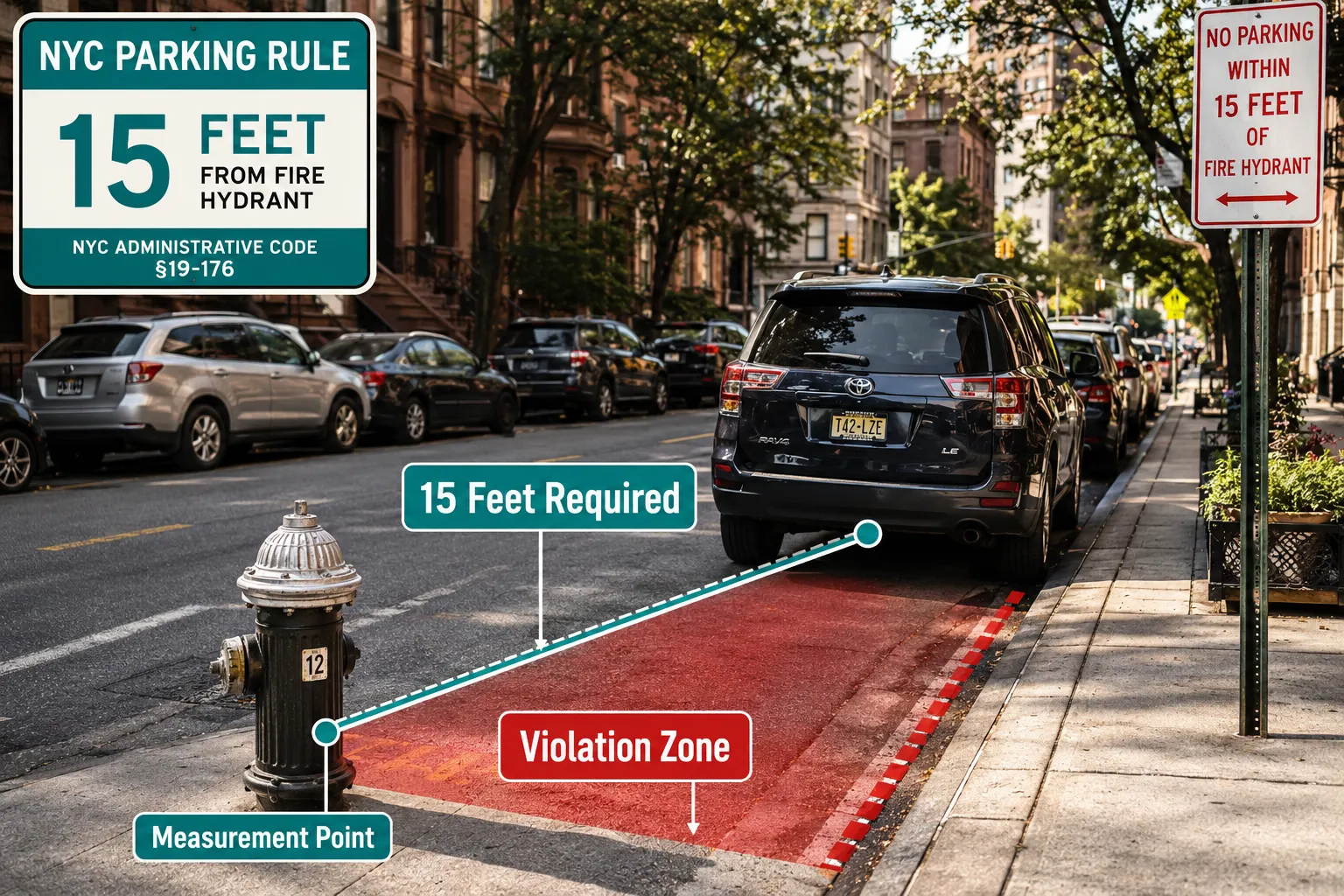
    NYC’s Department of Finance issued over 10 million parking tickets in 2025, with fire hydrant violations ranking among the most disputed citations. The $115 fine hits hard, especially when drivers believe they parked legally or when the distance measurement appears questionable.

    Learning how to fight a fire hydrant parking ticket in NYC starts with understanding the official rules and your dispute rights. The city requires 15 feet of clearance on either side of every hydrant, but enforcement officers sometimes make measurement errors or fail to document required elements on the summons.[1][3] Those mistakes create valid grounds for dismissal.

    This guide walks through the exact steps to challenge a fire hydrant ticket using NYC’s official dispute channels in 2026.

    Key Takeaways

    • Fire hydrant tickets (Violation 40) carry a $115 fine and require 15 feet clearance from the hydrant on either side
    • Contest tickets within 30 days of issuance through NYC DOF’s online portal, mobile app, mail, or in-person to avoid late penalties
    • The summons must specify the exact distance in feet your vehicle was from the hydrant, missing or inaccurate measurements are valid defenses
    • Submit photographic evidence showing measurements, timestamps, and street context to strengthen your dispute
    • Appeal unfavorable hearing decisions for a second review if the initial ruling goes against you

    Understanding NYC Fire Hydrant Parking Rules

    NYC law prohibits stopping, standing, or parking within 15 feet of a fire hydrant on either side.[1][3] This distance applies regardless of street design, including floating parking lanes next to protected bike lanes introduced in recent years.

    The NYC Department of Finance codes fire hydrant violations as «Violation 40» with a standard fine of $115 as of the August 2026 penalty schedule.[2] The violation applies 24 hours a day, seven days a week, with no exceptions for brief stops or emergency flashers.

    Critical measurement requirement: According to NYC DOF guidance updated July 24, 2026, every fire hydrant summons must specify how far, in feet, your vehicle was parked from the hydrant.[9] This required element becomes the foundation of many successful disputes when officers fail to document it or record inaccurate measurements.

    The 15-foot rule differs from other parking regulations. While Alternate Side Parking suspensions and street cleaning schedules vary by neighborhood and calendar, fire hydrant clearance requirements never change. Commercial delivery drivers and residents alike must maintain this distance at all times.

    Understanding NYC Fire Hydrant Parking Rules

    How to Fight a Fire Hydrant Parking Ticket in NYC: Step-by-Step Process

    Challenge unfair parking citations through NYC’s official dispute system. The process requires prompt action and proper documentation.

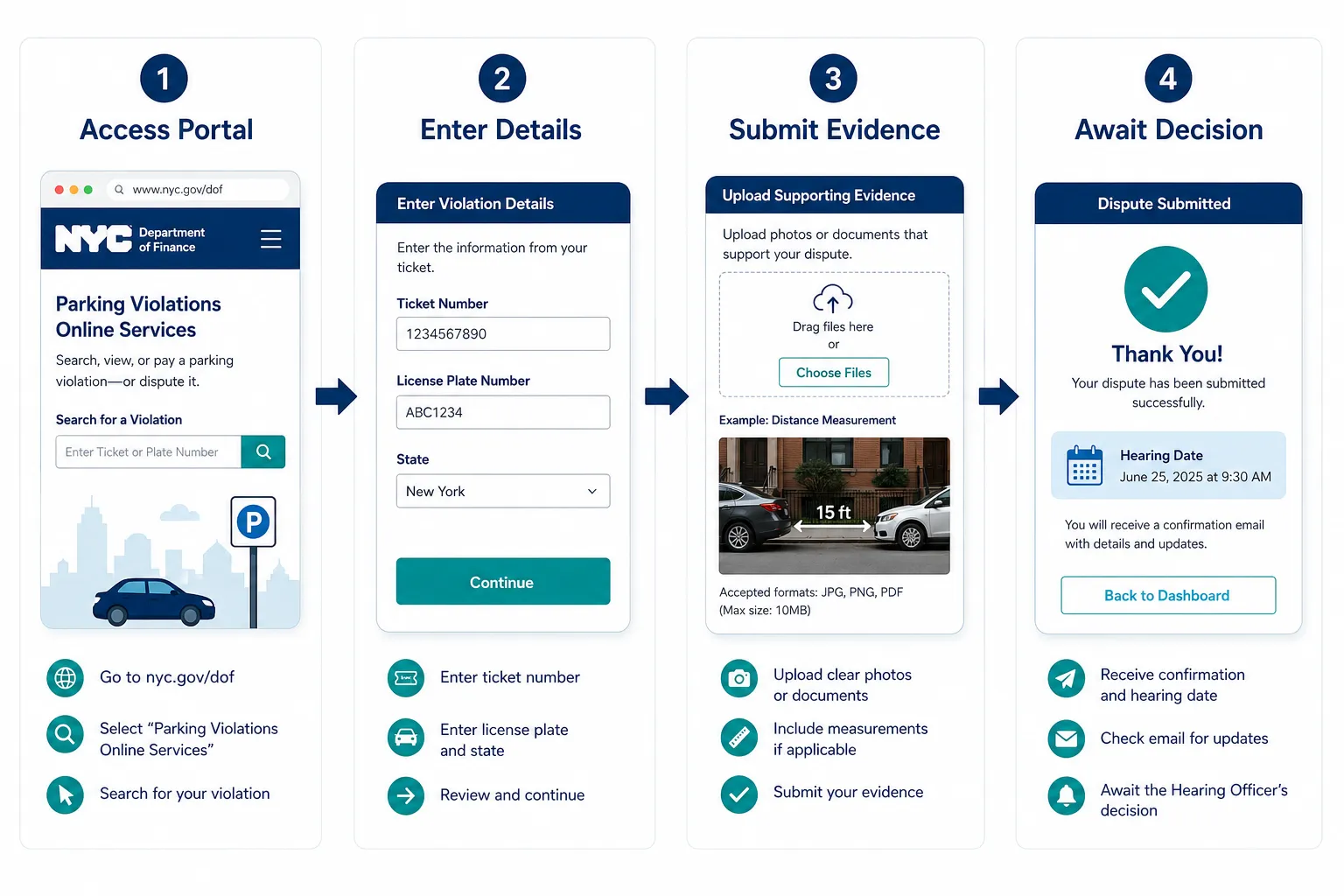
    Request a Hearing Within 30 Days

    Submit your dispute request within 30 days of the ticket issue date to avoid late penalties and preserve your appeal rights.[4][5][7][10] Missing this deadline triggers additional fines and eliminates your ability to contest the violation.

    NYC provides multiple official channels to request a hearing:

    Online Portal: Access the NYC DOF Dispute Web portal to enter your violation number and submit a written defense with supporting evidence.[4][8] The system accepts photo uploads showing distance measurements, timestamps, and street context.

    NYC Pay or Dispute Mobile App: Download the official app to dispute tickets directly from your phone, upload photos immediately after receiving the citation, and track your case status in real time.[6]

    By Mail: Send a written dispute letter to NYC Department of Finance, P.O. Box 29021, New York, NY 10087-9021. Include the violation number, license plate, defense statement, and copies of supporting photos.[5][7]

    In Person: Visit any NYC DOF business center to submit your dispute and speak with staff about evidence requirements.[5][10][11]

    The entire dispute process can be completed without appearing in person, making it convenient for drivers who work during business hours or live outside the city.[10][11]

    Build Your Defense with Required Evidence

    Strong fire hydrant defenses focus on measurement accuracy and summons defects. The burden of proof falls on you to demonstrate the vehicle was more than 15 feet from the hydrant.[13]

    Effective defense strategies:

    • Distance measurement evidence: Photograph your vehicle’s position relative to the hydrant immediately after receiving the ticket. Use a measuring tape to document the actual distance. If you can prove the car sat beyond 15 feet, the ticket must be dismissed.


    • Missing required elements: Review the summons for the distance specification required by NYC DOF.[9] If the officer failed to record how many feet your vehicle was from the hydrant, argue the ticket lacks a required element and should be dismissed.


    • Inaccurate measurements: Challenge the officer’s recorded distance with your own photographic evidence and measurements. Enforcement agents sometimes estimate distances without measuring, creating opportunities for successful disputes.


    • Obstructed or hidden hydrants: Document if snow, construction barriers, or overgrown vegetation obscured the hydrant from view. While not always successful, these defenses work when the hydrant was genuinely invisible to a reasonable driver.


    • Time and date verification: If the ticket shows an impossible time (you have proof you were elsewhere) or incorrect plate information, document these errors thoroughly.


    Build Your Defense with Required Evidence

    Submit Your Dispute Through Official Channels

    Access the NYC DOF searchViolation portal to begin your online dispute.[8] Enter the violation number from your ticket and follow the prompts to upload evidence and write your defense statement.

    Writing an effective dispute statement:

    Keep your written defense clear, factual, and specific. State the exact distance your vehicle was from the hydrant (with photo evidence). Reference the required elements guidance if the officer failed to document distance.[9] Avoid emotional language, focus on facts and measurements.

    The Office of the Parking Summons Advocate (OPSA) can help you understand your rights and evidence strategies for hydrant cases, according to their mission statement updated August 12, 2026.[15]

    Appeal Unfavorable Decisions

    If the initial hearing decision goes against you, NYC DOF’s dispute system confirms you have the right to appeal.[4][7] The appeal gives you a second chance to argue the hydrant rule was misapplied or the ticket’s required elements were defective.

    Submit your appeal through the same channels used for the initial dispute, online, by mail, or in person. Include any additional evidence you’ve gathered and address specific points from the hearing officer’s decision.

    Appeals work best when you can demonstrate clear errors in the original ruling or present new evidence that wasn’t available during the initial hearing.

    Common Mistakes That Weaken Your Fire Hydrant Ticket Defense

    Avoid these errors that reduce your chances of dismissal:

    Waiting too long to dispute: The 30-day window is firm. Late disputes face automatic penalties and limited review.[4][5][7][10]

    Failing to measure and photograph immediately: Distance evidence collected weeks after the ticket carries less weight than photos taken the same day.

    Arguing you were «only there for a minute»: Duration doesn’t matter. The 15-foot rule prohibits stopping, standing, and parking, even briefly.[2][3]

    Submitting blurry or unclear photos: Evidence must clearly show the hydrant, your vehicle, and the distance between them. Invest time in quality documentation.

    Ignoring required summons elements: Always check whether the officer documented the distance in feet. This required element, when missing, provides grounds for dismissal.[9]

    Giving up after an initial denial: Exercise your appeal rights. Many successful disputes win on appeal after presenting additional evidence or identifying errors in the first ruling.[4][7]

    Alternative Solutions: Avoid Fines and Towing Before They Happen

    Prevention beats disputing tickets after the fact. Use real-time parking information to avoid violations entirely.

    Check Real-Time Status for current Alternate Side Parking rules and suspension calendars that affect legal parking spots citywide. Understanding when street cleaning occurs helps you identify safe parking zones that keep you clear of hydrants and other restrictions.

    Explore off-street parking options in your neighborhood through the NYC Parking Directory. Garages and lots eliminate the risk of fire hydrant tickets entirely, especially in high-enforcement areas.

    Commercial delivery drivers operating across multiple boroughs benefit from checking Yonkers, Mount Vernon, and other municipal parking rules when making deliveries outside NYC proper.

    Study the complete guide to NYC parking regulations to understand how fire hydrant rules interact with other restrictions like street cleaning, commercial loading zones, and residential permit areas.

    Similar dispute strategies apply to other parking violations. Learn how to fight a double parking ticket in NYC using the same evidence-based approach.

    Conclusion

    Fighting a fire hydrant parking ticket in NYC requires quick action, precise evidence, and knowledge of official dispute procedures. Request your hearing within 30 days through the NYC DOF online portal, mobile app, mail, or in-person channels. Focus your defense on measurement accuracy, required summons elements, and photographic documentation proving your vehicle sat beyond the 15-foot legal threshold.

    Check the summons for the required distance specification, missing or inaccurate measurements create valid grounds for dismissal. Submit clear photos showing the hydrant, your vehicle, and the distance between them. Exercise your appeal rights if the initial decision goes against you.

    Take action now:

    • Access the NYC DOF Dispute Web portal to start your dispute today
    • Photograph your vehicle’s position relative to the hydrant before moving it
    • Measure the actual distance and document it thoroughly
    • Submit your dispute within 30 days to avoid late penalties
    • Check Real-Time Alternate Side Parking Status to prevent future violations

    The $115 fine and potential towing costs justify the effort to mount a proper defense. Thousands of NYC drivers successfully dispute fire hydrant tickets each year by following these official procedures and presenting strong evidence.

    References

    [1] Article – https://portal.311.nyc.gov/article/?kanumber=KA-01026

    [2] Services Violation Codes – https://www.nyc.gov/site/finance/vehicles/services-violation-codes.page

    [3] Parking Regulations – https://www.nyc.gov/html/dot/html/motorist/parking-regulations.shtml

    [4] Dispute Web – https://www.nyc.gov/site/finance/vehicles/dispute-web.page

    [5] Dispute A Ticket – https://www.nyc.gov/site/finance/vehicles/dispute-a-ticket.page

    [6] Nyc Pay Or Dispute – https://www.nyc.gov/site/finance/vehicles/nyc-pay-or-dispute.page

    [7] Dispute A Ticket Faqs – https://www.nyc.gov/site/finance/vehicles/dispute-a-ticket-faqs.page

    [8] Searchviolation – https://nycserv.nyc.gov/HBWNonCommercial/dispute/searchViolation.action

    [9] Required Elements In A Ticket – https://www.nyc.gov/site/finance/vehicles/required-elements-in-a-ticket.page

    [10] Parking And Camera Tickets – https://www.nyc.gov/main/services/parking-and-camera-tickets

  • What Time Do They Boot Cars in NYC: Official 2026 Enforcement Guide

    What Time Do They Boot Cars in NYC: Official 2026 Enforcement Guide

    New York City boots approximately 135,000 vehicles every year, yet there’s no single «boot time» marked on any enforcement schedule. Understanding what time do they boot cars in NYC requires knowing how parking violations, judgment debt, and enforcement patterns intersect across all five boroughs in 2026.

    The short answer: NYC does not boot cars at a specific time of day. Enforcement officers identify eligible vehicles throughout their shifts, typically between 7 AM and 7 PM on weekdays, though boots can be placed anytime a marshal or authorized contractor locates a scofflaw vehicle. Your car becomes eligible for booting the moment your unpaid parking tickets and camera violations reach $350 or more in judgment debt [1].

    This guide provides real-time clarity on boot enforcement schedules, payment procedures, and how to avoid fines and towing across New York City.

    Key Takeaways

    • NYC boots vehicles with $350+ in judgment debt, not at fixed daily times, enforcement runs primarily 7 AM, 7 PM weekdays [1]
    • Republic Immobilization Services administers the boot program; once booted, you have 48 hours to pay before towing risk [3]
    • Payment and boot authorization are available 24/7 online and by phone; removal at drop-off sites operates around the clock at many locations [1]
    • In-person DOF Business Centers operate weekdays 8:30 AM, 4:30 PM for payment of boot and tow debt [7]
    • Check your vehicle’s violation status and Alternate Side Parking rules daily to stay ahead of judgment debt

    Understanding NYC’s Boot Program: No Fixed «Boot Time»

    Many drivers assume parking enforcement operates on a predictable clock. In reality, what time do they boot cars in NYC depends entirely on when enforcement officers encounter your vehicle during their patrol routes [1].

    The NYC Department of Finance contracts with Republic Immobilization Services to identify and immobilize vehicles with outstanding judgment debt. Enforcement personnel work standard business hours,typically 7 AM to 7 PM Monday through Friday,but boots can legally be placed anytime an authorized agent locates an eligible vehicle, including weekends and evenings [3].

    The $350 Judgment Debt Threshold

    Your vehicle becomes boot-eligible when:

    • Total unpaid parking tickets, camera violations, and related fees reach $350 or more in judgment debt [1]
    • Violations have entered judgment status (you missed the dispute window and payment deadline)
    • Your license plate is flagged in the city’s scofflaw database

    Judgment debt accumulates faster than many drivers realize. A single street-cleaning ticket ($65) combined with a few expired-meter violations can push you over the threshold within weeks if left unpaid.

    Peak Enforcement Windows

    While no official «boot time» exists, enforcement activity clusters during:

    • Morning hours (7 AM, 11 AM): Officers patrol Alternate Side Parking zones during street cleaning windows
    • Midday (11 AM, 3 PM): Residential and commercial district sweeps
    • Late afternoon (3 PM, 7 PM): Final patrol rounds before shift end

    Enforcement is lighter on weekends and holidays, but scofflaw vehicles remain eligible 24/7/365.

    Peak Enforcement Windows

    What Happens After Your Car Gets Booted in NYC

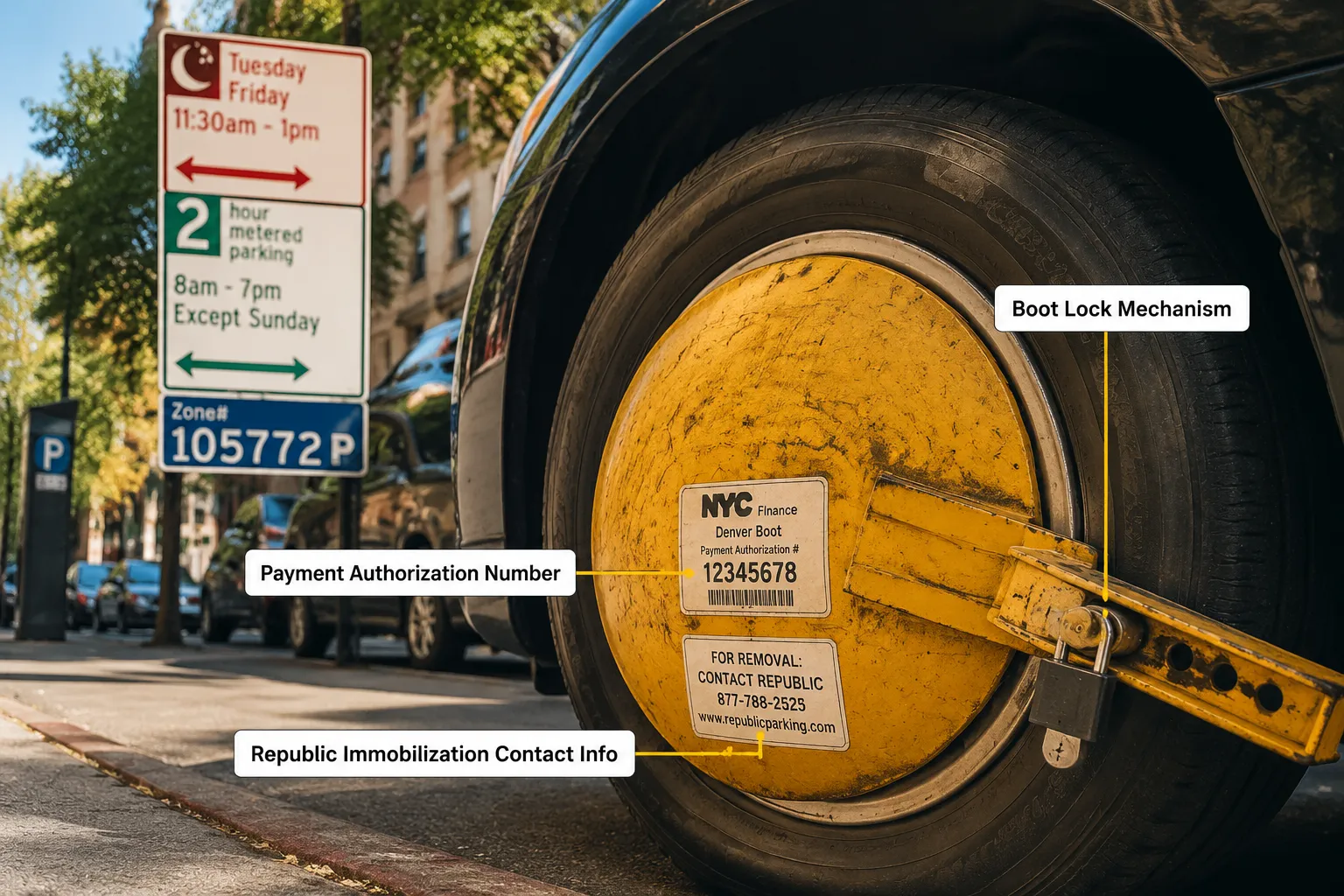
    Once a boot is installed, a bright yellow immobilization device locks onto your wheel, and a violation notice is affixed to your windshield [3]. The notice displays:

    • Your total judgment debt amount
    • Payment authorization phone number (646-517-1000)
    • Boot identification number
    • Warning: 48 hours to pay before towing [2]

    The 48-Hour Towing Window

    This is critical: you have 48 hours from the moment of booting to pay your debt and arrange boot removal [2]. After 48 hours, the city may tow your vehicle to an impound lot, adding:

    • Towing fees ($185+)
    • Daily storage charges ($20/day)
    • Additional administrative costs

    If your vehicle remains unclaimed for 10 days after towing, it becomes eligible for public auction [6].

    For help locating a towed vehicle, consult our comprehensive guide on how to find your towed car in NYC.

    24/7 Payment and Authorization

    Unlike many city services, boot payment and removal authorization operate around the clock [1]:

    Online Payment (24/7): Visit the NYC DOF website, enter your license plate, pay the full judgment debt plus boot fee ($136 as of 2026) [1]

    Phone Payment (24/7): Call 646-517-1000 to pay by credit/debit card and receive an authorization number immediately [1]

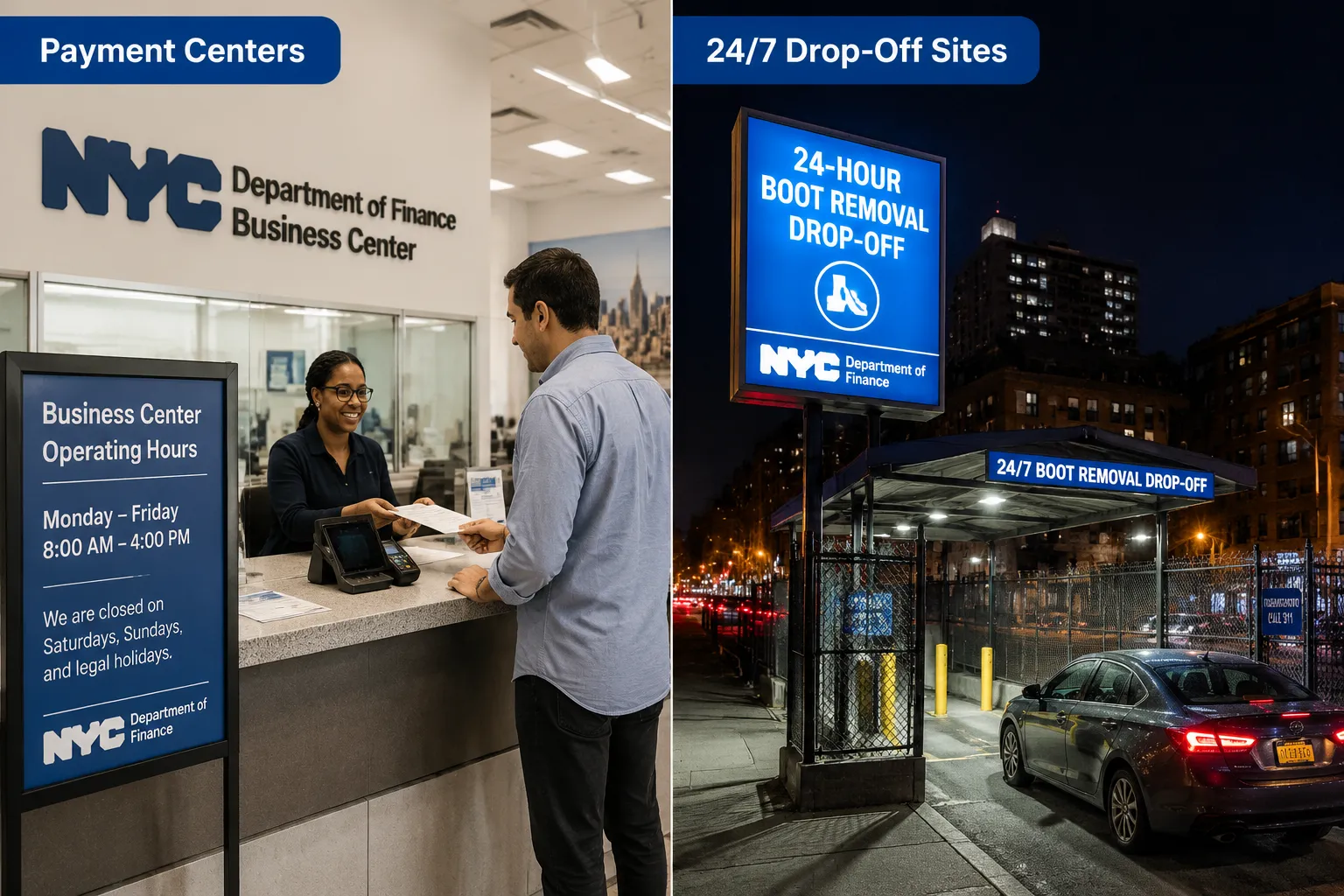
    In-Person Payment (Weekdays 8:30 AM, 4:30 PM): Visit any NYC Department of Finance Business Center to pay in person [7]

    Once payment clears, you receive a release authorization number. You must then drive (carefully, with the boot still attached) to an authorized drop-off location to have the boot physically removed.

    Boot Removal Drop-Off Locations and Hours

    After receiving your authorization number, you must visit a Republic Immobilization Services drop-off site to have the boot removed [3].

    Drop-Off Site Operating Hours

    24-Hour Locations (most common): Many drop-off sites operate continuously, allowing immediate removal any time of day or night [1]

    Limited-Hour Locations: Some sites maintain business-hour schedules (typically 8 AM, 6 PM weekdays) [3]

    Critical: Verify your nearest drop-off location’s hours before driving there. The authorization number you receive will include the closest site address and contact information.

    Removal Process

    1. Drive slowly to the drop-off location (the boot allows limited movement)
    2. Present your authorization number to the attendant
    3. Wait while the technician removes the boot (typically 5-15 minutes)
    4. Inspect your wheel for any damage before leaving

    Do not attempt to remove the boot yourself. Tampering with or damaging a boot is a criminal offense and will result in additional fines and potential arrest [2].

    Removal Process

    How to Avoid Getting Booted: Proactive Strategies

    Prevention is always cheaper than cure. Follow these strategies to stay off the boot list:

    Monitor Your Violation Status Weekly

    Check your parking ticket balance every week at the NYC DOF website. Set a calendar reminder. Judgment debt accumulates silently, by the time you notice, you may already be boot-eligible.

    Pay or Dispute Tickets Immediately

    You have 30 days to pay or dispute a parking ticket before it enters judgment [2]. Once in judgment, penalties increase and boot eligibility begins.

    For guidance on challenging unfair citations, visit our Tickets & Disputes resource hub.

    Use Real-Time Alternate Side Parking Alerts

    Street-cleaning violations are the most common path to boot eligibility. Stay informed with live ASP status:

    Consider Off-Street Parking for High-Risk Periods

    If you’re close to the $350 threshold and need time to resolve tickets, use secure off-street parking temporarily. Explore NYC Parking Directory for garage options across all boroughs.

    Understand No Standing Rules

    Many drivers confuse «No Parking» with «No Standing.» Learn the critical differences in our guide: What Does No Standing Mean in NYC?

    Boot vs. Tow: Understanding the Enforcement Escalation

    Booting is the first stage of NYC’s scofflaw enforcement ladder [6]:

    Stage 1: Boot Vehicle immobilized in place; 48-hour payment window; $136 boot fee

    Stage 2: Tow After 48 hours, vehicle towed to impound; $185+ towing fee plus $20/day storage

    Stage 3: Auction After 10 days unclaimed, vehicle sold at public auction; all debt transferred to owner’s record

    The city’s goal is revenue collection, not vehicle seizure. Pay within 48 hours and you’ll avoid the tow-and-storage cascade that can triple your total cost [6].

    For more on the towing process, see our Towing & Impounds articles.

    Frequently Asked Questions

    Can they boot my car on a Sunday? Yes. While enforcement is less common on weekends, boots can legally be placed any day if your vehicle is identified as a scofflaw [1].

    What if I’m in the car when they try to boot it? If you’re present and the boot is not yet installed, you may be able to drive away. Once the boot is locked, you cannot leave and must follow the payment process [2].

    Can I get booted for one unpaid ticket? No. You need $350 or more in judgment debt to become boot-eligible [1]. A single ticket will not trigger booting.

    How long does boot removal take after I pay? Online and phone payments post immediately, and you receive an authorization number within minutes. Physical removal at a drop-off site takes 5-15 minutes [1].

    What if I can’t afford to pay the full amount? NYC offers payment plans for judgment debt. Contact the Department of Finance at 646-517-1000 to discuss installment options. However, the boot will not be removed until full payment is made [9].

    Do boots damage my car? Properly installed boots should not damage your vehicle. If you notice wheel or tire damage after removal, document it immediately and file a claim with the Department of Finance [2].

    Conclusion

    What time do they boot cars in NYC? The answer is: anytime your vehicle is found with $350+ in judgment debt, though enforcement is most active 7 AM, 7 PM on weekdays. There is no fixed «boot time», only eligibility thresholds and patrol patterns.

    Take action now:

    1. Check your violation status at the NYC DOF website today
    2. Pay or dispute any outstanding tickets within 30 days
    3. Set up Alternate Side Parking alerts to avoid street-cleaning violations
    4. Bookmark payment and removal resources so you’re prepared if booted
    5. Explore off-street parking options if you’re close to the $350 threshold

    Stay ahead of judgment debt, monitor suspension calendars, and use real-time ASP status tools to avoid fines and towing. For more parking guidance, visit the Park Rules Live Blog and explore our New York City Articles for neighborhood-specific tips.

    References

    [1] Services Booting – https://www.nyc.gov/site/finance/vehicles/services-booting.page [2] Article – https://portal.311.nyc.gov/article/?kanumber=KA-02054 [3] Vehicle Booting – https://www.risnyc.com/vehicle-booting/ [6] Nyc Boot Tow Guide – https://clearplates.com/insights/nyc-boot-tow-guide [7] Contact Us By Visit – https://www.nyc.gov/site/finance/about/contact-us-by-visit.page [9] Contact Us – https://www.nyc.gov/site/finance/about/contact-us.page