Etiqueta: asp suspension

  • How to Read Alternate Side Parking Signs in NYC (With Examples)

    How to Read Alternate Side Parking Signs in NYC (With Examples)

    Misreading a sign is one of the most common ways NYC drivers end up with a ticket. A single alternate side parking sign can hold three or four overlapping rules stacked on top of each other, and getting one detail wrong, a day, a time, an arrow, is often the difference between a free parking spot and a fine. Understanding how to read an alternate side parking sign is not optional knowledge for NYC drivers; it is survival skill.

    This guide breaks down exactly what every symbol, day, and time window on an alternate side parking sign means, walks through real-world sign combinations you will actually encounter, and explains how holidays, and weather suspensions change the rules on any given day.

    Key Takeaways

    • An alternate side parking sign uses a broom symbol to signal «No Parking» during street-cleaning hours, not an all-day ban.
    • Most residential blocks post two cleaning windows per week, often around 90 minutes each.
    • Multiple signs on one pole must be read together, a suspended ASP sign does not cancel a separate «No Standing» or metered-parking sign below it.
    • NYC provides a 5-minute grace period for ASP and meter violations, but do not plan your parking around it.
    • Holidays, snow emergencies, and city-ordered suspensions can cancel ASP for the day, always confirm live status before assuming a sign’s printed schedule applies.

    What an Alternate Side Parking Sign Actually Means

    An alternate side parking sign exists to enforce street cleaning. The city sweeps streets on a rotating schedule, and the sign tells drivers when they must move their car so the mechanical broom can pass. Outside those posted windows, the same spot is typically legal for parking, unless another sign on the same pole says otherwise.

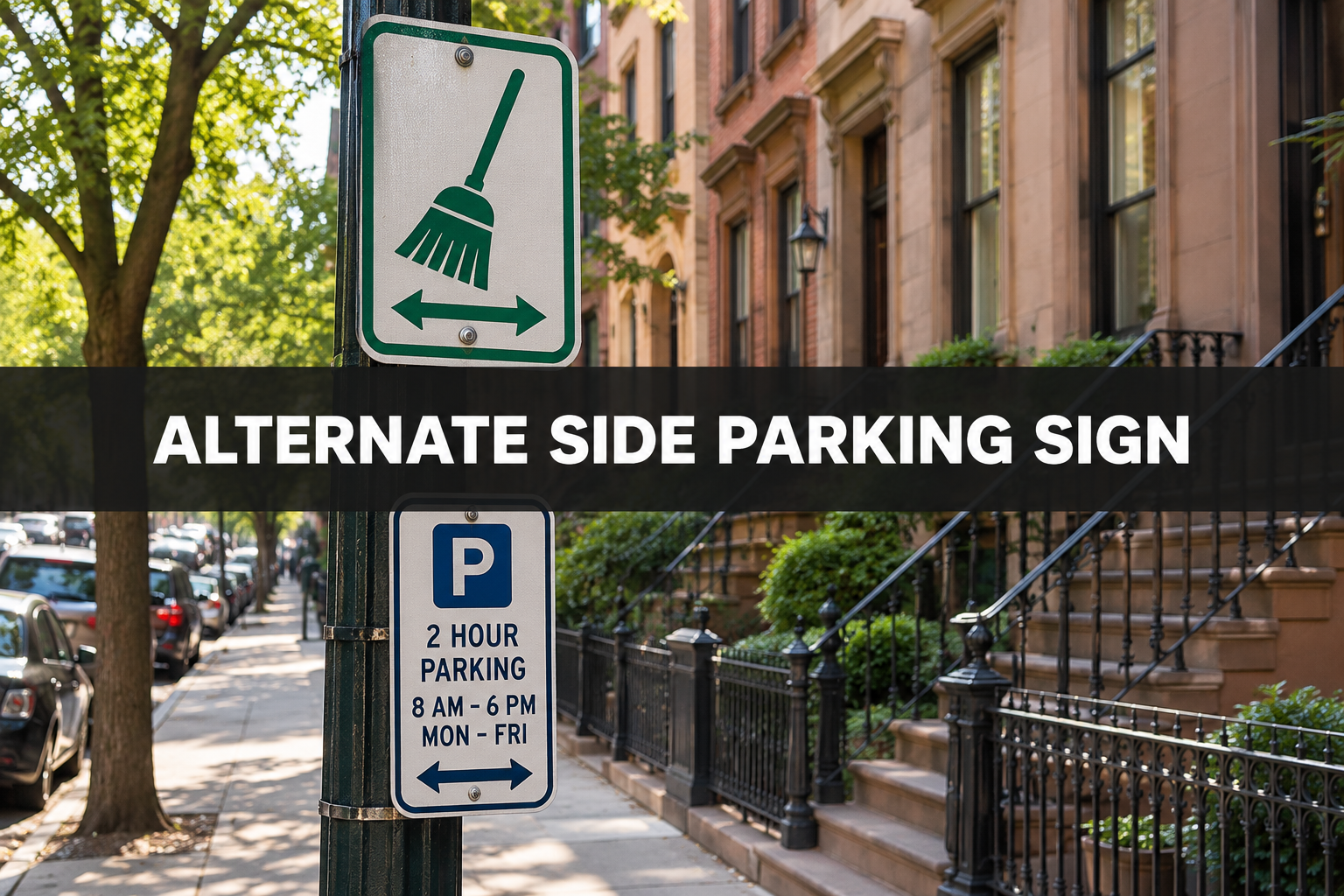
    The key visual cue is the broom icon, usually paired with the words «No Parking» and a specific day/time range. This is legally distinct from a generic «No Parking» sign without a broom symbol, which may apply for different reasons (loading zones, commercial vehicle restrictions, etc.) and follow different hours. If you do not see the broom, you are not looking at an ASP sign at all.

    Decoding the Broom Symbol and Text

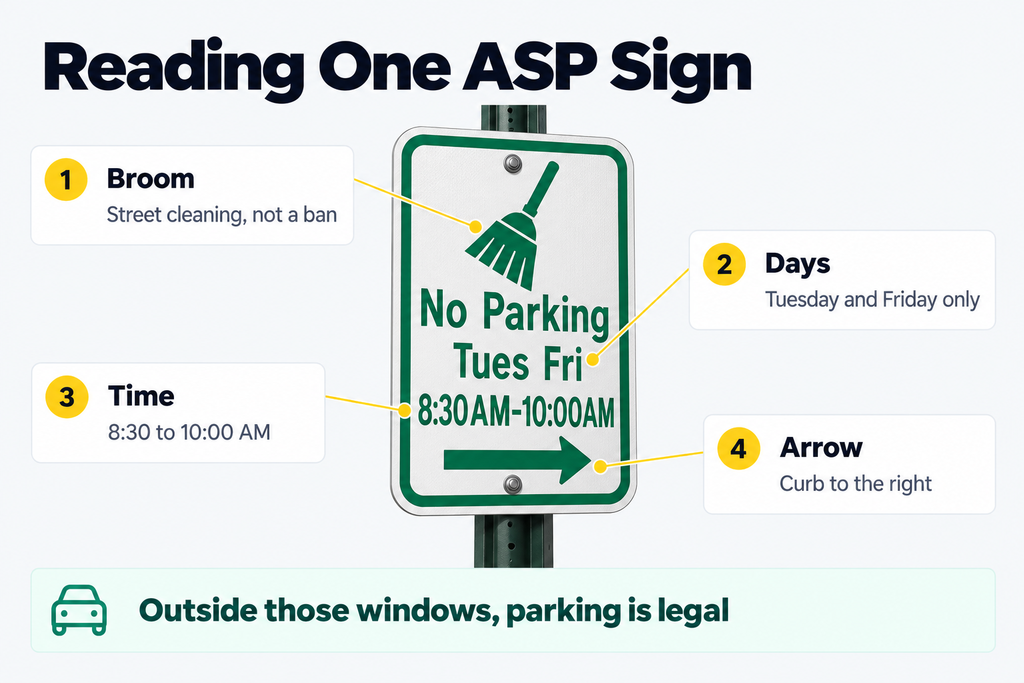
    A standard alternate side parking sign includes:

    1. The broom icon, confirms this is a street-cleaning rule, not a general parking ban.
    2. «No Parking» text, the restriction type during the posted window.
    3. Day(s) of the week, for example, «Mon Thu» meaning Monday and Thursday.
    4. Time range, for example, «9:00AM, 10:30AM,» showing exactly when the restriction is active.
    5. Arrows, pointing left, right, or both directions, indicating which section of curb the sign governs. A single sign rarely covers an entire block; arrows mark the boundary where the rule starts or stops.

    «If you only remember one thing about alternate side parking signs: the broom means street cleaning, and street cleaning is temporary, not permanent.»

    Step-by-Step: How to Read a Typical ASP Sign
    Step-by-Step: How to Read a Typical ASP Sign

    Follow this sequence every time you approach a sign:

    1. Find the broom icon. If present, this is an alternate side parking sign tied to sanitation.
    2. Identify the days listed. Many residential blocks use two-day patterns (Monday/Thursday or Tuesday/Friday) to split the street into cleaning cycles.
    3. Read the time window carefully. Standard residential ASP windows often run about 90 minutes, though commercial corridors may have longer or multiple windows.
    4. Check the arrows. Confirm the sign applies to the stretch of curb where your car is parked, not the adjacent block.
    5. Look for a second sign on the same pole. Many poles carry a combination of ASP plus meter rules, «No Standing,» or «No Stopping» restrictions.
    6. Cross-reference the date. Determine whether today is a suspension day (holiday, weather emergency, or declared suspension).

    Worked Example 1: Basic ASP Only

    Sign reads: Broom symbol, «No Parking,» «Tues Fri,» «8:30AM, 10:00AM,» arrow pointing right.

    Interpretation: On Tuesdays and Fridays only, between 8:30 and 10:00 AM, parking is prohibited on the curb to the right of the sign. Outside those two windows, including all day Monday, Wednesday, Thursday, Saturday, and Sunday, and outside the 8:30-10:00 window on Tuesday/Friday, parking is legal here, assuming no other restriction applies.

    Worked Example 2: ASP Plus Metered Parking

    Sign reads: Top sign, broom symbol, «No Parking, Mon Thu, 11:30AM, 1:00PM.» Bottom sign, «Muni-Meter Parking, 8AM, 7PM except Sunday.»

    Interpretation: This spot is metered most of the day, but during the Monday/Thursday street-cleaning window, the ASP rule overrides the meter, you cannot park there even if you pay. Outside that window, normal meter rules and payment apply.

    Worked Example 3: ASP Plus No Standing

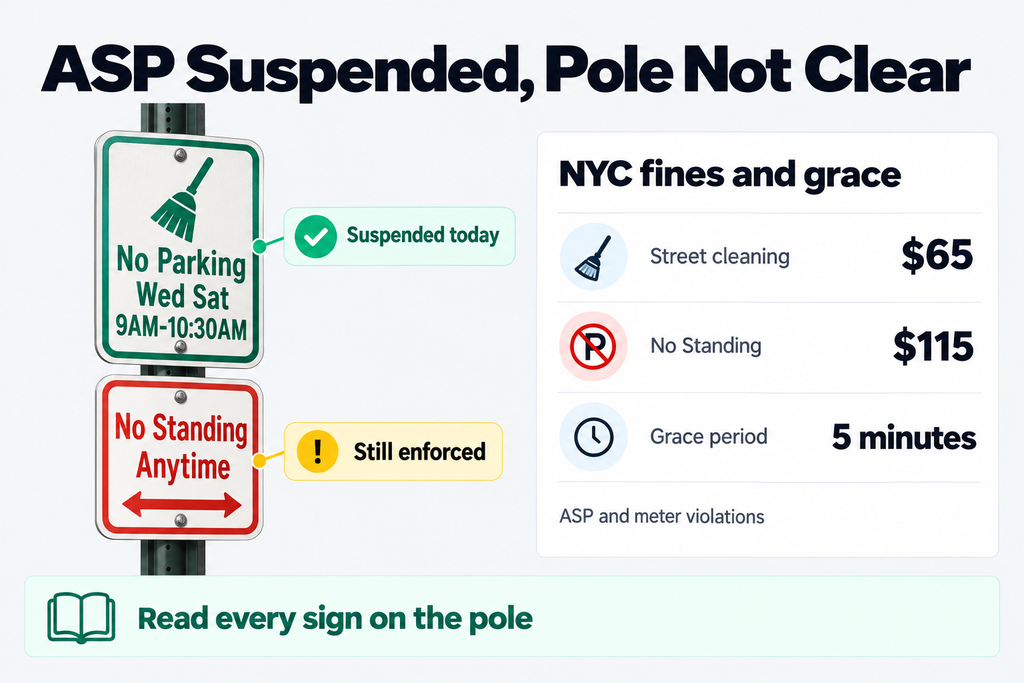
    Sign reads: Top sign, broom symbol, «No Parking, Wed Sat, 9AM, 10:30AM.» Bottom sign, «No Standing Anytime.»

    Interpretation: The «No Standing Anytime» sign controls here at all times, including outside the ASP window. The street-cleaning sign is essentially redundant for parking purposes since standing is never allowed regardless of the day. This combination is common near bus stops, fire hydrants, or corners. For a deeper look at the rules, read what «No Standing» means in NYC.

    Worked Example 4: ASP Plus No Stopping

    Sign reads: Broom symbol, «No Parking, Mon Wed Fri, 8AM, 9AM,» combined with «No Stopping 4PM, 7PM» lower on the pole.

    Interpretation: Two separate restricted windows exist on the same curb for different reasons. Mornings are governed by street cleaning; the evening rush-hour window is a no-stopping zone unrelated to sanitation. A driver must track both time blocks independently.

    How Holidays and Suspensions Affect an Alternate Side Parking Sign

    The printed schedule on an alternate side parking sign assumes a normal business day. It does not automatically apply on:

    • Official NYC holidays, the city publishes an annual calendar (updated for 2026) listing which holidays suspend ASP citywide.
    • Snow emergencies or weather events, the Department of Sanitation can suspend ASP on short notice when plows need the streets, sometimes with same-day notice.
    • Religious observances, ASP is suspended on various designated dates throughout the year.

    When ASP is suspended, the broom-symbol sign is paused for that day only, it does not disappear and does not cancel any other sign on the same pole. This is the single most common point of confusion: a driver sees «ASP suspended today» and assumes the whole pole is clear, then gets ticketed under a separate No Standing or metered rule that was never suspended.

    Practical rule: When ASP is suspended, read the other sign on the pole. That second sign is still fully active and enforceable. Our complete guide to NYC alternate side parking rules covers the full rulebook.

    Past Pilot: Once-a-Week ASP in Prospect Heights

    From August 3 to September 25, 2026, the Department of Sanitation tested once-a-week street cleaning on several blocks of Prospect Heights, Brooklyn, between Eastern Parkway and Atlantic Avenue. Drivers only had to move their cars on the second day listed on the sign. DSNY ended the pilot without making it permanent after compliance fell from 73% to 62%, and affected drivers go back to moving their cars twice a week. The lesson is simple: read the sign actually posted on your block, and check the live status for your neighborhood, such as Park Slope or Williamsburg.

    Ticket Risk and the Grace Period
    Ticket Risk and the Grace Period

    NYC law provides a 5-minute grace period for alternate side parking and parking meter violations. Treat it as a safety margin, not a right you can demand on the spot, and do not rely on it as a parking strategy.

    The fine for an alternate side parking (street cleaning) violation is $65 citywide, according to the NYC Department of Finance. A general No Standing violation (code 14) is $115. Always check your actual summons for the exact violation code and amount.

    Violation Type Common Trigger Fine (NYC DOF)
    Street cleaning (ASP) Parked during posted broom-symbol window $65
    No Standing Parked at any time in a no-standing zone $115

    Fine amounts are set by violation code, so confirm the exact figure on your summons. For current penalties and next steps, see our NYC parking ticket fine guide and the walkthrough on how to fight a parking ticket.

    How to Double-Check with Official Sources

    Because suspensions and holiday schedules change throughout the year, the printed sign alone is not always enough. Before relying solely on the pole:

    • Check the NYC Department of Transportation’s official sign legend and street parking map for your exact block.
    • Review the Department of Sanitation’s current-year ASP holiday suspension calendar.
    • Confirm there is no active weather-related suspension announced for that day.
    • When in doubt, verify real-time status rather than guessing from memory.

    Check Live ASP Status Before You Park

    Reading a sign correctly is only half the battle, knowing whether today’s rules are even active is the other half. For real-time alternate side parking status across New York City neighborhoods, visit the live NYC alternate side parking status page before you leave your car for the day.

    Conclusion

    An alternate side parking sign is a layered piece of information: a broom icon signaling street cleaning, specific days and times, directional arrows, and often a second sign governing standing, stopping, or meter rules. Misreading any single element, or assuming a suspension clears the entire pole, is how avoidable tickets happen. The safest approach is methodical: identify the broom, confirm the days and times, check the arrows, read every sign on the pole, and verify today’s suspension status before you walk away. When schedules shift due to holidays or weather, a quick check of live, current-day status takes the guesswork out of parking in New York City. Browse more ASP guides or find a garage on our NYC parking directory when you would rather skip street cleaning altogether.
  • Safe Places to Park in NYC: Official Guide to Avoiding Fines and Towing in 2026

    Safe Places to Park in NYC: Official Guide to Avoiding Fines and Towing in 2026

    New York City towed more vehicles for illegal parking in 2026 than any year on record, with drivers losing an average of $400 per incident between fines, towing fees, and impound storage. Every single block in NYC is a designated tow-away zone, meaning one misread sign or overlooked rule can cost you hundreds and hours of recovery time[8]. Finding truly safe places to park in NYC isn’t about luck, it’s about understanding official regulations, tracking real-time Alternate Side Parking status, and choosing locations that minimize citation risk.

    Key Takeaways

    • All of NYC is a tow-away zone; safe parking requires strict adherence to posted signs, ASP schedules, and state law
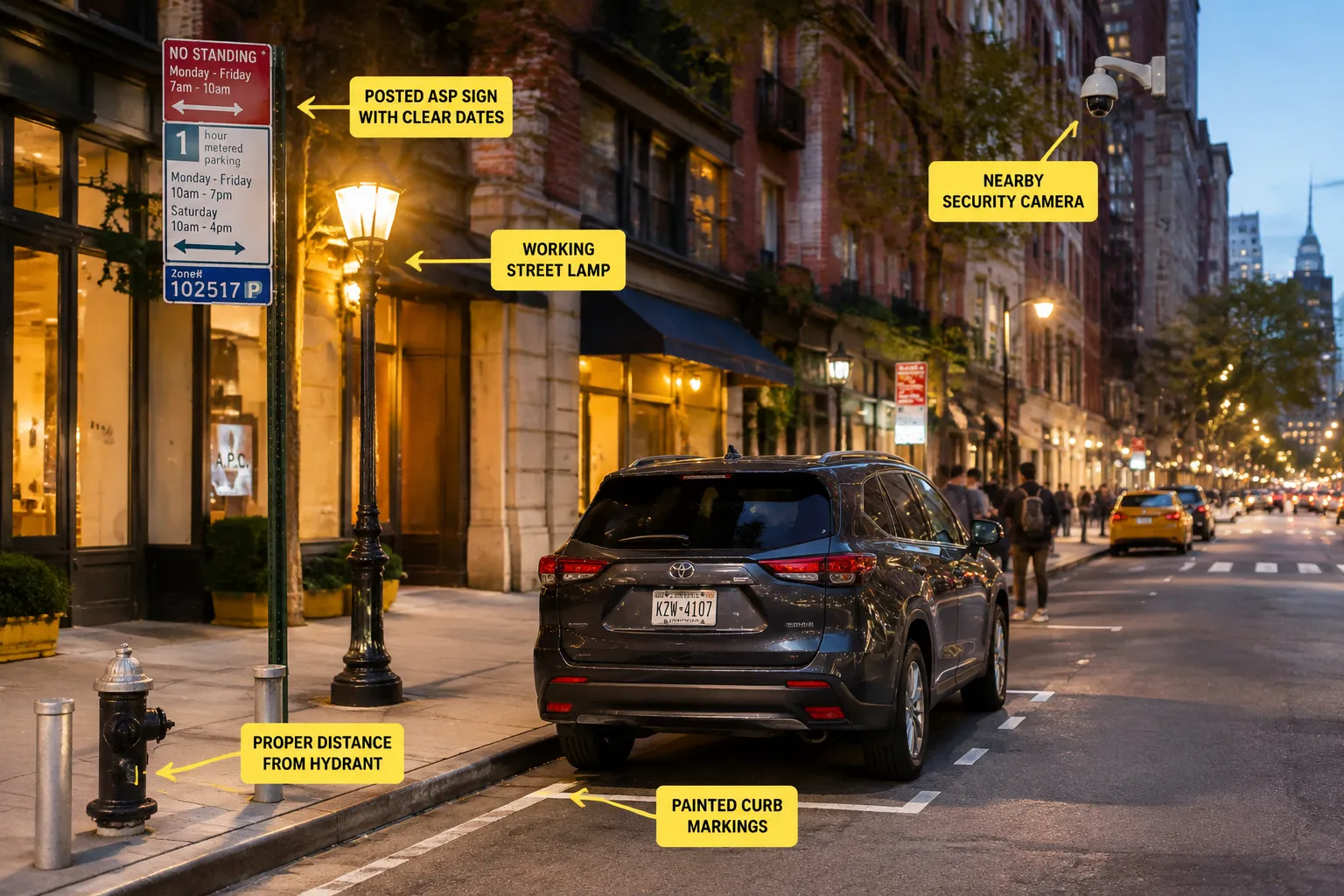
    • The 15-foot fire hydrant rule remains the most violated safety regulation, with painted curbs offering no legal protection
    • Real-time ASP suspension tracking is essential; street cleaning violations account for thousands of tickets monthly
    • Off-street garages and legal metered spaces offer the lowest-risk parking, while cone-reserved spots and bike lanes carry immediate citation exposure
    • Enforcement is shifting from NYPD to DOT in 2026, with increased focus on safety-critical violations like blocking bike lanes and crosswalks

    Understanding What Makes Parking «Safe» in NYC

    Safe places to park in NYC are defined by legality first, security second. The NYC Department of Transportation emphasizes that all five boroughs operate as tow-away zones, meaning any vehicle parked illegally, with expired registration, or missing inspection stickers can be towed immediately without warning[8].

    «Safe» parking means:

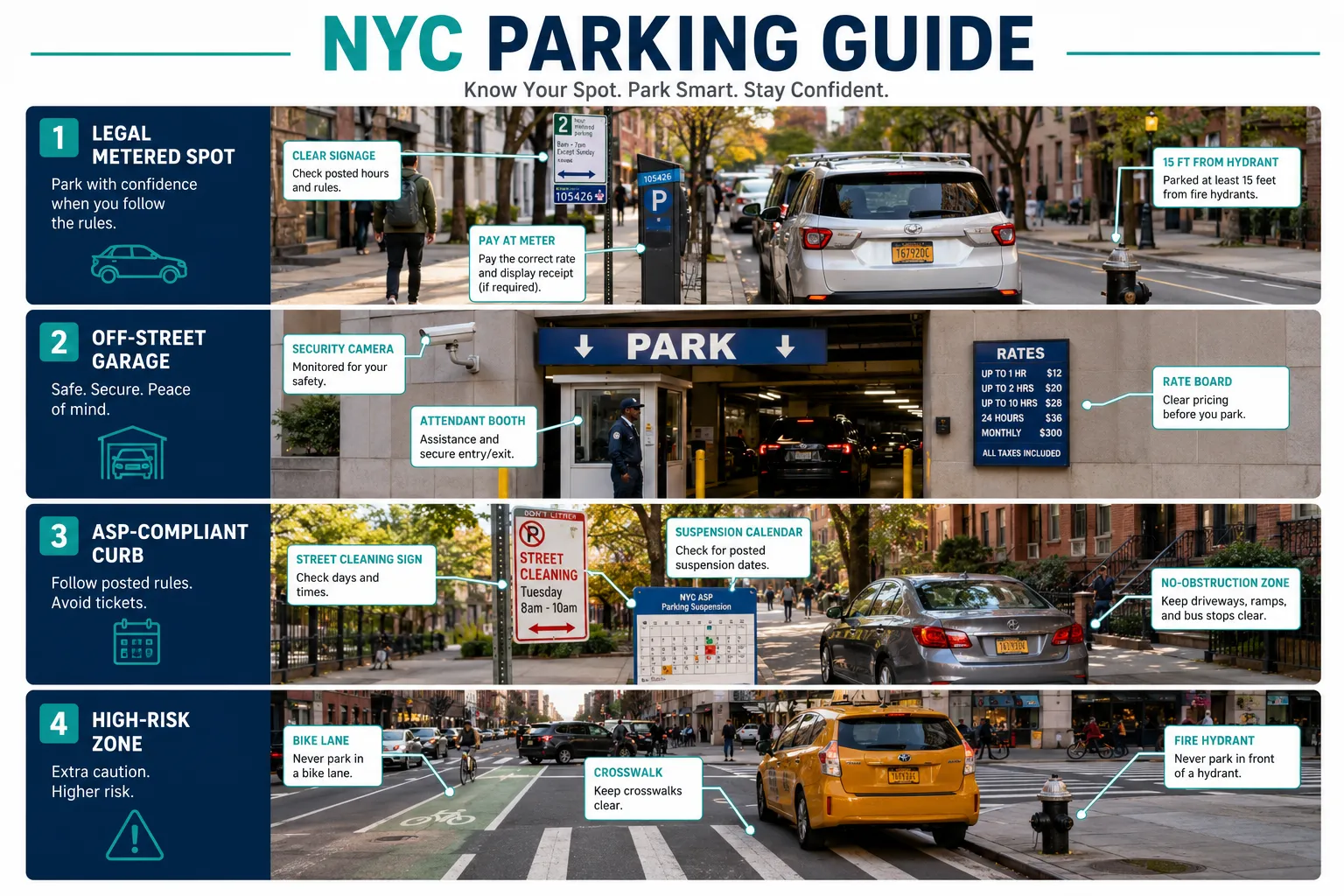
    • Full compliance with posted signage: Every sign on the block applies to your spot
    • Adherence to Alternate Side Parking rules: Active ASP windows trigger $65 fines and potential towing
    • Respect for safety zones: 15 feet from hydrants, no blocking crosswalks, bus stops, or bike lanes
    • Valid registration and inspection: Vehicles with temporary plates or expired documents attract scrutiny[4]

    The 2026 parking regulations updated in August make clear that double parking of passenger vehicles is illegal at all times, including during street cleaning operations[8]. Painted curbs near fire hydrants are not reliable legal indicators, drivers must estimate or measure the 15-foot distance themselves, as violations carry $115 fines[5][8].

    Understanding What Makes Parking "Safe" in NYC

    Top Safe Places to Park in NYC: Borough-by-Borough Breakdown

    Manhattan: Metered Spots and Managed Garages

    Manhattan has fewer than 190,000 free street parking spots, creating intense competition and enforcement pressure[11]. The safest parking options prioritize:

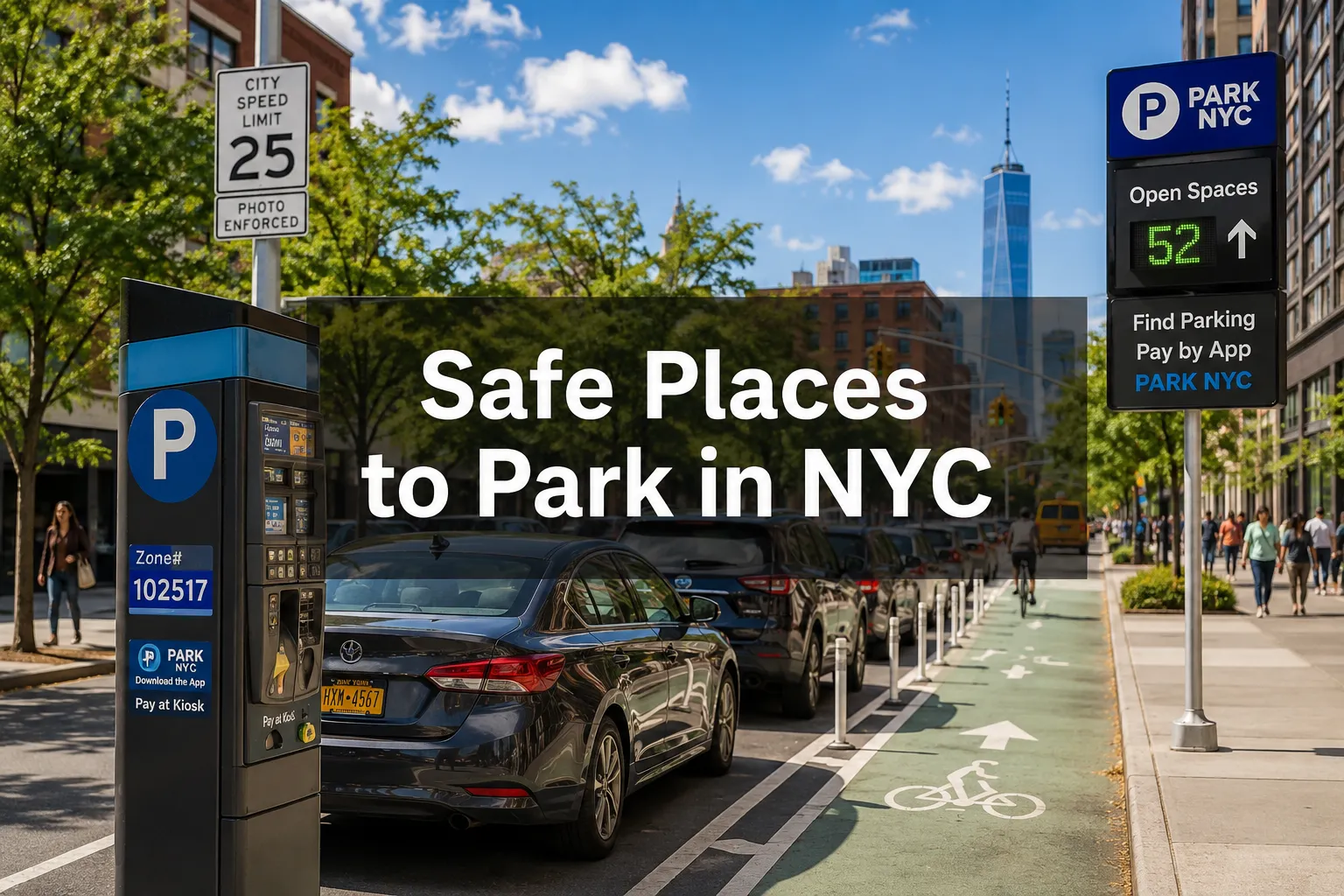
    Legal Metered Spaces: Use the ParkNYC app to extend sessions and avoid overstay violations. Metered spots with clear signage and digital payment options reduce misunderstanding risk[5][10].

    Managed Off-Street Facilities: Professional garages like MPG: Manhattan Parking and Public Parking – 1440 Amsterdam Garage offer attended security, surveillance, and zero citation risk.

    Upper Manhattan Residential Blocks: Areas with straightforward ASP schedules (Monday/Thursday or Tuesday/Friday patterns) and minimal commercial traffic offer safer street parking when ASP is suspended.

    Avoid: Blocks with DIY cone «reservations,» which trigger illegal obstruction summonses for both the cone placer and any driver who parks improperly around them[7][10].

    Brooklyn: Neighborhood-Specific ASP Compliance

    Brooklyn parking requires hyper-local ASP tracking. Safe places to park in NYC’s most populous borough include:

    Park Slope During Suspensions: Check real-time ASP status for Park Slope before committing to curbside parking. Suspensions for holidays and snow operations create multi-day safe windows[2][9].

    Greenpoint Commercial Meters: Well-marked metered spots near commercial corridors offer clear signage and frequent turnover. Track Greenpoint ASP status to avoid cleaning-day conflicts.

    Managed Lots: Facilities like Park Here Corporation and Stable Car Parking Incorporated eliminate street-rule complexity.

    Brooklyn saw the highest volume of tickets tied to illegal cone-placement «parking scams» in January 2026, making blocks with visible spot-saving attempts high-risk zones[7].

    Bronx: Off-Street Facilities and Residential Compliance

    The Bronx parking landscape offers more off-street options than Manhattan, reducing citation exposure:

    Established Garages: Quik Park, Estrella Parking, and Zoom Parking Corporation provide secure, legal parking with no ASP concerns.

    24-Hour Facilities: Parking 24 Hours Parkchester and Sherman Parking serve overnight and extended-stay needs.

    Residential Streets with Clear ASP: Outer Bronx neighborhoods with simple two-day ASP schedules and low commercial density offer safer street parking when suspensions are active.

    Queens: Airport Proximity and Neighborhood Meters

    Queens parking varies dramatically by neighborhood:

    Flushing Commercial Districts: Parking in Flushing includes metered spots and managed facilities like Skyview Parking Lot near transit hubs.

    Astoria Metered Zones: Astoria parking offers well-marked meters and facilities like Astoria Parking Management. Check Astoria ASP status before street parking.

    Airport-Adjacent Lots: Jamaica JFK Discount Parking and similar facilities serve travelers needing extended safe storage.

    Staten Island: Residential and Commercial Balance

    Staten Island parking combines suburban-style availability with NYC enforcement standards. Managed facilities like Huguenot Parking offer secure options, while residential blocks with infrequent ASP schedules provide safer street parking during suspensions.

    Staten Island: Residential and Commercial Balance

    Alternate Side Parking: The Key to Safe Street Parking

    Alternate Side Parking violations account for thousands of monthly tickets because drivers fail to track suspension calendars and active cleaning windows[2][14]. Safe places to park in NYC require real-time ASP monitoring.

    How ASP Suspensions Create Safe Parking Windows

    The official 2026 ASP calendar lists scheduled suspensions for holidays and religious observances[2]. Additional suspensions occur for:

    • Snow operations: February 2026 saw multiple emergency ASP suspensions through February 8 and February 10 to facilitate plowing[14][15]
    • Major holidays: Independence Day 2026 suspended ASP for July 3-4, creating a two-day safe window[2][9]
    • Emergency declarations: Weather and municipal events trigger unscheduled suspensions

    During suspensions, drivers do not need to move vehicles for street cleaning. However, all other rules, hydrant distances, crosswalk clearances, bus lane restrictions, remain fully enforceable[8][9].

    Real-Time ASP Status Tools

    Check status before parking:

    • Official DOT suspension announcements: Posted at nyc.gov/dot and via 311 alerts
    • Neighborhood-specific trackers: Monitor local ASP status for precise compliance
    • Mobile alerts: Set phone reminders for ASP windows and meter expirations[5][10]

    Explore the Parking Education Hub for comprehensive guides on suspension calendars and citation avoidance.

    High-Risk Parking Zones to Avoid

    Certain locations guarantee citations or towing, regardless of posted signs:

    Safety-Critical Violations

    • Within 15 feet of fire hydrants: $115 fine; painted curbs are not legal indicators[5][8]
    • Blocking bike lanes: Increasingly enforced as DOT assumes parking oversight[1][13]
    • Bus stops and bus lanes: $115 fine plus potential towing[5]
    • Crosswalks and intersections: $115 fine; blocks pedestrian access[8]

    Illegal Spot-Saving and Obstruction Zones

    January 2026 investigations revealed record ticket volumes tied to illegal cone placement[7]. Blocks with visible DIY «reserved» spots using cones, chairs, or barriers are high-risk because:

    • Placing objects on the street is illegal obstruction
    • Parking around improperly placed items can trigger summonses
    • Enforcement targets both the obstruction placer and any driver benefiting from it[7][10]

    Travel Lanes and Double Parking

    Double parking of passenger vehicles is illegal at all times, including during ASP operations[8]. Parking in travel lanes often results in immediate towing plus fines[5].

    Enforcement Shifts and 2026 Policy Changes

    DOT Takeover of Parking Enforcement

    Multiple NYC community boards voted in March and April 2026 to shift parking enforcement from NYPD back to DOT, arguing that police have not prioritized street safety[1][13]. If implemented citywide, expect:

    • Increased focus on safety violations: Blocking bike lanes, bus lanes, and crosswalks will attract more citations
    • Systematic enforcement: DOT may deploy automated systems and dedicated enforcement teams
    • Higher fine collection rates: Specialized parking enforcement historically issues more citations than NYPD patrol

    Shame Stickers for Repeat Violators

    The City Council reauthorized neon adhesive «shame stickers» in July 2026 for chronic bad parkers[12]. These stickers target:

    • Vehicles repeatedly violating ASP rules
    • Cars blocking street sweepers
    • Drivers with multiple unpaid citations

    The policy aims to deter repeat violations in high-turnover cleaning zones.

    Enhanced Plate Verification

    City Council measure Int 0550-2026 requires NYPD to verify license plates and VINs for vehicles with temporary plates or outstanding summonses, publishing quarterly enforcement reports[4]. This scrutiny makes parking with legitimate, properly registered plates in well-marked legal spaces more critical than ever.

    Practical Strategies for Finding Safe Places to Park in NYC

    Walk the Entire Block

    Many tickets result from missing one sign on the block[5][10]. Before committing to a spot:

    • Read every sign from corner to corner
    • Note overlapping restrictions (metered + ASP + time limits)
    • Verify hydrant distances by walking 15 feet (approximately 5 adult paces)

    Use Digital Payment and Alerts

    The ParkNYC app allows meter extensions without returning to your vehicle, reducing overstay violations[5][10]. Set phone alarms for:

    • Meter expirations
    • ASP window starts
    • Street cleaning schedules

    Subscribe to Official Calendars

    Official suspension calendars and 311 alerts provide advance notice of safe parking windows[2][6]. Subscribe to:

    • DOT ASP suspension announcements
    • Borough-specific parking newsletters
    • Neighborhood community board alerts

    Choose Off-Street When Possible

    Professional garages eliminate citation risk, ASP complexity, and security concerns. Compare rates through the NYC Parking Directory to find cost-effective managed facilities.

    Understand Typical Fine Levels

    Common violations carry predictable penalties[5]:

    • Expired meter: $50-$65
    • ASP violation: $65
    • Hydrant, bus stop, bike lane, crosswalk: $115
    • Travel lane parking: Fine plus towing (typically $400+ total)

    From a risk perspective, parking near hydrants, bus stops, or in ambiguous travel lanes is financially high-risk, while clearly signed legal meters and garages are comparatively safer choices.

    Resources for Tickets, Disputes, and Towing Recovery

    Fighting Unfair Parking Citations

    If you receive an unfair citation, the Tickets & Disputes resource hub provides:

    • Step-by-step dispute filing guides
    • Evidence collection checklists
    • Common defense strategies for ASP, meter, and signage violations

    Towed Vehicle Recovery

    If your vehicle is towed, act immediately to minimize storage fees. The Towing & Impounds guide covers:

    • Locating your towed vehicle through official NYC systems
    • Required documentation for release
    • Contesting wrongful tows
    • Calculating total recovery costs

    ASP Education and Alerts

    The ASP Articles collection provides:

    • Detailed explanations of suspension calendars
    • Neighborhood-specific ASP schedules
    • Historical suspension patterns for planning
    • Real-time status checking procedures

    Citywide Parking Guides

    Explore New York City parking articles for comprehensive coverage of municipal rules, policy changes, and enforcement trends across all five boroughs.

    Conclusion

    Safe places to park in NYC in 2026 are defined by strict legal compliance, real-time ASP tracking, and strategic location selection. With all five boroughs operating as tow-away zones and enforcement shifting toward DOT oversight, drivers must prioritize:

    Immediate Actions:

    1. Check real-time ASP status before parking on any residential block
    2. Verify 15-foot distances from hydrants and avoid all safety-critical zones
    3. Use legal metered spots with ParkNYC app payment to reduce overstay risk
    4. Choose managed off-street garages for extended stays and overnight parking
    5. Subscribe to official suspension calendars and 311 alerts for advance notice

    Avoid High-Risk Zones:

    • Blocks with DIY cone «reservations» and illegal obstructions
    • Bike lanes, bus stops, crosswalks, and travel lanes
    • Areas within 15 feet of fire hydrants, regardless of painted curbs

    Leverage Official Resources:

    Explore the Parking Education Hub at Park Rules Live for real-time ASP status, suspension calendars, garage rate comparisons, and citation dispute guides. Access neighborhood-specific trackers for Brooklyn, Williamsburg, DUMBO, and dozens of other NYC neighborhoods to avoid fines and towing.

    Understand the rules. Check the status. Locate safe, legal parking. Avoid unfair parking citations and impounds by staying informed with official, real-time information.

    References

    [1] Parking Enforcement Nypd To Dot – https://clearplates.com/insights/parking-enforcement-nypd-to-dot [2] Asp Calendar 2026 – https://www.nyc.gov/html/dot/downloads/pdf/asp-calendar-2026.pdf [4] 0550 2026+ – https://intro.nyc/0550-2026+ [5] Nyc Parking Laws 2026 Guide To Rules Tickets And Street Signs – https://citychicliving.com/nyc-parking-laws-2026-guide-to-rules-tickets-and-street-signs/ [6] Alternate Side Parking – https://www.nyc.gov/html/dot/html/motorist/alternate-side-parking.shtml [7] Nyc Drivers Hit With Record Number Of Tickets In Parking Scam And This Borough Is Worst – https://nypost.com/2026/01/20/us-news/nyc-drivers-hit-with-record-number-of-tickets-in-parking-scam-and-this-borough-is-worst/ [8] Parking Regulations – https://www.nyc.gov/html/dot/html/motorist/parking-regulations.shtml [9] Nyc Parking Rules Fourth Of July – https://secretnyc.co/nyc-parking-rules-fourth-of-july/ [10] Avoid Parking Tickets Nyc The 2026 Survival Playbook – https://snagparking.app/avoid-parking-tickets-nyc-the-2026-survival-playbook/ [11] Parking wars in Manhattan – https://nypost.com/2026/03/15/us-news/parking-wars-in-manhattan/ [12] Shame stickers for chronic bad parkers – https://nypost.com/2026/07/10/us-news/shame-stickers-for-chronic-bad-parkers/ [13] Community boards vote to shift parking enforcement – https://clearplates.com/insights/parking-enforcement-nypd-to-dot [14] Suspension Of Alternate Side Parking Regulations Feb 23 26 – https://www.nyc.gov/html/dot/html/pr2026/suspension-of-alternate-side-parking-regulations-feb-23-26.shtml [15] Snow operations ASP suspensions – https://www.nyc.gov/html/dot/html/pr2026/suspension-of-alternate-side-parking-regulations-feb-23-26.shtml

  • How Much Parking Ticket NYC: Official 2026 Fine Amounts & Costs

    How Much Parking Ticket NYC: Official 2026 Fine Amounts & Costs

    New York City issued over 10 million parking tickets in fiscal year 2025, generating more than $500 million in revenue. Understanding how much parking ticket NYC violations actually cost can save drivers hundreds of dollars annually and prevent collections nightmares. Whether you’re a daily commuter navigating Alternate Side Parking rules or a visitor unfamiliar with Manhattan’s premium fine zones, knowing the exact dollar amounts for each violation type is essential to avoiding fines and towing.

    This guide breaks down official 2026 parking ticket costs across all five boroughs, explains borough-specific pricing differences, and shows you how to check Real-Time Status for street cleaning suspensions before you park.

    Key Takeaways

    • Expired meter fines range from $35 outside Manhattan to $65 in Manhattan, reflecting borough premium pricing for core commercial zones.
    • Street cleaning and Alternate Side Parking violations cost $65 citywide as of 2026, making them the most common mid-tier citation.
    • Serious curb violations like fire hydrant, bus stop, and double parking carry $115 fines, while blocking driveways costs around $95.
    • Disabled parking violations are the most expensive: $180 for parking in a disabled bay without a permit, and $250 or more for permit misuse.
    • Late payment adds cumulative penalties: $10 at 30 days, $20 at 60 days, $30 at 90 days, with judgment entered at 100 days triggering collections.

    How Much Parking Ticket NYC Violations Cost in 2026

    How Much Parking Ticket NYC Violations Cost in 2026

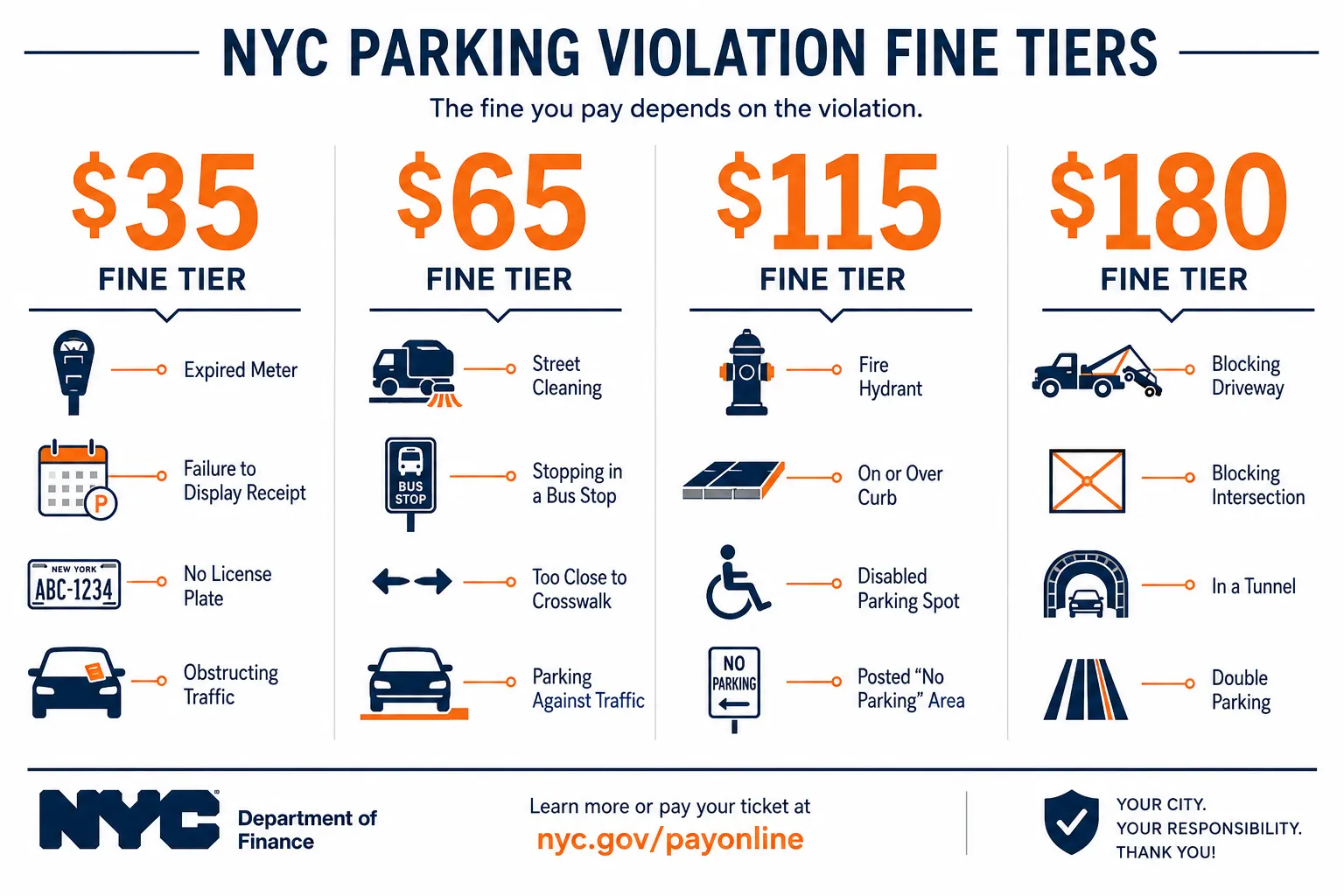
    Official fine amounts vary significantly by violation type and location. As of August 2026, consumer guides mirroring the NYC Department of Finance violation table show that the most common parking tickets fall into four main tiers.[1][2]

    Tier 1: Low-Level Meter & Time Violations

    Expired meter tickets cost $35 in the Bronx, Brooklyn, Queens, and Staten Island, but jump to $65 in Manhattan.[1][2][11] This borough premium reflects Manhattan’s high-demand commercial zones and the city’s strategy to discourage long-term street parking in core business districts.

    Tier 2: Street Cleaning & Alternate Side Parking

    Street cleaning violations and Alternate Side Parking tickets cost $65 across all five boroughs in 2026.[1][2][5][14] This flat citywide rate makes ASP violations one of the most predictable, and most frequently issued, citations. Check Status daily using real-time alternate side parking alerts to avoid these fines.

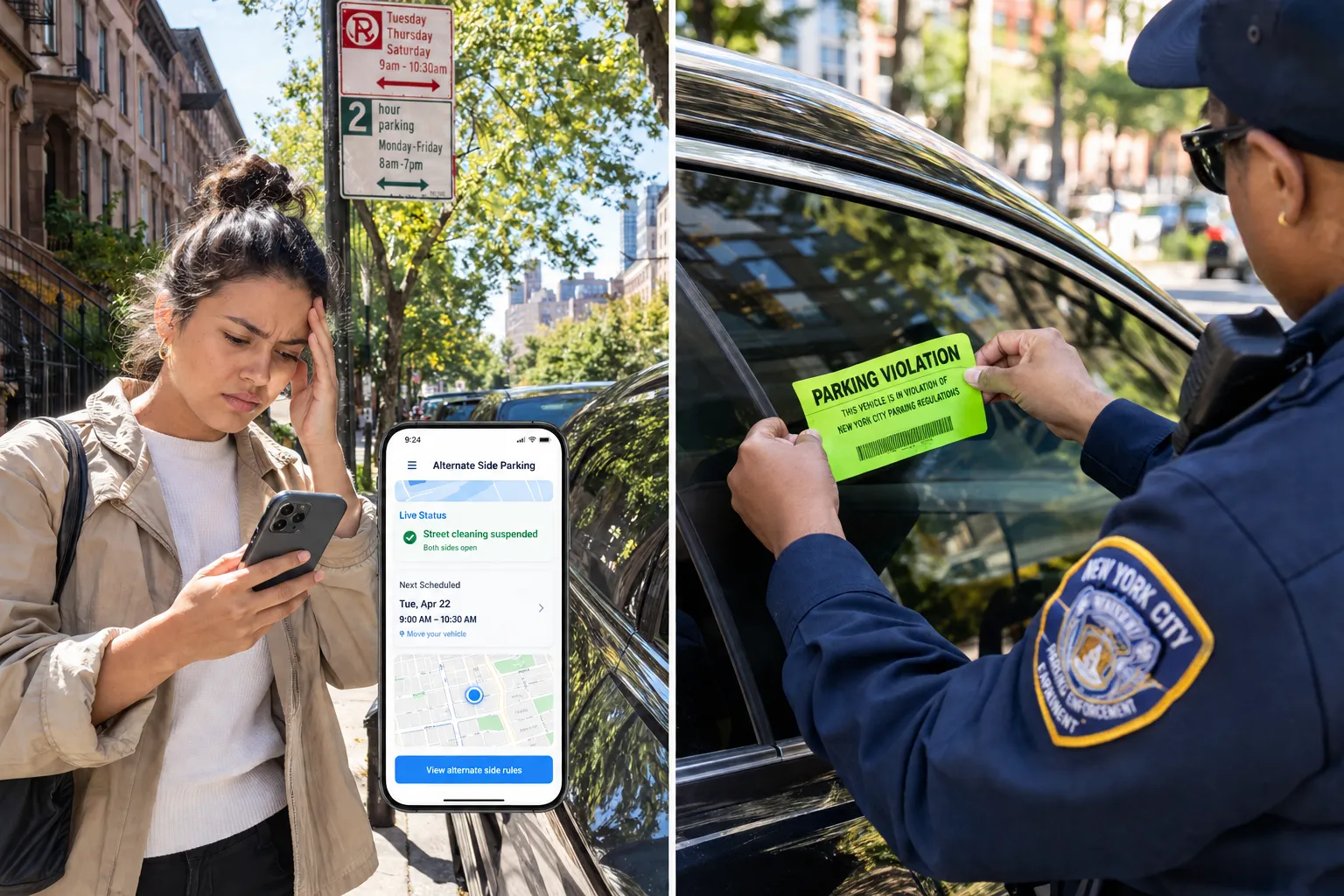
    In early August 2026, NYC brought back bright neon-green «shame» stickers for alternate-side violators, applied alongside the standard $65 ticket.[10][14] The stickers serve as a visual deterrent and public reminder of enforcement presence.

    Tier 3: No Parking & No Standing Zones

    Typical fines for «no parking» and «no standing» violations range from $65 to $115, depending on the specific code and whether the zone is commercial, rush-hour, or restricted at all times.[1][2][9][11] Manhattan locations often land at the higher end of this range.

    Tier 4: Serious Curb & Access Violations

    More serious curb-space violations carry steeper fines:

    • Fire hydrant parking: $115
    • Bus stop parking: $115
    • Double parking: $115
    • Crosswalk parking: $115
    • Sidewalk parking: $115
    • Blocking driveway: $95[1][2][6][11]

    Tier 5: Disabled Access Violations (Highest Fines)

    Parking related to disabled access carries the highest regularly issued fines:

    • Parking in a disabled bay without a valid permit: $180
    • Misuse of a disabled parking permit: $250 or more[1][2][9][11][15]

    These amounts reflect the city’s commitment to protecting accessible parking and deterring fraudulent permit use.

    An August 2026 comparison of major U.S. cities lists New York City’s typical parking fine range as $35,$180 per ticket, placing NYC near the top nationally for parking-ticket costs.[1][15]

    Understanding Late Fees, Penalties & Payment Deadlines

    The NYC Department of Finance’s guidance on parking and camera tickets, updated summer 2026, sets out clear late-payment penalties:[4]

    • 0-30 days: No additional charge if paid within 30 days of the ticket date
    • 30 days: Extra $10 penalty added
    • 60 days: Additional $20 penalty (cumulative with the 30-day fee)
    • 90 days: Additional $30 penalty (cumulative)
    • 100 days: Ticket enters judgment, triggering collections and enforcement actions[4]

    Once a ticket enters judgment, the city can boot or tow your vehicle, suspend your registration, and send the debt to collections agencies. Avoid fines and towing by paying or disputing tickets promptly.

    For guidance on contesting unfair parking citations, see our complete guide to fighting a double parking ticket in NYC.

    Official NYC Parking Fine Schedule & Violation Codes

    Official NYC Parking Fine Schedule & Violation Codes

    NYC’s official rules in RCNY §39-05 list base fine amounts that underpin the applied Department of Finance schedules:[7][8]

    • $100 for stopping where prohibited
    • $30 for general «parking where prohibited»
    • $20 for meter violations (base amount; actual applied fines are higher)
    • $150 for disabled-permit violations
    • $50 for street-cleaning violations (base amount; actual applied fine is $65)[7][8]

    These base amounts serve as the formal schedule, but the Department of Finance applies updated stipulated fine amounts that reflect inflation adjustments and policy changes. Always reference the current DOF violation table or official parking resources for the exact amount you’ll pay.[4]

    Fleet and data-analysis sources summarizing 2026 enforcement patterns note that the most common parking fines fall between $65 and $115, and that bus-lane camera fines escalate from $50 up to $250 per vehicle over a rolling 12-month period, reflecting a broader strategy of using escalating penalties for repeat offenders.[6][15]

    A newly published «Parking Violations Issued, Fiscal Year 2026» dataset (covering July 1, 2026 to June 30, 2027) provides granular records of individual tickets, violation codes, locations, and dates, giving researchers and fleets an authoritative way to analyze where and how often specific fine amounts are being applied.[12]

    How to Avoid Parking Tickets & Check Real-Time Alternate Side Parking Status

    Avoiding tickets starts with understanding when and where rules are in effect. Locate Real-Time Status for Alternate Side Parking suspensions before you park:

    • Check the live NYC alternate side parking status daily
    • Review suspension calendars for holidays and special events
    • Set alerts for your neighborhood to receive notifications of rule changes
    • Explore off-street parking options through the NYC parking directory to find garages and lots with competitive rates

    In August 2026, a new alternate-side parking pilot in Brooklyn caused confusion, with drivers receiving numerous $65 street-cleaning tickets due to poorly communicated rules.[5][14] This underscores the importance of checking official Real-Time Status rather than relying on memory or outdated signage.

    For drivers in other New York State cities, explore Yonkers alternate side parking rules, Buffalo alternate parking status, Rochester ASP rules, and Albany parking status for city-specific guidance.

    Tickets & Disputes: Fighting Unfair Parking Citations

    If you believe a ticket was issued in error, you have the right to dispute it. The NYC Parking Violations Bureau accepts online disputes through the official parking and camera tickets portal.[4]

    Common grounds for disputes include:

    • Incorrect violation code or location
    • Valid parking permit not visible to officer
    • Signage missing, obscured, or contradictory
    • Alternate Side Parking suspended on the ticket date
    • Vehicle already moved before ticket timestamp

    Submit disputes within 30 days to avoid late fees while your case is under review. For step-by-step guidance, visit our Parking Education Hub and read how to fight a double parking ticket in NYC.

    Off-Street Parking & Garage Savings Across NYC

    Off-street parking can be more cost-effective than risking tickets, especially in high-enforcement zones. Explore garage options across all five boroughs:

    Browse the full NYC parking directory to compare rates, hours, and locations. Many garages offer monthly rates that are cheaper than accumulating multiple street-parking tickets.

    For additional savings strategies, explore our parking garages & savings articles and learn about the best parking apps in NYC for 2026.

    Conclusion

    Understanding how much parking ticket NYC violations cost in 2026 is essential for every driver navigating the city’s complex parking rules. Fines range from $35 for an expired meter outside Manhattan to $250 or more for disabled-permit misuse, with the most common tickets, street cleaning and ASP violations, costing $65 citywide. Late fees add up quickly, and judgment at 100 days can trigger boots, towing, and collections.

    Take action now:

    • Check Real-Time Status for Alternate Side Parking suspensions daily
    • Review official suspension calendars before parking
    • Dispute unfair parking citations within 30 days
    • Explore off-street parking options to avoid high-enforcement zones
    • Set alerts for your neighborhood to stay informed of rule changes

    Avoid fines and towing by staying informed. Locate your neighborhood’s live parking status, explore garage savings, and access the Parking Education Hub for Tickets & Disputes guidance today.

    References

    [1] Fines – https://www.19pine.ai/parking-tickets/us/new-york/new-york-city/fines [2] Nyc Parking Tickets – https://nyc-parks.com/nyc-parking-tickets [4] Parking And Camera Tickets – https://www.nyc.gov/main/services/parking-and-camera-tickets [5] City Slaps Brooklyn Drivers With Tickets After Botching New Asp Pilot – https://nypost.com/2026/08/06/us-news/city-slaps-brooklyn-drivers-with-tickets-after-botching-new-asp-pilot/ [6] Nyc Parking Camera Ticket Data 2026 – https://clearplates.com/insights/nyc-parking-camera-ticket-data-2026 [7] Parking Rules39 – https://www.nyc.gov/assets/finance/downloads/pdf/04pdf/parking_rules39.pdf [8] 0 0 0 146073 – https://codelibrary.amlegal.com/codes/newyorkcity/latest/NYCrules/0-0-0-146073 [9] The Ultimate Nyc Parking Ticket Guide 2026 – https://ticketwiperapp.com/the-ultimate-nyc-parking-ticket-guide-2026/ [10] Nyc Brings Back Bright Green Stickers For Alternate Side Parking Violations – https://council.nyc.gov/gale-brewer/2026/08/05/nyc-brings-back-bright-green-stickers-for-alternate-side-parking-violations/ [11] Fines – https://www.19pine.ai/parking-tickets/us/new-york/new-york-city/fines [12] Nyc Parking Camera Ticket Data 2026 – https://clearplates.com/insights/nyc-parking-camera-ticket-data-2026 [14] City Slaps Brooklyn Drivers With Tickets After Botching New Asp Pilot – https://nypost.com/2026/08/06/us-news/city-slaps-brooklyn-drivers-with-tickets-after-botching-new-asp-pilot/ [15] Nyc Parking Camera Ticket Data 2026 – https://clearplates.com/insights/nyc-parking-camera-ticket-data-2026

  • Commercial Vehicle Parking Rules NYC: Official 2026 Guide to Avoiding Fines and Towing

    Commercial Vehicle Parking Rules NYC: Official 2026 Guide to Avoiding Fines and Towing

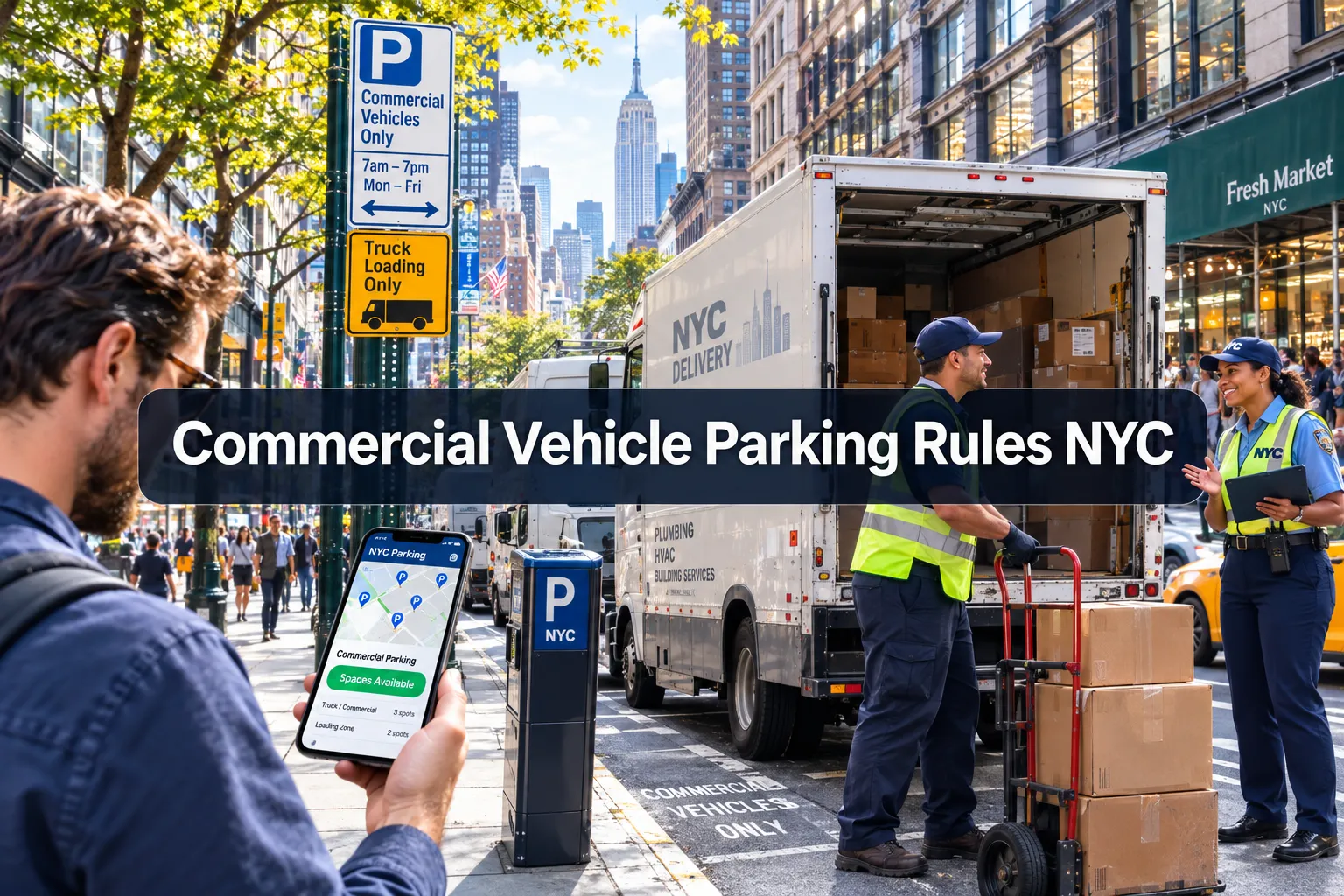
    NYC issues over 10 million parking tickets annually, and commercial vehicle violations account for a substantial share. One wrong move, parking your work van overnight on a residential block or exceeding the three-hour limit, can cost you $115 or more, plus towing fees that spiral into the hundreds. Understanding commercial vehicle parking rules NYC is not optional for delivery drivers, contractors, and fleet operators working in the five boroughs in 2026.

    This guide breaks down the official regulations, real-time enforcement tools, and new pilot programs that govern where and when you can legally park a commercial vehicle in New York City. Whether you drive a box truck, a cargo van, or a tractor-trailer, these rules determine whether you wake up to a clear windshield or a citation, and knowing them can save you thousands in fines and lost time.

    Key Takeaways

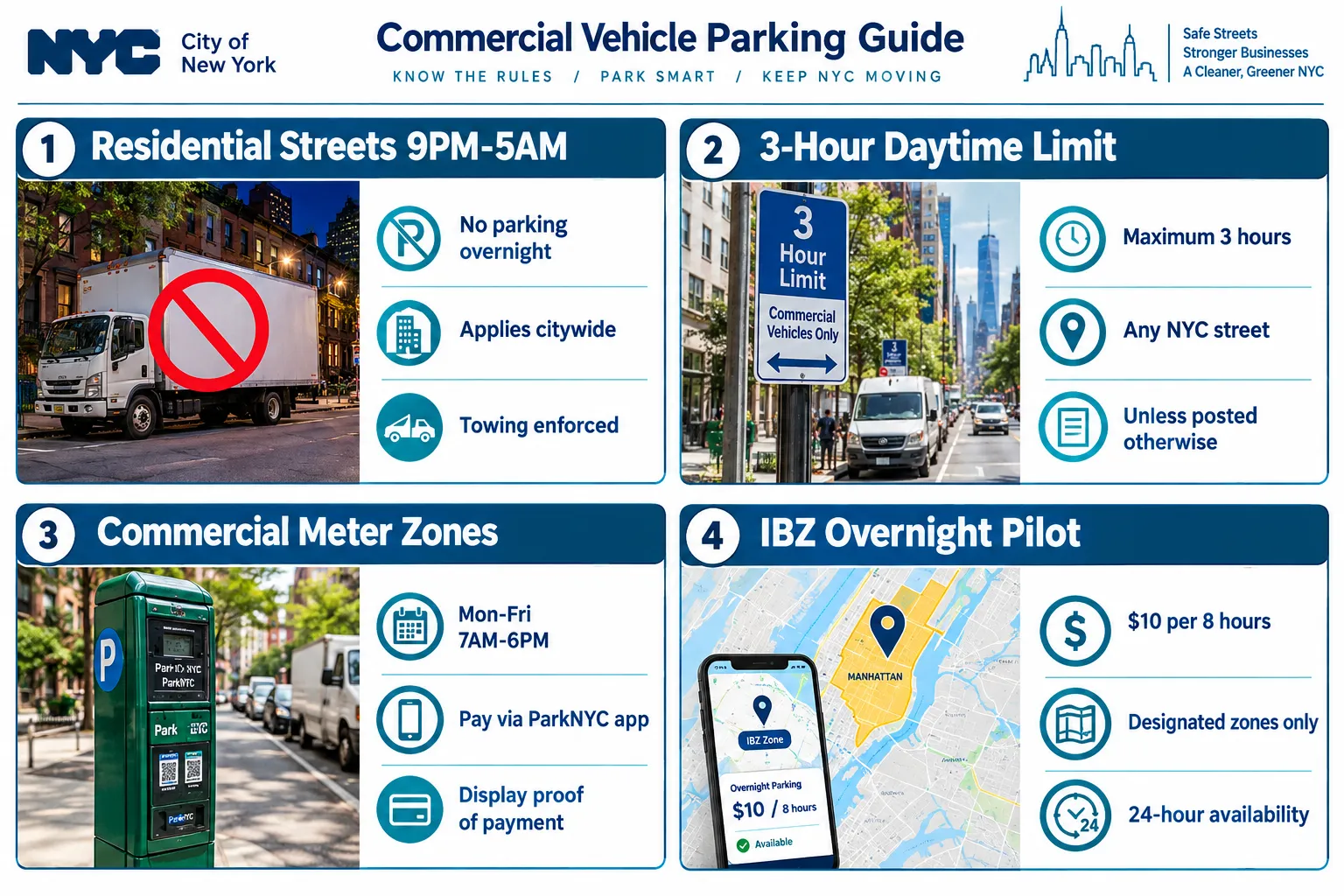
    • Commercial vehicles may not park on any NYC street for more than three hours unless signs permit otherwise, and overnight parking on residential streets (9 p.m. to 5 a.m.) is prohibited citywide.
    • New metered overnight truck parking zones in Industrial Business Zones (IBZs) across Brooklyn, the Bronx, and Queens allow 8-hour sessions for $10 via the ParkNYC app, operating 24 hours Monday through Saturday.
    • NYPD enforcement has intensified with Operation Heavy Duty and deployment of the Barnacle windshield boot, targeting illegal overnight and residential truck parking.
    • More than 500 new curbside commercial loading zones have been installed citywide to reduce double-parking, while automated camera enforcement on MTA buses captures violations in real time.
    • Check real-time Alternate Side Parking status and suspension calendars to coordinate commercial deliveries and avoid street-sweeping tickets during ASP windows.

    Understanding NYC’s Core Commercial Vehicle Parking Restrictions

    NYC Administrative Code §19-170 establishes two foundational rules that apply to every commercial vehicle in the city. First, commercial vehicles may not park anywhere in NYC for more than three hours when parking is not otherwise restricted. Second, commercial vehicles are prohibited from parking on residential streets between 9 p.m. and 5 a.m.,a ban that remains in force across all five boroughs as of 2026.[1][2]

    These provisions form the backbone of enforcement. A «commercial vehicle» under NYC Traffic Rules §4-08 includes any vehicle designed, maintained, or used primarily for the transportation of property, or any vehicle with commercial plates. Box trucks, cargo vans, tractor-trailers, and even pickup trucks with commercial registration fall under these restrictions.[4]

    Key restrictions at a glance:

    • Three-hour limit: Applies citywide on any street where parking is not otherwise prohibited. Exceeding three hours triggers a violation even if you paid a meter or parked legally at the start.
    • Overnight residential ban: From 9 p.m. to 5 a.m., no commercial vehicle may park on a residential street. Enforcement is active every night, and violations carry fines starting at $115 plus potential towing.
    • Midtown Manhattan rules: Between 14th and 60th Streets, from 1st to 12th Avenues, commercial vehicles must park parallel within 12 inches of the curb and may not occupy more than 10 feet of roadway width.[4]
    • No street storage: NYC prohibits using public streets as storage for unaltered commercial vehicles, meaning you cannot leave a truck parked in one spot indefinitely, even during permitted hours.
    Understanding NYC's Core Commercial Vehicle Parking Restrictions

    These rules remain unchanged from their December 2024 codification and are cited by NYPD and the Department of Finance when issuing summonses.[1][4] Drivers who rely on street parking for work vehicles must plan around the three-hour cap and find off-street or designated zones for overnight storage.

    For general guidance on Alternate Side Parking rules in NYC, including how ASP interacts with commercial vehicle restrictions, consult our comprehensive ASP guide.

    Where Commercial Vehicles Can Park Legally: Meters, Loading Zones, and IBZ Pilots

    NYC has expanded legal parking options for commercial vehicles in 2026 through a combination of metered zones, dedicated loading areas, and pilot programs in Industrial Business Zones.

    Commercial Meter Zones and Pay-by-App Spaces

    In «No Standing Commercial Vehicles Only» metered zones, commercial vehicles can park Monday through Friday from 7 a.m. to 6 p.m. for up to three hours per block after paying at a meter or via the ParkNYC mobile app and displaying proof of payment.[5][6] These zones are marked with green or white «Commercial Vehicles Only» signs and are typically located in commercial corridors.

    NYC DOT has also launched pay-by-app-only commercial meters on specific corridors, including Sixth Avenue between West 14th and West 23rd Streets in Manhattan. Drivers must use the ParkNYC app to pay; coin or card payment at physical meters is not accepted in these pilot areas.[3]

    Overnight Truck Parking Pilot in Industrial Business Zones

    Launched in March 2025, the Overnight Truck Parking Pilot created approximately 45 metered commercial vehicle spaces across three IBZ corridors:[3][7][8]

    • Flatlands/Fairfield, Brooklyn: Flatlands Avenue between Erskine Street and Fountain Avenue
    • Hunts Point, Bronx: Ryawa Avenue between Manida Street and Halleck Street
    • Maspeth, Queens: 56th Road between 43rd Street and 49th Street

    Truck operators pay $10 for each 8-hour session via the ParkNYC app. Parking is available 24 hours a day, Monday through Saturday, with no payment required on Sundays. The pilot runs for one year and aims to reduce illegal overnight truck parking on residential streets.[3][7][8]

    If you’re seeking off-street parking in the Bronx, explore garage options such as MPG Parking or Quik Park to avoid street restrictions entirely.

    City Council-Mandated IBZ Overnight Truck Parking Program

    Separate from the metered pilot, NYC Council legislation (Intro 99-A/99-B, adopted in 2025) requires DOT to establish curbside overnight truck parking areas within each IBZ, with parking allowed for up to 10 continuous hours between 8 p.m. and 6 a.m.[9][4] Non-commercial vehicles are prohibited in these zones during overnight hours. This program carries a five-year sunset and is designed to transform the initial pilot into a broader, time-limited policy across industrial areas citywide.[9]

    Industry coverage notes that the Council-mandated overnight curbside program focuses on «overnight-only» spaces inactive between 8 a.m. and 6 p.m., distinct from the 24-hour metered pilot.[7][9] However, a 2025 analysis by THE CITY found that the pilot did not cover several neighborhoods most heavily impacted by illegal truck parking, including parts of southeast Queens, fueling calls for expansion.[3]

    New Curbside Loading Zones

    NYC DOT has installed more than 500 new curbside loading zones citywide to address double-parking and blocked bus and bike lanes.[5][10] These zones reflect community feedback on freight activity hot spots and provide legal short-term parking for commercial deliveries. Loading zones are typically time-limited (15 to 30 minutes) and marked with «Loading Zone» signs; drivers must move vehicles promptly after unloading.

    For parking in Queens, including neighborhoods like Astoria and Flushing, check garage availability to supplement street options during peak delivery hours.

    Enforcement Escalation: Operation Heavy Duty, the Barnacle Boot, and Automated Cameras

    NYPD and NYC DOT have ramped up enforcement of commercial vehicle parking rules NYC since 2024, deploying new tools and operations to deter illegal overnight and residential truck parking.

    Operation Heavy Duty Enforcement

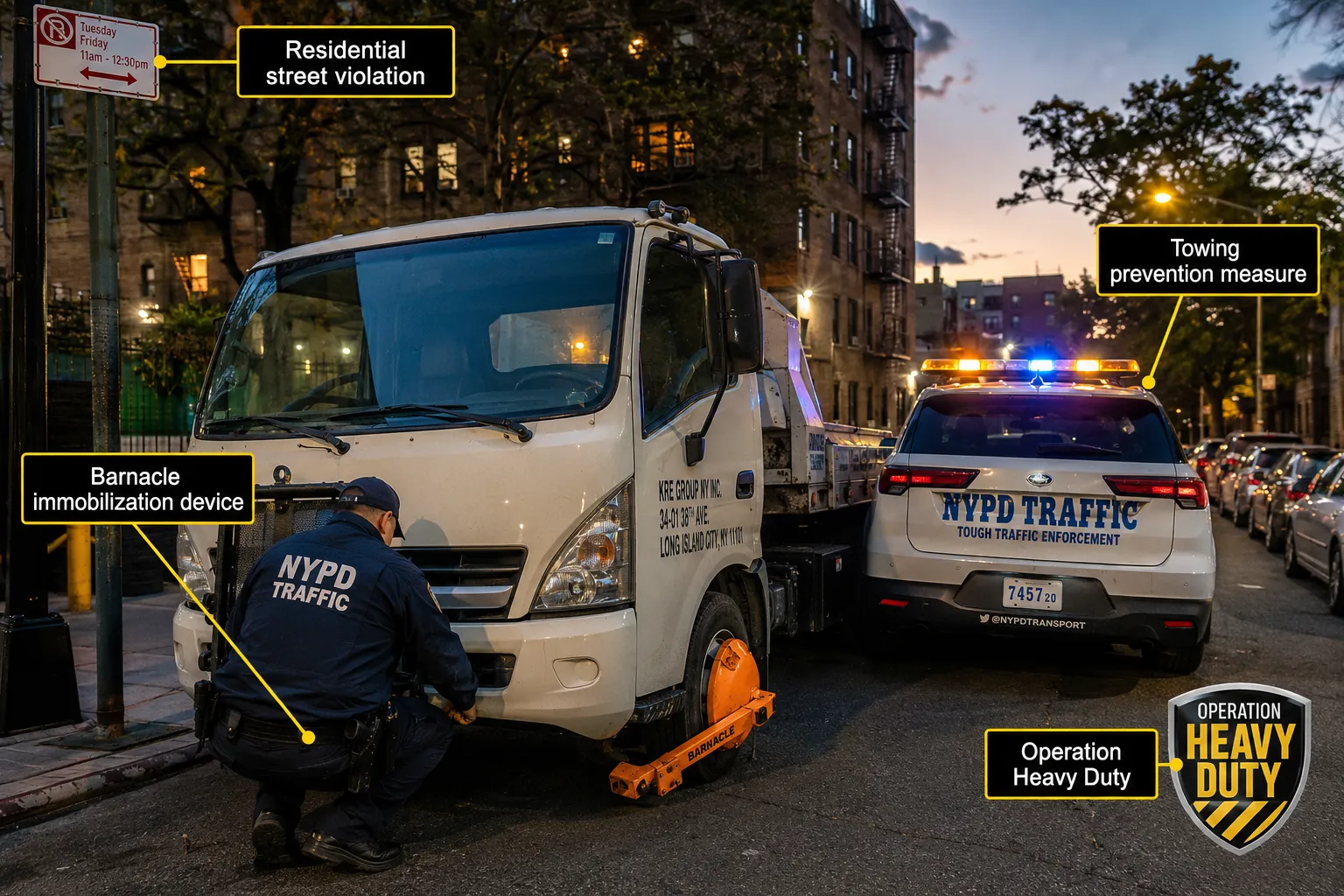
    Launched in 2024 and continuing through 2026, Operation Heavy Duty targets illegally parked trucks in Queens and other boroughs. NYPD reports issuing hundreds of summonses and conducting dozens of truck tows under this initiative.[9] Enforcement focuses on residential streets during the 9 p.m. to 5 a.m. ban and on trucks exceeding the three-hour daytime limit.

    The Barnacle Windshield Boot

    NYPD has deployed the Barnacle, a large orange suction-cup device that immobilizes vehicles by covering the windshield, to enforce commercial vehicle violations.[9] The Barnacle is applied to trucks with excessive unpaid fines or those parked illegally overnight on residential streets. Removal requires payment of outstanding fines and a release fee, and attempting to remove the device without authorization can result in additional penalties.

    The Barnacle Windshield Boot

    This tool signals a policy shift away from informal tolerance toward strict enforcement of the overnight residential ban.[2][9]

    Automated Camera Enforcement (ACE) Program

    NYC DOT’s Automated Camera Enforcement (ACE) program uses cameras mounted on over 1,000 MTA buses to capture double-parking violations and bus lane obstructions, many involving commercial vehicles, and forward them to DOT for processing.[7][10] Violations are issued automatically, and fines are mailed to the registered owner. The program has expanded significantly in 2025-2026, increasing the likelihood that illegal parking will be detected even in the absence of a traffic agent.

    Stipulated Fine Program Adjustments

    The Department of Finance’s Annual Parking Tickets and Camera Violations report (Local Law 6 report for FY25) documents changes to the Stipulated Fine Program, which allows commercial fleets to enroll and pay reduced fines for certain violations.[10] However, Streetsblog NYC highlighted that reduced stipulated fines for double-parking (dropping from $80 to $65 for enrolled firms) and bus lane parking might unintentionally encourage double-parking by commercial vehicles rather than curb it.[1]

    Drivers and fleet managers should weigh the cost of fines against the cost of securing legal off-street parking in Manhattan or other boroughs to avoid repeat violations and escalating penalties.

    Real-Time Alternate Side Parking Status and Commercial Vehicle Coordination

    Alternate Side Parking (ASP) rules intersect with commercial vehicle parking rules NYC in critical ways. During ASP windows, typically 8 a.m. to 11 a.m. or 11:30 a.m. to 2 p.m. on designated days, streets are cleared for sweeping, and parking is prohibited on the affected side. Commercial vehicles parked during ASP enforcement are ticketed and may be towed, just like passenger cars.

    Check real-time ASP status to coordinate deliveries and avoid violations. Park Rules Live provides live ASP suspension alerts for neighborhoods across NYC, including Astoria, Williamsburg, Park Slope, DUMBO, and Greenpoint. Use these tools to confirm whether ASP is suspended due to holidays or emergency declarations before parking a commercial vehicle on a residential block.

    Key ASP coordination tips for commercial drivers:

    • Plan around ASP windows: Schedule deliveries and pickups outside ASP enforcement hours to avoid moving your vehicle mid-shift.
    • Use suspension calendars: Official holiday suspension calendars list days when ASP is not in effect, allowing you to park legally on both sides of the street.
    • Monitor real-time alerts: Weather emergencies, snow operations, and special events can trigger ASP suspensions. Check Park Rules Live’s real-time status tracker for up-to-the-minute updates.
    • Understand block-specific schedules: ASP schedules vary by block. Read posted signs carefully and confirm the schedule for the exact block where you plan to park.

    For cities beyond NYC, including Yonkers, Buffalo, and Binghamton, consult city-specific ASP guides to coordinate commercial parking with local street-cleaning rules.

    Proposed Legislation and Future Expansions

    NYC lawmakers continue to introduce bills aimed at curbing illegal truck parking and expanding legal options for commercial vehicles. Proposed measures in 2025-2026 include:[3]

    • 90-minute citywide parking limit for large commercial vehicles such as trailers and semis, further restricting long-term street parking.
    • Requirements for DOT to establish overnight parking areas for large commercial vehicles within IBZs, operating from 8 p.m. to 6 a.m., building on the existing pilot.
    • Mandates for at least three off-street truck parking facilities citywide by early 2026, to be acquired and managed by a designated city agency.

    These proposals reflect ongoing tension between the need for commercial vehicle access and community complaints about illegal truck parking. Drivers should monitor legislative updates and adjust parking strategies as new rules take effect.

    Avoiding Fines, Towing, and Unfair Parking Citations

    Avoid fines and towing by following these best practices:

    1. Never park a commercial vehicle on a residential street overnight. The 9 p.m. to 5 a.m. ban is enforced citywide, and violations carry fines starting at $115 plus towing fees.
    2. Respect the three-hour limit. Even if you paid a meter or parked legally at the start, exceeding three hours triggers a violation. Set a timer and move your vehicle before the limit expires.
    3. Use designated IBZ overnight zones. If you need overnight parking, use the metered pilot zones in Flatlands, Hunts Point, or Maspeth, or explore off-street parking options in your borough.
    4. Pay meters and display proof. In commercial meter zones, always pay via the ParkNYC app or at the meter and display your receipt or confirmation on the dashboard.
    5. Check ASP status before parking. Use real-time suspension calendars and alerts to confirm whether ASP is in effect on the block where you plan to park.
    6. Fight unfair parking citations. If you receive a ticket you believe is incorrect, use the NYC Parking Education Hub resources on tickets and disputes to challenge the citation. Document your parking location, time, and any relevant signs with photos.

    For additional support on tickets and disputes, consult guides on contesting unfair parking citations and recovering towed vehicles through the city’s impound system.

    Conclusion

    Navigating commercial vehicle parking rules NYC in 2026 requires vigilance, planning, and real-time information. The three-hour daytime limit and overnight residential ban remain strictly enforced, while new metered IBZ zones and expanded loading areas offer legal alternatives for drivers willing to pay and plan ahead. NYPD’s Operation Heavy Duty, the Barnacle boot, and automated camera enforcement have raised the stakes for violations, making compliance essential to avoid fines and towing.

    Take action now:

    • Check real-time ASP status on Park Rules Live before parking on any residential block.
    • Explore off-street parking in Brooklyn, Manhattan, the Bronx, Queens, and Staten Island to secure legal overnight storage.
    • Use the ParkNYC app to pay for metered commercial zones and IBZ overnight pilot spaces.
    • Set reminders to move your vehicle before the three-hour limit expires.
    • Monitor suspension calendars and real-time alerts to coordinate deliveries around ASP enforcement.

    By understanding the rules, leveraging official tools, and staying informed on enforcement trends, commercial drivers can avoid costly citations, protect their vehicles from towing and impounds, and keep their operations running smoothly in the nation’s most complex parking environment.

    References

    [1] A Fine Mess City To Expand Encouragement For Truckers To Double Park – https://nyc.streetsblog.org/2024/10/22/a-fine-mess-city-to-expand-encouragement-for-truckers-to-double-park

    [2] New York City Creates Pilot Program For Three Truck Parking Lots – https://www.truckersnews.com/news/article/15740890/new-york-city-creates-pilot-program-for-three-truck-parking-lots

    [3] Pols Aim To Put Brakes On Illegal Truck Parking – https://queenseagle.com/all/2024/10/15/pols-aim-to-put-brakes-on-illegal-truck-parking

    [4] New York City Passes Bill To Expand Overnight Truck Parking – https://landline.media/new-york-city-passes-bill-to-expand-overnight-truck-parking/

    [5] Nyc Dot Loading Zones – https://www.nyc.gov/html/dot/html/pr2024/nyc-dot-loading-zones.shtml

    [6] 0099 2024+ – https://intro.nyc/0099-2024+

    [7] Nyc Advances Commonsense Solution To Address Truck Parking – https://landline.media/magazine/nyc-advances-commonsense-solution-to-address-truck-parking/

    [8] Mondays Headlines You Aint Goin Nowhere Edition – https://nyc.streetsblog.org/2024/04/08/mondays-headlines-you-aint-goin-nowhere-edition

    [9] Mayor Eric Adams Nypd Launch Crackdown On Commercial Vehicles Parking Illegally In Queens – https://www.cbsnews.com/newyork/news/mayor-eric-adams-nypd-launch-crackdown-on-commercial-vehicles-parking-illegally-in-queens/

    [10] Legislationdetail – https://legistar.council.nyc.gov/LegislationDetail.aspx?GUID=E10D907C-092A-4BFF-8FB5-BACB2CB71AE7&ID=6509477

  • How to Find a Towed Vehicle NYC: Official 2026 Lookup Guide

    How to Find a Towed Vehicle NYC: Official 2026 Lookup Guide

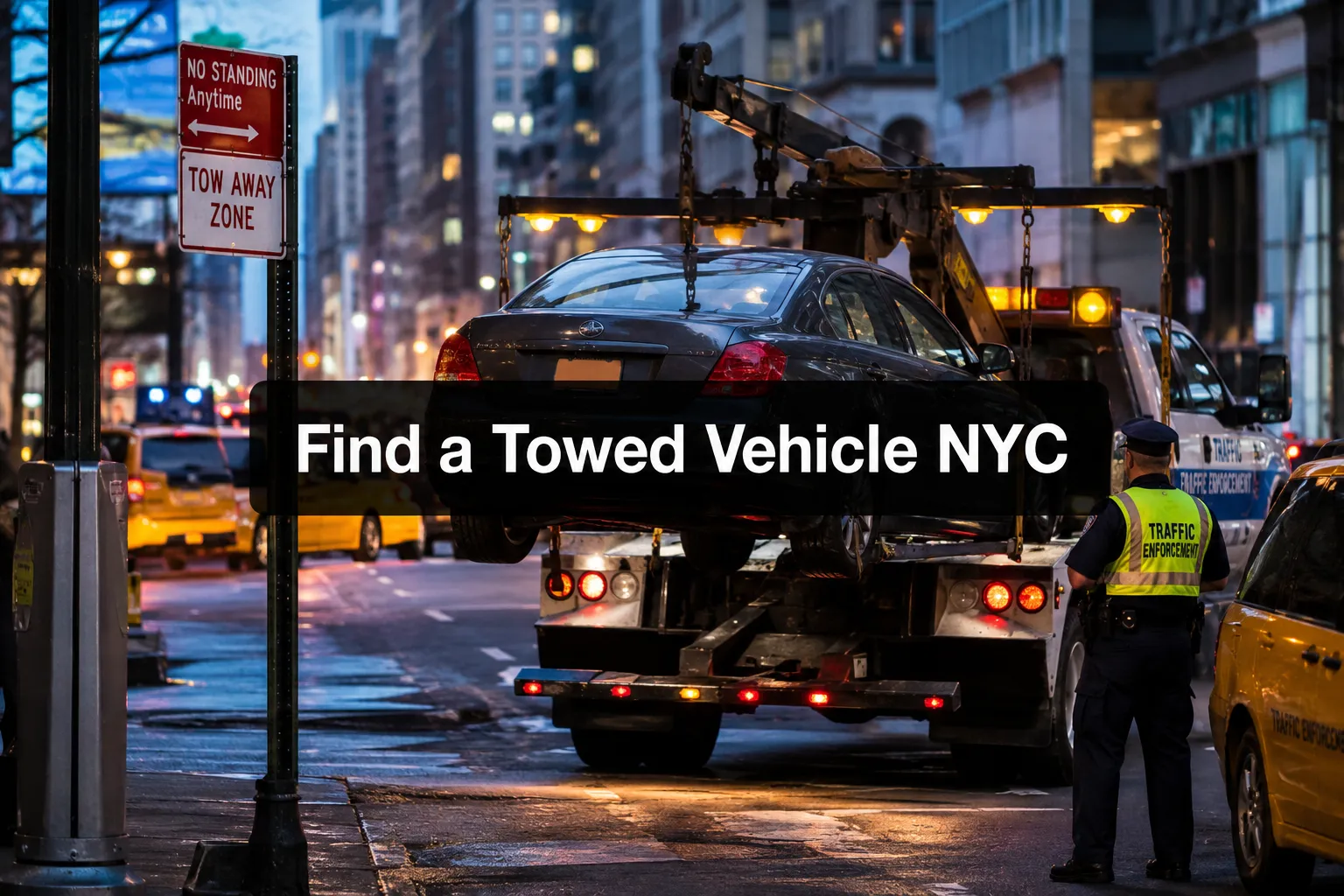
    Every year, over 200,000 vehicles are towed in New York City, and most drivers discover their car is missing at the worst possible moment. Whether you parked during Alternate Side Parking enforcement, violated street cleaning rules, or returned to an empty spot after a crash, knowing exactly how to find a towed vehicle NYC can save hours of frustration and hundreds of dollars in storage fees.

    This guide walks through the official 2026 process, pound locations, recovery requirements, and Real-Time Status tools to locate and retrieve your vehicle fast.

    Key Takeaways

    • Use the official NYCServ Find Towed Vehicle tool with your license plate, state, and vehicle type to confirm tow status and pound location instantly.
    • Call 311 or visit NYC311 online if your vehicle doesn’t appear in the system, it may have been relocated rather than impounded.
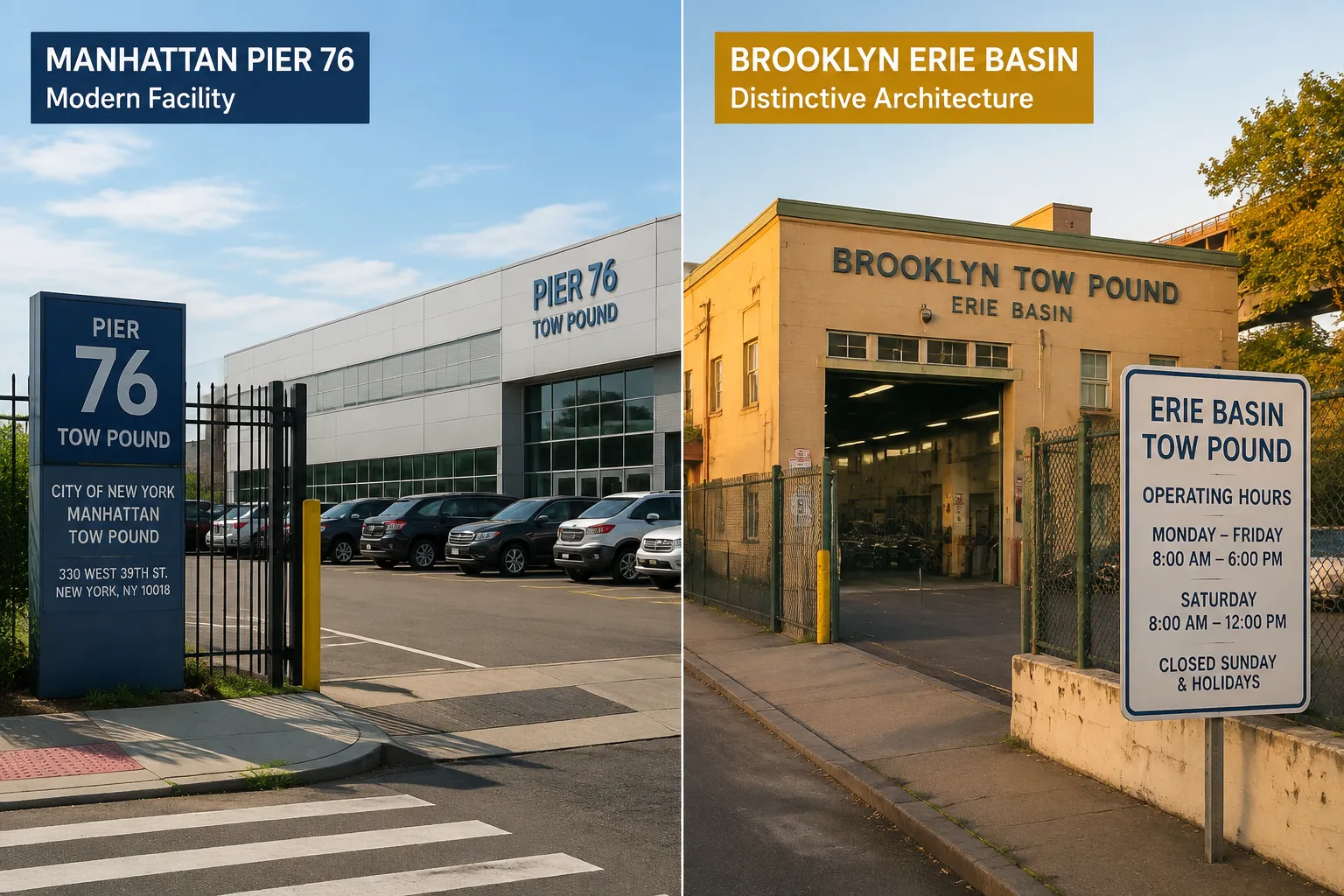
    • NYPD tow pounds operate in the Bronx, Brooklyn, Queens, and Manhattan (Pier 76), with varying hours; Manhattan’s Pier 76 is open nearly 24/7.
    • Bring your driver’s license, vehicle registration, and a credit card or cash to pay towing and storage fees at the pound.
    • Vehicles towed as evidence or after serious collisions go to separate NYPD Property Clerk auto pounds with restricted weekday-only access.

    Official NYC Towed Vehicle Lookup: Start Here to Find a Towed Vehicle NYC

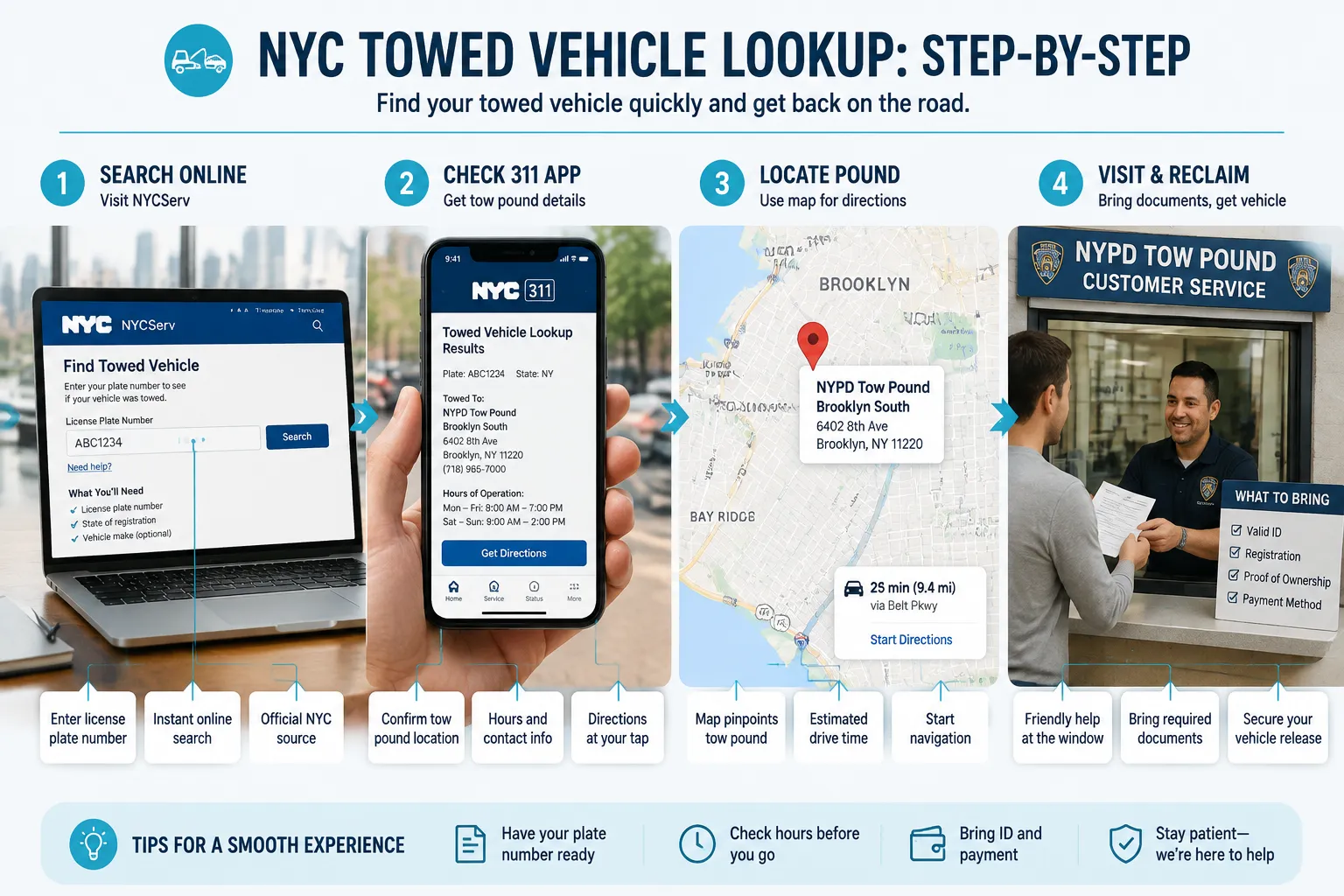
    The fastest, most reliable way to find a towed vehicle NYC is the NYCServ Find Towed Vehicle online tool.[1][2] This official city service searches all NYPD, Department of Finance, marshal, and sheriff tow records in real time.

    How to use the NYCServ tool:

    1. Visit the NYCServ Find Towed Vehicle page.
    2. Enter your license plate number exactly as it appears.
    3. Select your state of registration from the dropdown.
    4. Choose your vehicle type: passenger car, commercial vehicle, taxi, motorcycle, or other.
    5. Click «Search.»

    If your vehicle was towed, the results display which pound holds it, the pound’s address, phone number, and operating hours.[1][8] You can then call ahead to confirm fees and required documents.

    Official NYC Towed Vehicle Lookup: Start Here to Find a Towed Vehicle NYC

    If your vehicle doesn’t appear: Call 311 immediately or use the NYC311 mobile app.[3][7] Provide your plate number, state, exact cross streets where you parked, borough, and the approximate time you last saw the car. The 311 operator can check additional databases and confirm whether the vehicle was relocated (moved a few spaces by police) rather than towed to a pound.[3][15]

    For comprehensive parking guidance and Real-Time Status updates on Alternate Side Parking, check suspension calendars to avoid future towing.

    NYPD Tow Pound Locations, Hours, and What to Bring

    Once you confirm your vehicle’s pound location, plan your visit carefully. Each borough’s NYPD tow pound has distinct hours and procedures.[4][13]

    Borough-by-Borough Pound Details

    Manhattan, Pier 76 (West 38th Street at 12th Avenue)

    • Hours: 7:00 a.m. Monday through 5:00 a.m. Sunday (essentially 24/6 operation; closed only 5:00 a.m. Sunday to 7:00 a.m. Monday).[13][8]
    • Phone: Check the official NYPD Towed Vehicles page for current contact.
    • Notes: Busiest pound; longest weekend hours; accessible by public transit and taxi.

    Bronx, 3880 Bronx Boulevard

    • Hours: Typically weekdays and Saturdays, daytime to early evening; closed Sundays.[13][9]
    • Phone: Listed on NYPD site.

    Brooklyn, Erie Basin Auto Pound (Columbia Street)

    • Hours: Weekdays and Saturdays, daytime hours; closed Sundays.[13][9]
    • Phone: Listed on NYPD site.

    Queens, 129-01 31st Avenue (College Point)

    • Hours: Weekdays and Saturdays, daytime hours; closed Sundays.[13][9]
    • Phone: Listed on NYPD site.

    For the most current addresses, phone numbers, and holiday closures, always consult the official NYPD Towed Vehicles page.[4]

    Borough-by-Borough Pound Details

    What to Bring to Retrieve Your Vehicle

    Required documents:[2][3][8]

    • Valid driver’s license (must match the name on the registration or rental agreement).
    • Vehicle registration or rental agreement.
    • Proof of insurance (often requested).
    • Payment method: credit card, debit card, or cash. Towing fees typically start around $185, plus $20 per day storage after the first day.[8][9]

    For rental cars: Bring your rental agreement and the credit card used to book the rental. The rental company may require you to notify them before retrieval.[15]

    For commercial vehicles: Additional paperwork (TLC license, commercial registration) may be required.

    Towing & Impounds: Evidence and Collision Vehicles

    Vehicles towed as evidence or after serious collisions are held at separate NYPD Property Clerk auto pounds, not the standard borough pounds.[4][14]

    Property Clerk Auto Pound Locations:

    • Brooklyn: Columbia Street facility (separate from the Erie Basin tow pound).
    • Queens: Springfield Gardens facility near JFK Airport.

    Hours: Monday through Friday, 8:00 a.m. to 3:00 p.m., excluding holidays.[14] Public access is restricted; you may need a release from the investigating officer or detective.

    If your vehicle was involved in an accident and doesn’t appear in the NYCServ tool, contact the precinct that handled the accident report to determine whether it was towed or relocated.[7] For more guidance on Towing & Impounds procedures, explore the Parking Education Hub.

    Avoid Fines and Towing: Real-Time Alternate Side Parking Status

    The best way to find a towed vehicle NYC is to never have it towed in the first place. Most NYC tows result from Alternate Side Parking violations during street cleaning.[6][9]

    Check Real-Time Status daily:

    • Visit Park Rules Live for live ASP suspension calendars and alerts.
    • Sign up for push notifications when street cleaning is suspended due to holidays or snow emergencies.
    • Review neighborhood-specific rules in Brooklyn, Queens, the Bronx, and Manhattan.

    Other common towing triggers:

    For hyper-local ASP rules, check Yonkers Alternate Side Parking and Mount Vernon Alternate Side Parking if you park outside the five boroughs.

    What to Do If Your Car Was Relocated, Not Towed

    Sometimes NYPD officers move a vehicle a few spaces or around the corner to facilitate emergency access, construction, or filming, without towing it to a pound.[3][6] This is called a «relocation.»

    Steps to find a relocated vehicle:

    1. Walk a two-block radius around where you parked, checking side streets and nearby blocks.
    2. Call 311 and provide your plate, state, exact cross streets, and borough. The operator can check relocation logs.[3][15]
    3. Contact the local precinct if 311 has no record. Precinct desk officers maintain relocation notes.[7]

    Relocated vehicles are not listed in the NYCServ towed-vehicle database, so always call 311 if the online search returns no results.[3][7]

    Tickets & Disputes: Challenge Unfair Parking Citations

    If you believe your vehicle was towed unjustly, for example, during a posted ASP suspension or from a spot with unclear signage, you can dispute both the towing fee and any associated parking tickets.[2][3]

    How to dispute:

    • Visit the NYC Department of Finance Parking Violations Bureau online portal.
    • Submit photos of signage, proof of ASP suspension, or evidence of a malfunctioning meter.
    • Reference the exact date, time, and location.
    • Request a hearing or submit a written appeal.

    For step-by-step guidance, explore the Tickets & Disputes section of the Parking Education Hub. Fighting unfair citations can save hundreds of dollars and prevent points on your license.

    Off-Street Parking: Avoid Future Tows with Garage Savings

    If street parking feels too risky, especially during ASP enforcement or snow emergencies, consider monthly garage rates or daily off-street parking.[6][9]

    Find garage deals:

    Monthly garage contracts often cost less than a single towing incident plus storage fees, and you’ll never worry about ASP again.

    Conclusion

    Knowing how to find a towed vehicle NYC starts with the official NYCServ lookup tool and 311 support. Enter your license plate, state, and vehicle type to confirm tow status and pound location instantly. If your car doesn’t appear, call 311 to check relocation logs or contact the precinct that handled any accident report. Always bring your driver’s license, registration, and payment to the pound, and verify hours before you go, Manhattan’s Pier 76 operates nearly 24/7, but other borough pounds close on Sundays.

    Next steps:

    Stay informed, act fast, and recover your vehicle with minimal hassle.

    References

    [1] Pvo Find Towed Vehicle – https://nycserv.nyc.gov/NYCServWeb/PVO_Find_Towed_Vehicle.jsp [2] Services Towed Vehicles – https://www.nyc.gov/site/finance/vehicles/services-towed-vehicles.page [3] Article – https://portal.311.nyc.gov/article/?kanumber=KA-02055 [4] Towed Vehicles – https://www.nyc.gov/site/nypd/services/vehicles-property/towed-vehicles.page [5] Where Is My Towed Car – https://www.brownstoner.com/queens/news/where-is-my-towed-car/ [6] Car Towed Nyc – https://secretnyc.co/car-towed-nyc/ [7] How To Find My Towed Car Nyc – https://www.njnylawyers.com/blog/how-to-find-my-towed-car-nyc/ [8] Towed Car Nyc – https://www.cartowed.com/find-car-towed-by-city/towed-car-nyc/ [9] What To Do If Your Car Is Towed In Nyc – https://towtruck.nyc/blog/what-to-do-if-your-car-is-towed-in-nyc/ [13] NYPD Tow Pound Hours – (referenced from source [4]) [14] NYPD Property Clerk Auto Pounds – (referenced from source [4]) [15] Rental Car Towing Guide – (referenced from source [7])