Categoría: Uncategorized

  • Motorcycle Parking Rules NYC: Official 2026 Guide to Avoid Fines and Towing

    Motorcycle Parking Rules NYC: Official 2026 Guide to Avoid Fines and Towing

    New York City issued over 180,000 parking violations to motorcycles in 2025 alone. Most riders didn’t know they were breaking the law. The motorcycle parking rules NYC enforces in 2026 are strict, specific, and actively ticketed. Understand the official regulations now to avoid costly citations and impounds.

    Key Takeaways

    • Motorcycles follow the same parking rules as cars in NYC, including metered parking, alternate side parking, and no-standing zones
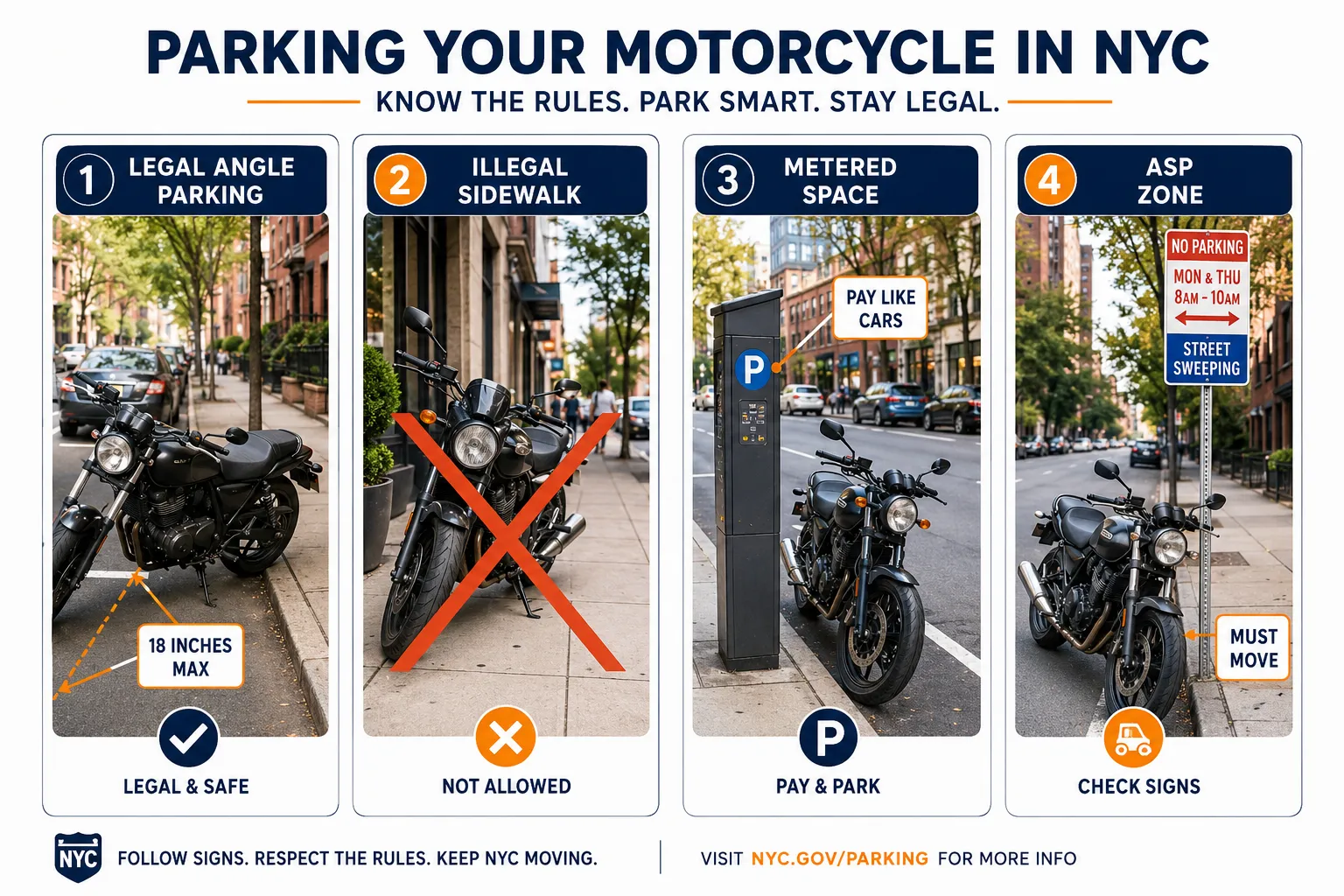
    • Legal angle parking to the curb is permitted within 18 inches maximum distance from the curb face
    • Sidewalk parking is illegal and results in immediate tickets; license plates must remain visible at all times
    • Payment methods for metered spaces include ParkNYC app, meters, and parking cards, motorcycles pay the same rates as cars
    • Alternate side parking enforcement applies to motorcycles and is a leading cause of violations and towing in 2026

    Understanding Core Motorcycle Parking Rules NYC Enforces
    Understanding Core Motorcycle Parking Rules NYC Enforces

    Motorcycles must obey the same parking regulations as passenger vehicles throughout all five boroughs. The NYC Department of Transportation clarifies that motorcycles are subject to identical restrictions on standing, stopping, and parking [1]. This means no-parking zones, fire hydrant clearances, crosswalk restrictions, and bus stop prohibitions all apply equally.

    Angle Parking Is Legal, With Limits

    NYC explicitly permits motorcycles to park at an angle to the curb, a practice that maximizes street space. The legal requirement: your motorcycle must remain within 18 inches of the curb face [2]. Exceed this distance and enforcement agents will issue a violation. Position your front or rear wheel close to the curb and ensure the bike doesn’t protrude into the travel lane.

    Sidewalk Parking Results in Immediate Tickets

    Parking any part of your motorcycle on the sidewalk is illegal citywide [4]. Enforcement is consistent and fines are issued without warnings. Riders frequently assume small scooters or mopeds can use sidewalk space, they cannot. Keep both wheels in the roadway or designated parking area.

    License Plate Visibility Requirements

    Your motorcycle’s license plate must remain visible from the rear at all times when parked [5]. Covering, obscuring, or angling your plate to avoid detection violates state vehicle and traffic law. Motorcycles without visible plates or VIN numbers face towing and impound [6].

    Metered Parking and Payment Methods for Motorcycles

    Motorcycles occupy metered parking spaces under the same rules and rates as cars. As of August 2026, the NYC DOT updated guidance confirming motorcycles must pay at meters, use the ParkNYC mobile app, or purchase parking cards [3]. Rates vary by neighborhood and time of day, ranging from $1.50 to $7.50 per hour in Manhattan’s busiest districts.

    How to Pay for Metered Motorcycle Parking

    • ParkNYC App: Enter your license plate and zone number; payment starts immediately
    • Parking Meters: Insert coins or credit card; display receipt on your motorcycle if required by signage
    • Parking Cards: Purchase prepaid cards at DOT Business Centers and authorized retailers

    Multiple motorcycles may share a single metered space if all riders pay the meter for the full duration [5]. However, each motorcycle must display proof of payment if the meter requires it, and all bikes must fit within the marked space boundaries.

    Motorcycle Parking Rules NYC: Alternate Side Parking Enforcement
    Motorcycle Parking Rules NYC: Alternate Side Parking Enforcement

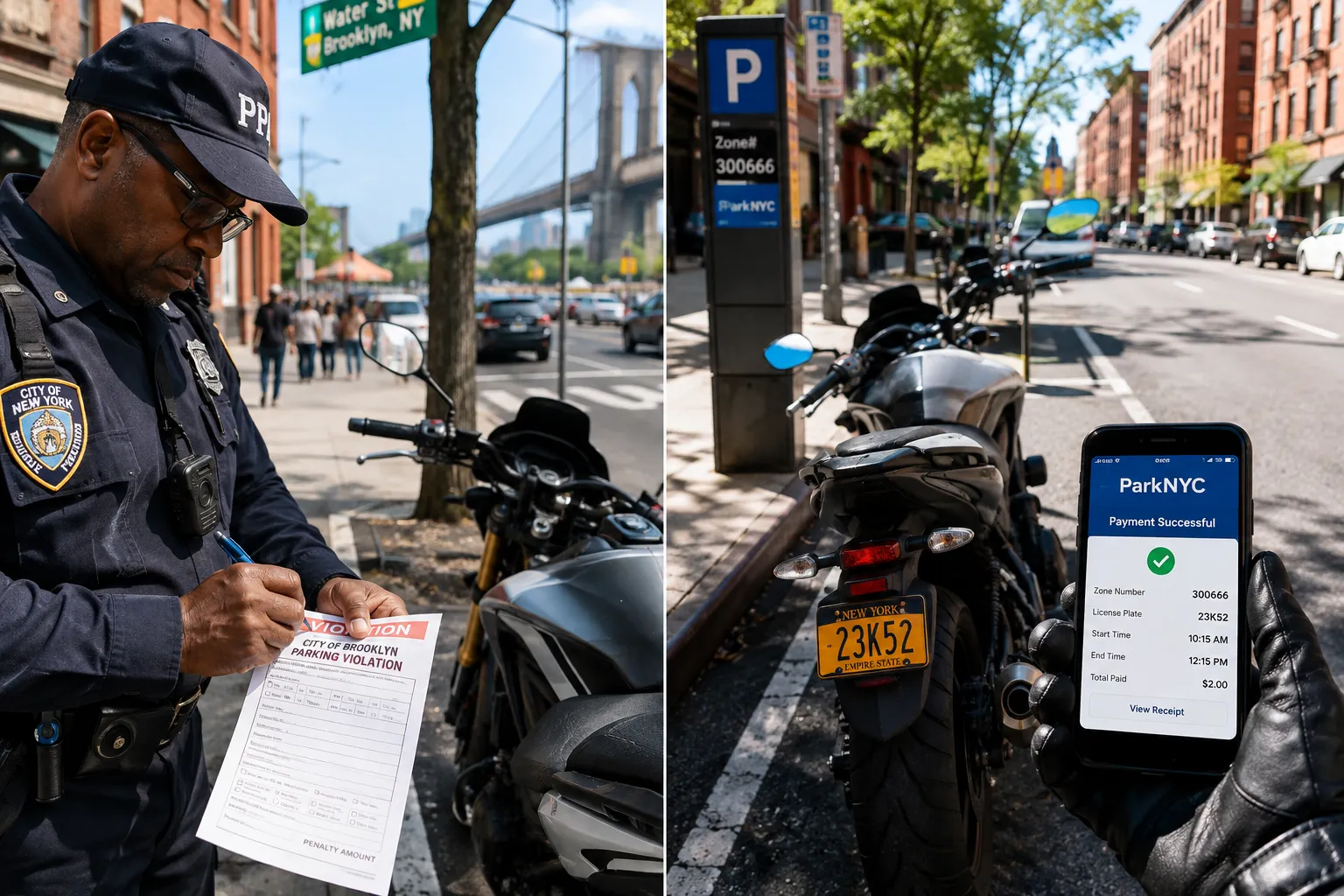
    Alternate Side Parking regulations apply to motorcycles with the same force as cars. Street sweeping schedules run year-round in most neighborhoods, and motorcycles parked on the restricted side during posted hours will be ticketed and towed [6]. In 2026, ASP remains one of the top causes of motorcycle violations citywide.

    Check Real-Time Status Before You Park

    Suspensions occur on holidays and during emergencies, but enforcement resumes quickly. Use live lookup tools to check the current alternate side parking status before leaving your motorcycle on any residential street. Neighborhoods like Astoria, Park Slope, Greenpoint, Williamsburg, and DUMBO enforce ASP strictly.

    For a comprehensive breakdown of how ASP works across the city, explore our complete guide to alternate side parking rules in NYC.

    Suspension Calendars and Alerts

    Official suspension calendars list all city holidays and weather-related exemptions. Sign up for real-time alerts to receive notifications when ASP is suspended or reinstated. Missing a single suspension can cost you a $45 ticket and towing fees exceeding $200.

    Off-Street Parking: Garages, Lots, and Municipal Facilities

    Private garages and parking lots set their own policies for motorcycles. Many facilities in Manhattan, Brooklyn, and the Bronx accept motorcycles at reduced daily or monthly rates, while others prohibit two-wheeled vehicles entirely due to insurance or layout constraints [5].

    Finding Motorcycle-Friendly Garages

    Search the NYC Parking Directory to locate facilities that accommodate motorcycles. Borough-specific directories for Manhattan, Brooklyn, Queens, Bronx, and Staten Island list rates, hours, and vehicle restrictions.

    NYCHA Facilities and Permit Rules

    New York City Housing Authority parking areas require permits displayed on the motorcycle’s windshield or fairing [8]. Permits must remain visible and unobstructed. Motorcycles parked in NYCHA lots without valid permits face towing and impound.

    Common Violations and Fines for Motorcycle Parking

    Enforcement agents issue violations for the same infractions that apply to cars, plus motorcycle-specific errors. The most frequent tickets in 2026 include:

    Violation Fine Amount Notes
    Sidewalk parking $115 Immediate towing risk
    Exceeding 18-inch curb distance $65 Measured from curb face
    Blocked license plate $65 Includes dirt, covers, or angle obstruction
    Metered space non-payment $35,$65 Varies by zone
    Alternate side parking $45 Plus towing and storage fees
    Fire hydrant (within 15 feet) $115 No exceptions
    Double parking $115 Blocking travel or parking lane

    Fines increase for repeat violations within 12 months. Unpaid tickets accrue interest and late fees, and three or more unpaid violations can result in booting or towing [4].

    Fighting Unfair Parking Citations

    Dispute unjust tickets through NYC’s online hearing system or by mail. Common grounds for dismissal include:

    • Incorrect plate number or vehicle description on the summons
    • Photographic evidence showing compliance with posted signage
    • Proof of meter payment or valid parking permit
    • ASP suspension in effect on the violation date

    Submit evidence within 30 days of the ticket issue date. The Parking Education Hub provides step-by-step guides for filing disputes and gathering supporting documentation. Successful challenges result in dismissal and refund of any payments made.

    Practical Best Practices to Avoid Fines and Towing

    Position Your Motorcycle for Visibility

    Park at an angle that keeps your license plate visible from the street. Position the bike so passing enforcement vehicles can read your plate without stopping. Avoid parking behind large vehicles or in shadowed areas where your plate may be obscured.

    Share Metered Spaces Legally

    Two or more motorcycles can share a single metered parking space if all riders pay for the full duration [5]. Coordinate payment using the ParkNYC app and ensure all bikes fit within the painted lines. Overhanging into adjacent spaces or the travel lane will result in tickets.

    Monitor Alternate Side Parking Schedules

    Set recurring reminders for your neighborhood’s ASP days. Use real-time status tools to confirm enforcement before leaving your motorcycle overnight. Move your bike to the correct side of the street before the posted start time, enforcement begins at the minute listed on the sign.

    Avoid High-Risk Zones

    Bike lanes, bus stops, crosswalks, and within 15 feet of fire hydrants are strictly enforced no-parking zones. Double parking, even briefly, results in $115 fines and towing. Plan your route to include legal parking options rather than risking a quick stop in a prohibited area.

    Towing and Impounds: Recovery Process

    Motorcycles towed for parking violations are transported to NYPD or private impound facilities. Recovery requires:

    1. Paying all outstanding fines and penalties online or at the impound office
    2. Providing proof of ownership (registration and valid ID)
    3. Paying towing and storage fees (typically $185 towing + $20/day storage)

    Locate your towed motorcycle using the city’s online tow lookup tool. Enter your license plate number to find the impound location and hours. Delays in recovery increase storage fees daily.

    Secure Parking Initiatives and Future Developments

    NYC is expanding secure bike parking infrastructure, but current programs focus on bicycles rather than motorcycles. Proposed bike locker installations across 500 locations in 2026 are designed for pedal bikes, with dimensions too small for most motorcycles [7][10]. Advocacy groups continue to push for dedicated motorcycle parking zones and secure facilities, but no large-scale municipal program exists as of mid-2026.

    Riders seeking secure off-street options should explore private garages and lots that offer monthly contracts with security features. Compare rates and amenities using parking directories and garage-specific pages.

    Conclusion

    The motorcycle parking rules NYC enforces in 2026 are clear, strict, and actively ticketed. Follow the same regulations as cars, park within 18 inches of the curb, avoid sidewalks, pay meters, and obey alternate side parking schedules. Check real-time ASP status before parking overnight, keep your license plate visible, and dispute unfair citations promptly.

    Take Action Now:

    Stay informed. Park legally. Avoid costly violations.

    References

    [1] Trafrule – https://www.nyc.gov/html/dot/downloads/pdf/trafrule.pdf [2] Article – https://portal.311.nyc.gov/article/?kanumber=KA-01026 [3] Parking Rates – https://www.nyc.gov/html/dot/html/motorist/parking-rates.shtml [4] Motorcycle In Nyc – https://parkingtickets.org/ny-new-york/motorcycle-in-nyc/ [5] How To Park A Motorcycle Scooter In Nyc – http://www.nymstf.org/issues/parking-2/how-to-park-a-motorcycle-scooter-in-nyc/ [6] Parking Motorcycle Nyc 2 – https://newyorkparkingticket.com/parking-motorcycle-nyc-2/ [7] Nycs Plan For 500 Unsightly Bike Lockers Leaves Locals Wheelie Annoyed As Cost Could Be 26m – https://nypost.com/2026/07/27/us-news/nycs-plan-for-500-unsightly-bike-lockers-leaves-locals-wheelie-annoyed-as-cost-could-be-26m/ [8] Parking – https://www.nyc.gov/site/nycha/residents/parking.page [10] Locked In Mamdani Proposes 25 Million For Long Awaited Secure Bike Parking – https://nyc.streetsblog.org/2026/03/05/locked-in-mamdani-proposes-25-million-for-long-awaited-secure-bike-parking/
  • Safe Places to Park in NYC: Official Guide to Avoiding Fines and Towing in 2026

    Safe Places to Park in NYC: Official Guide to Avoiding Fines and Towing in 2026

    New York City towed more vehicles for illegal parking in 2026 than any year on record, with drivers losing an average of $400 per incident between fines, towing fees, and impound storage. Every single block in NYC is a designated tow-away zone, meaning one misread sign or overlooked rule can cost you hundreds and hours of recovery time[8]. Finding truly safe places to park in NYC isn’t about luck, it’s about understanding official regulations, tracking real-time Alternate Side Parking status, and choosing locations that minimize citation risk.

    Key Takeaways

    • All of NYC is a tow-away zone; safe parking requires strict adherence to posted signs, ASP schedules, and state law
    • The 15-foot fire hydrant rule remains the most violated safety regulation, with painted curbs offering no legal protection
    • Real-time ASP suspension tracking is essential; street cleaning violations account for thousands of tickets monthly
    • Off-street garages and legal metered spaces offer the lowest-risk parking, while cone-reserved spots and bike lanes carry immediate citation exposure
    • Enforcement is shifting from NYPD to DOT in 2026, with increased focus on safety-critical violations like blocking bike lanes and crosswalks

    Understanding What Makes Parking «Safe» in NYC

    Safe places to park in NYC are defined by legality first, security second. The NYC Department of Transportation emphasizes that all five boroughs operate as tow-away zones, meaning any vehicle parked illegally, with expired registration, or missing inspection stickers can be towed immediately without warning[8].

    «Safe» parking means:

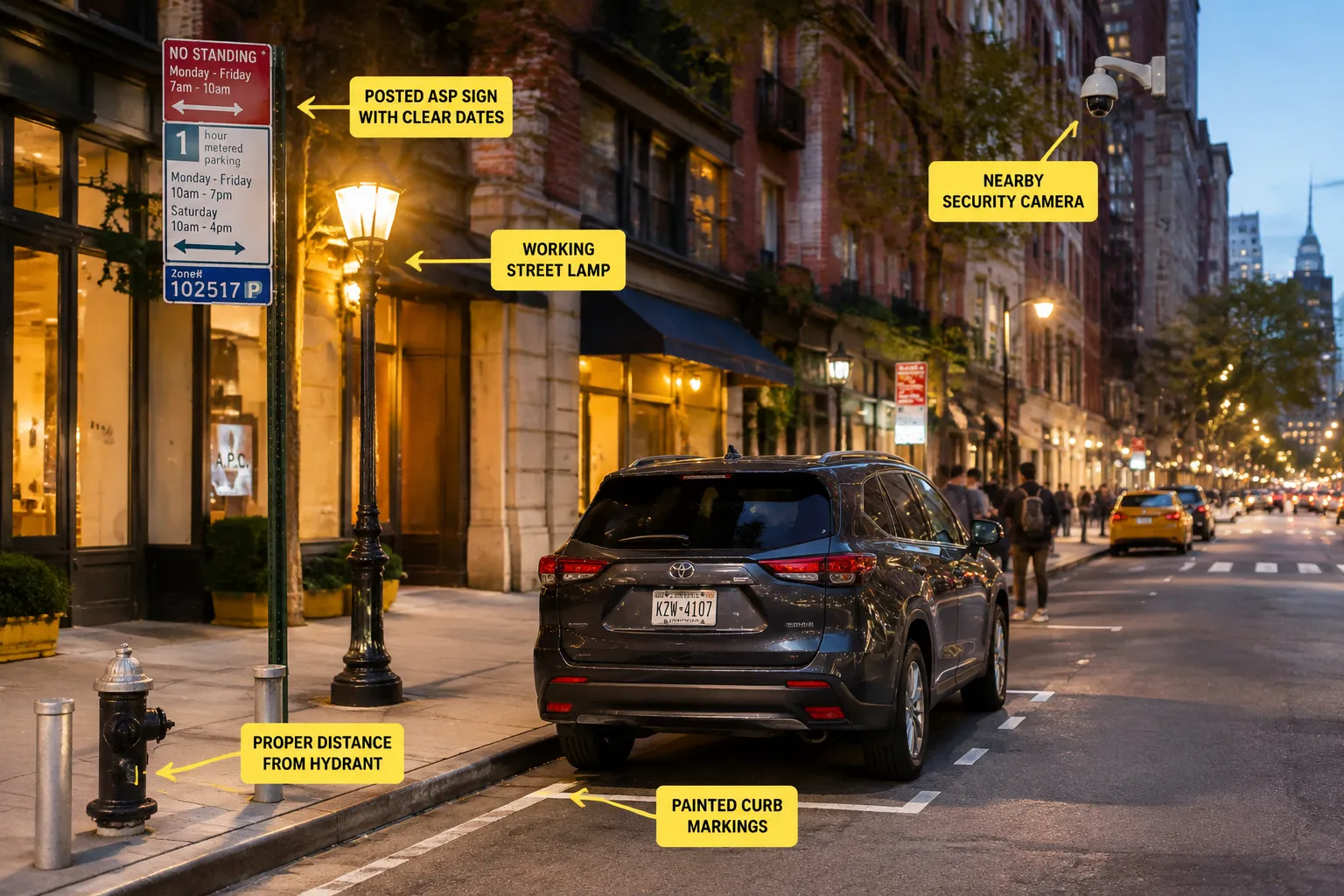
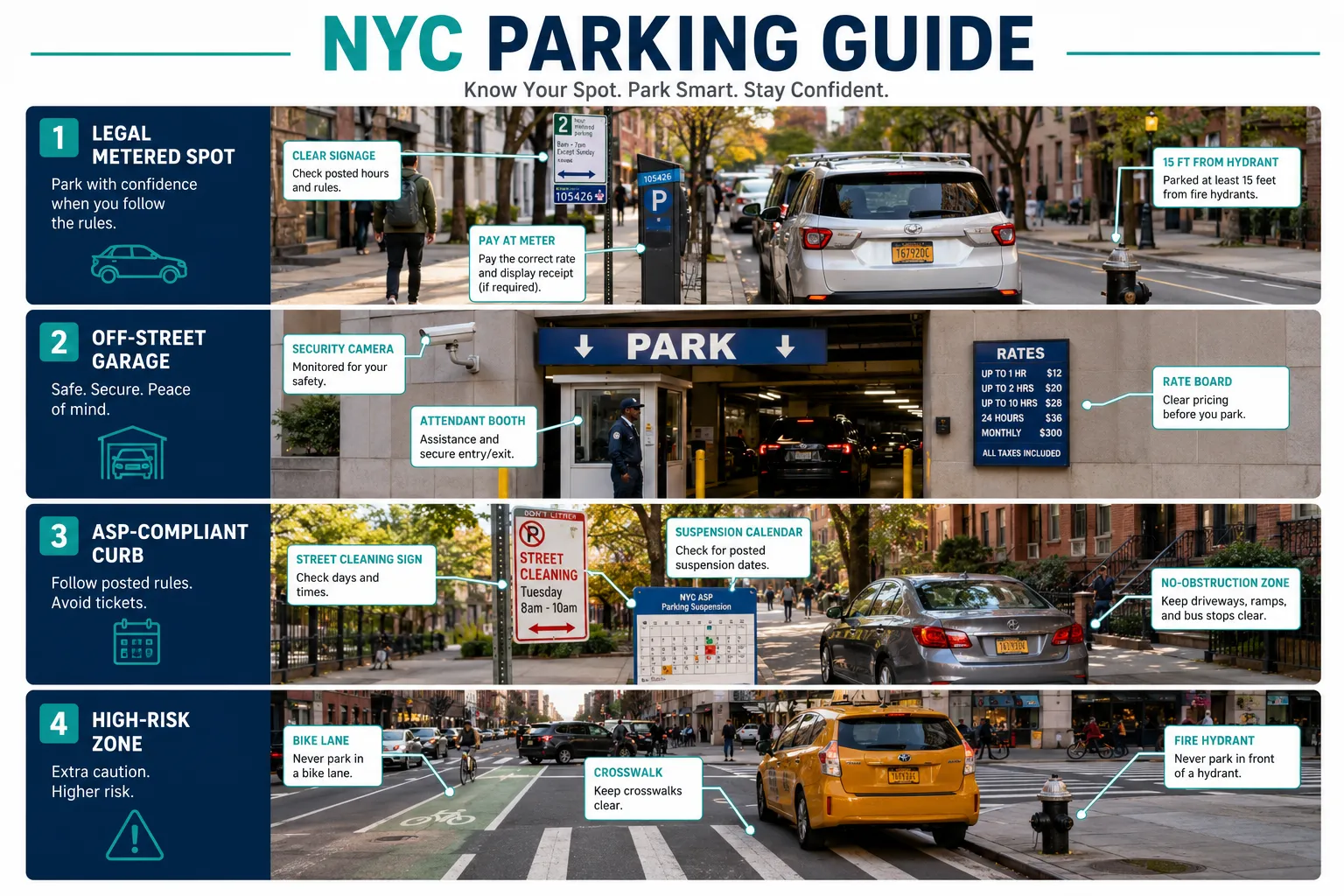
    • Full compliance with posted signage: Every sign on the block applies to your spot
    • Adherence to Alternate Side Parking rules: Active ASP windows trigger $65 fines and potential towing
    • Respect for safety zones: 15 feet from hydrants, no blocking crosswalks, bus stops, or bike lanes
    • Valid registration and inspection: Vehicles with temporary plates or expired documents attract scrutiny[4]

    The 2026 parking regulations updated in August make clear that double parking of passenger vehicles is illegal at all times, including during street cleaning operations[8]. Painted curbs near fire hydrants are not reliable legal indicators, drivers must estimate or measure the 15-foot distance themselves, as violations carry $115 fines[5][8].

    Understanding What Makes Parking "Safe" in NYC

    Top Safe Places to Park in NYC: Borough-by-Borough Breakdown

    Manhattan: Metered Spots and Managed Garages

    Manhattan has fewer than 190,000 free street parking spots, creating intense competition and enforcement pressure[11]. The safest parking options prioritize:

    Legal Metered Spaces: Use the ParkNYC app to extend sessions and avoid overstay violations. Metered spots with clear signage and digital payment options reduce misunderstanding risk[5][10].

    Managed Off-Street Facilities: Professional garages like MPG: Manhattan Parking and Public Parking – 1440 Amsterdam Garage offer attended security, surveillance, and zero citation risk.

    Upper Manhattan Residential Blocks: Areas with straightforward ASP schedules (Monday/Thursday or Tuesday/Friday patterns) and minimal commercial traffic offer safer street parking when ASP is suspended.

    Avoid: Blocks with DIY cone «reservations,» which trigger illegal obstruction summonses for both the cone placer and any driver who parks improperly around them[7][10].

    Brooklyn: Neighborhood-Specific ASP Compliance

    Brooklyn parking requires hyper-local ASP tracking. Safe places to park in NYC’s most populous borough include:

    Park Slope During Suspensions: Check real-time ASP status for Park Slope before committing to curbside parking. Suspensions for holidays and snow operations create multi-day safe windows[2][9].

    Greenpoint Commercial Meters: Well-marked metered spots near commercial corridors offer clear signage and frequent turnover. Track Greenpoint ASP status to avoid cleaning-day conflicts.

    Managed Lots: Facilities like Park Here Corporation and Stable Car Parking Incorporated eliminate street-rule complexity.

    Brooklyn saw the highest volume of tickets tied to illegal cone-placement «parking scams» in January 2026, making blocks with visible spot-saving attempts high-risk zones[7].

    Bronx: Off-Street Facilities and Residential Compliance

    The Bronx parking landscape offers more off-street options than Manhattan, reducing citation exposure:

    Established Garages: Quik Park, Estrella Parking, and Zoom Parking Corporation provide secure, legal parking with no ASP concerns.

    24-Hour Facilities: Parking 24 Hours Parkchester and Sherman Parking serve overnight and extended-stay needs.

    Residential Streets with Clear ASP: Outer Bronx neighborhoods with simple two-day ASP schedules and low commercial density offer safer street parking when suspensions are active.

    Queens: Airport Proximity and Neighborhood Meters

    Queens parking varies dramatically by neighborhood:

    Flushing Commercial Districts: Parking in Flushing includes metered spots and managed facilities like Skyview Parking Lot near transit hubs.

    Astoria Metered Zones: Astoria parking offers well-marked meters and facilities like Astoria Parking Management. Check Astoria ASP status before street parking.

    Airport-Adjacent Lots: Jamaica JFK Discount Parking and similar facilities serve travelers needing extended safe storage.

    Staten Island: Residential and Commercial Balance

    Staten Island parking combines suburban-style availability with NYC enforcement standards. Managed facilities like Huguenot Parking offer secure options, while residential blocks with infrequent ASP schedules provide safer street parking during suspensions.

    Staten Island: Residential and Commercial Balance

    Alternate Side Parking: The Key to Safe Street Parking

    Alternate Side Parking violations account for thousands of monthly tickets because drivers fail to track suspension calendars and active cleaning windows[2][14]. Safe places to park in NYC require real-time ASP monitoring.

    How ASP Suspensions Create Safe Parking Windows

    The official 2026 ASP calendar lists scheduled suspensions for holidays and religious observances[2]. Additional suspensions occur for:

    • Snow operations: February 2026 saw multiple emergency ASP suspensions through February 8 and February 10 to facilitate plowing[14][15]
    • Major holidays: Independence Day 2026 suspended ASP for July 3-4, creating a two-day safe window[2][9]
    • Emergency declarations: Weather and municipal events trigger unscheduled suspensions

    During suspensions, drivers do not need to move vehicles for street cleaning. However, all other rules, hydrant distances, crosswalk clearances, bus lane restrictions, remain fully enforceable[8][9].

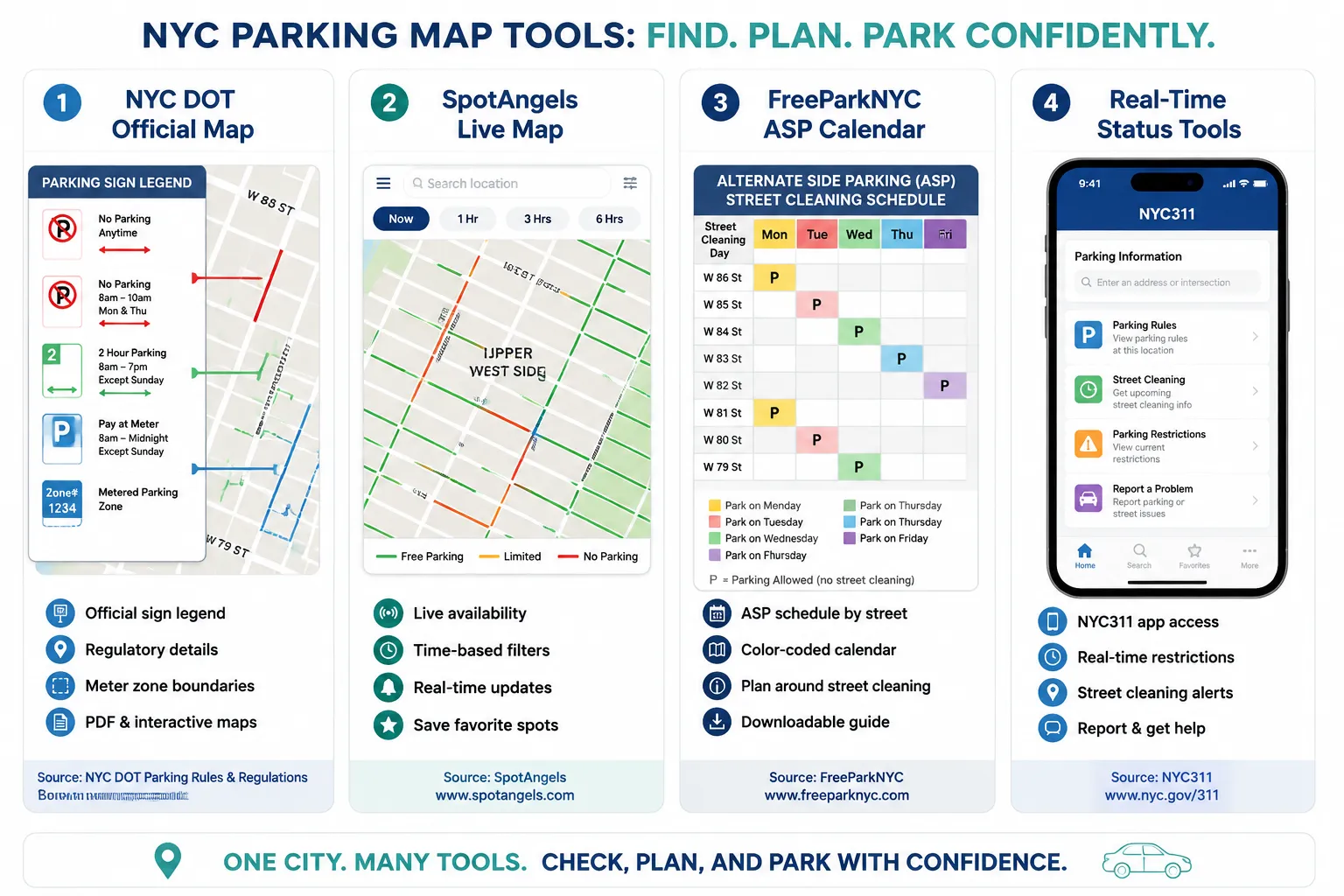
    Real-Time ASP Status Tools

    Check status before parking:

    • Official DOT suspension announcements: Posted at nyc.gov/dot and via 311 alerts
    • Neighborhood-specific trackers: Monitor local ASP status for precise compliance
    • Mobile alerts: Set phone reminders for ASP windows and meter expirations[5][10]

    Explore the Parking Education Hub for comprehensive guides on suspension calendars and citation avoidance.

    High-Risk Parking Zones to Avoid

    Certain locations guarantee citations or towing, regardless of posted signs:

    Safety-Critical Violations

    • Within 15 feet of fire hydrants: $115 fine; painted curbs are not legal indicators[5][8]
    • Blocking bike lanes: Increasingly enforced as DOT assumes parking oversight[1][13]
    • Bus stops and bus lanes: $115 fine plus potential towing[5]
    • Crosswalks and intersections: $115 fine; blocks pedestrian access[8]

    Illegal Spot-Saving and Obstruction Zones

    January 2026 investigations revealed record ticket volumes tied to illegal cone placement[7]. Blocks with visible DIY «reserved» spots using cones, chairs, or barriers are high-risk because:

    • Placing objects on the street is illegal obstruction
    • Parking around improperly placed items can trigger summonses
    • Enforcement targets both the obstruction placer and any driver benefiting from it[7][10]

    Travel Lanes and Double Parking

    Double parking of passenger vehicles is illegal at all times, including during ASP operations[8]. Parking in travel lanes often results in immediate towing plus fines[5].

    Enforcement Shifts and 2026 Policy Changes

    DOT Takeover of Parking Enforcement

    Multiple NYC community boards voted in March and April 2026 to shift parking enforcement from NYPD back to DOT, arguing that police have not prioritized street safety[1][13]. If implemented citywide, expect:

    • Increased focus on safety violations: Blocking bike lanes, bus lanes, and crosswalks will attract more citations
    • Systematic enforcement: DOT may deploy automated systems and dedicated enforcement teams
    • Higher fine collection rates: Specialized parking enforcement historically issues more citations than NYPD patrol

    Shame Stickers for Repeat Violators

    The City Council reauthorized neon adhesive «shame stickers» in July 2026 for chronic bad parkers[12]. These stickers target:

    • Vehicles repeatedly violating ASP rules
    • Cars blocking street sweepers
    • Drivers with multiple unpaid citations

    The policy aims to deter repeat violations in high-turnover cleaning zones.

    Enhanced Plate Verification

    City Council measure Int 0550-2026 requires NYPD to verify license plates and VINs for vehicles with temporary plates or outstanding summonses, publishing quarterly enforcement reports[4]. This scrutiny makes parking with legitimate, properly registered plates in well-marked legal spaces more critical than ever.

    Practical Strategies for Finding Safe Places to Park in NYC

    Walk the Entire Block

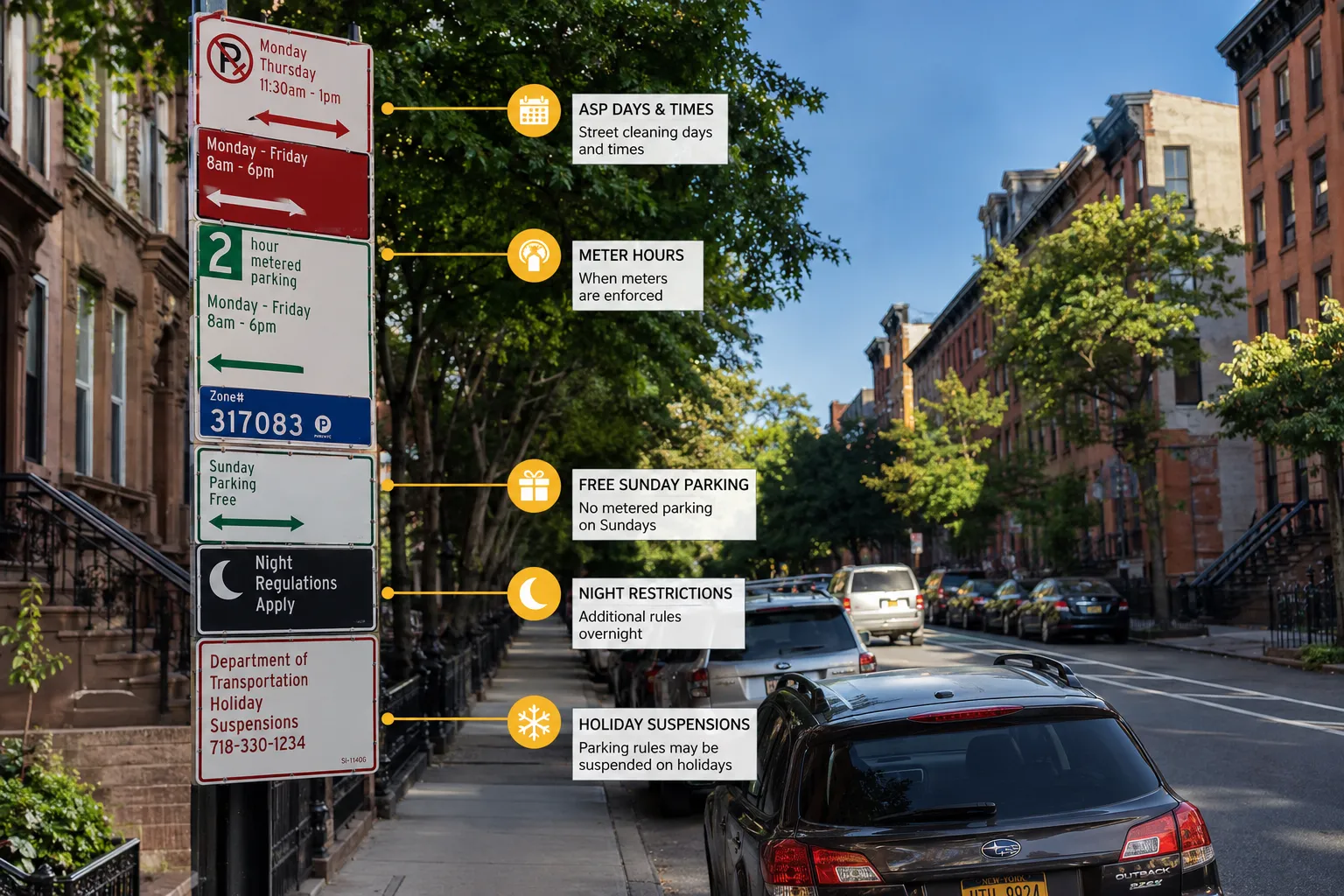
    Many tickets result from missing one sign on the block[5][10]. Before committing to a spot:

    • Read every sign from corner to corner
    • Note overlapping restrictions (metered + ASP + time limits)
    • Verify hydrant distances by walking 15 feet (approximately 5 adult paces)

    Use Digital Payment and Alerts

    The ParkNYC app allows meter extensions without returning to your vehicle, reducing overstay violations[5][10]. Set phone alarms for:

    • Meter expirations
    • ASP window starts
    • Street cleaning schedules

    Subscribe to Official Calendars

    Official suspension calendars and 311 alerts provide advance notice of safe parking windows[2][6]. Subscribe to:

    • DOT ASP suspension announcements
    • Borough-specific parking newsletters
    • Neighborhood community board alerts

    Choose Off-Street When Possible

    Professional garages eliminate citation risk, ASP complexity, and security concerns. Compare rates through the NYC Parking Directory to find cost-effective managed facilities.

    Understand Typical Fine Levels

    Common violations carry predictable penalties[5]:

    • Expired meter: $50-$65
    • ASP violation: $65
    • Hydrant, bus stop, bike lane, crosswalk: $115
    • Travel lane parking: Fine plus towing (typically $400+ total)

    From a risk perspective, parking near hydrants, bus stops, or in ambiguous travel lanes is financially high-risk, while clearly signed legal meters and garages are comparatively safer choices.

    Resources for Tickets, Disputes, and Towing Recovery

    Fighting Unfair Parking Citations

    If you receive an unfair citation, the Tickets & Disputes resource hub provides:

    • Step-by-step dispute filing guides
    • Evidence collection checklists
    • Common defense strategies for ASP, meter, and signage violations

    Towed Vehicle Recovery

    If your vehicle is towed, act immediately to minimize storage fees. The Towing & Impounds guide covers:

    • Locating your towed vehicle through official NYC systems
    • Required documentation for release
    • Contesting wrongful tows
    • Calculating total recovery costs

    ASP Education and Alerts

    The ASP Articles collection provides:

    • Detailed explanations of suspension calendars
    • Neighborhood-specific ASP schedules
    • Historical suspension patterns for planning
    • Real-time status checking procedures

    Citywide Parking Guides

    Explore New York City parking articles for comprehensive coverage of municipal rules, policy changes, and enforcement trends across all five boroughs.

    Conclusion

    Safe places to park in NYC in 2026 are defined by strict legal compliance, real-time ASP tracking, and strategic location selection. With all five boroughs operating as tow-away zones and enforcement shifting toward DOT oversight, drivers must prioritize:

    Immediate Actions:

    1. Check real-time ASP status before parking on any residential block
    2. Verify 15-foot distances from hydrants and avoid all safety-critical zones
    3. Use legal metered spots with ParkNYC app payment to reduce overstay risk
    4. Choose managed off-street garages for extended stays and overnight parking
    5. Subscribe to official suspension calendars and 311 alerts for advance notice

    Avoid High-Risk Zones:

    • Blocks with DIY cone «reservations» and illegal obstructions
    • Bike lanes, bus stops, crosswalks, and travel lanes
    • Areas within 15 feet of fire hydrants, regardless of painted curbs

    Leverage Official Resources:

    Explore the Parking Education Hub at Park Rules Live for real-time ASP status, suspension calendars, garage rate comparisons, and citation dispute guides. Access neighborhood-specific trackers for Brooklyn, Williamsburg, DUMBO, and dozens of other NYC neighborhoods to avoid fines and towing.

    Understand the rules. Check the status. Locate safe, legal parking. Avoid unfair parking citations and impounds by staying informed with official, real-time information.

    References

    [1] Parking Enforcement Nypd To Dot – https://clearplates.com/insights/parking-enforcement-nypd-to-dot [2] Asp Calendar 2026 – https://www.nyc.gov/html/dot/downloads/pdf/asp-calendar-2026.pdf [4] 0550 2026+ – https://intro.nyc/0550-2026+ [5] Nyc Parking Laws 2026 Guide To Rules Tickets And Street Signs – https://citychicliving.com/nyc-parking-laws-2026-guide-to-rules-tickets-and-street-signs/ [6] Alternate Side Parking – https://www.nyc.gov/html/dot/html/motorist/alternate-side-parking.shtml [7] Nyc Drivers Hit With Record Number Of Tickets In Parking Scam And This Borough Is Worst – https://nypost.com/2026/01/20/us-news/nyc-drivers-hit-with-record-number-of-tickets-in-parking-scam-and-this-borough-is-worst/ [8] Parking Regulations – https://www.nyc.gov/html/dot/html/motorist/parking-regulations.shtml [9] Nyc Parking Rules Fourth Of July – https://secretnyc.co/nyc-parking-rules-fourth-of-july/ [10] Avoid Parking Tickets Nyc The 2026 Survival Playbook – https://snagparking.app/avoid-parking-tickets-nyc-the-2026-survival-playbook/ [11] Parking wars in Manhattan – https://nypost.com/2026/03/15/us-news/parking-wars-in-manhattan/ [12] Shame stickers for chronic bad parkers – https://nypost.com/2026/07/10/us-news/shame-stickers-for-chronic-bad-parkers/ [13] Community boards vote to shift parking enforcement – https://clearplates.com/insights/parking-enforcement-nypd-to-dot [14] Suspension Of Alternate Side Parking Regulations Feb 23 26 – https://www.nyc.gov/html/dot/html/pr2026/suspension-of-alternate-side-parking-regulations-feb-23-26.shtml [15] Snow operations ASP suspensions – https://www.nyc.gov/html/dot/html/pr2026/suspension-of-alternate-side-parking-regulations-feb-23-26.shtml

  • How Much Is Impound Fee Per Day NY: 2026 Official Rate Guide

    How Much Is Impound Fee Per Day NY: 2026 Official Rate Guide

    New York drivers face $20 per day at NYPD tow pounds and up to $15 daily at private lots under current NYC regulations, but proposed legislation could triple those caps by 2027. Understanding how much is impound fee per day NY varies dramatically by municipality and tow type is critical to avoiding hundreds in unexpected storage charges.

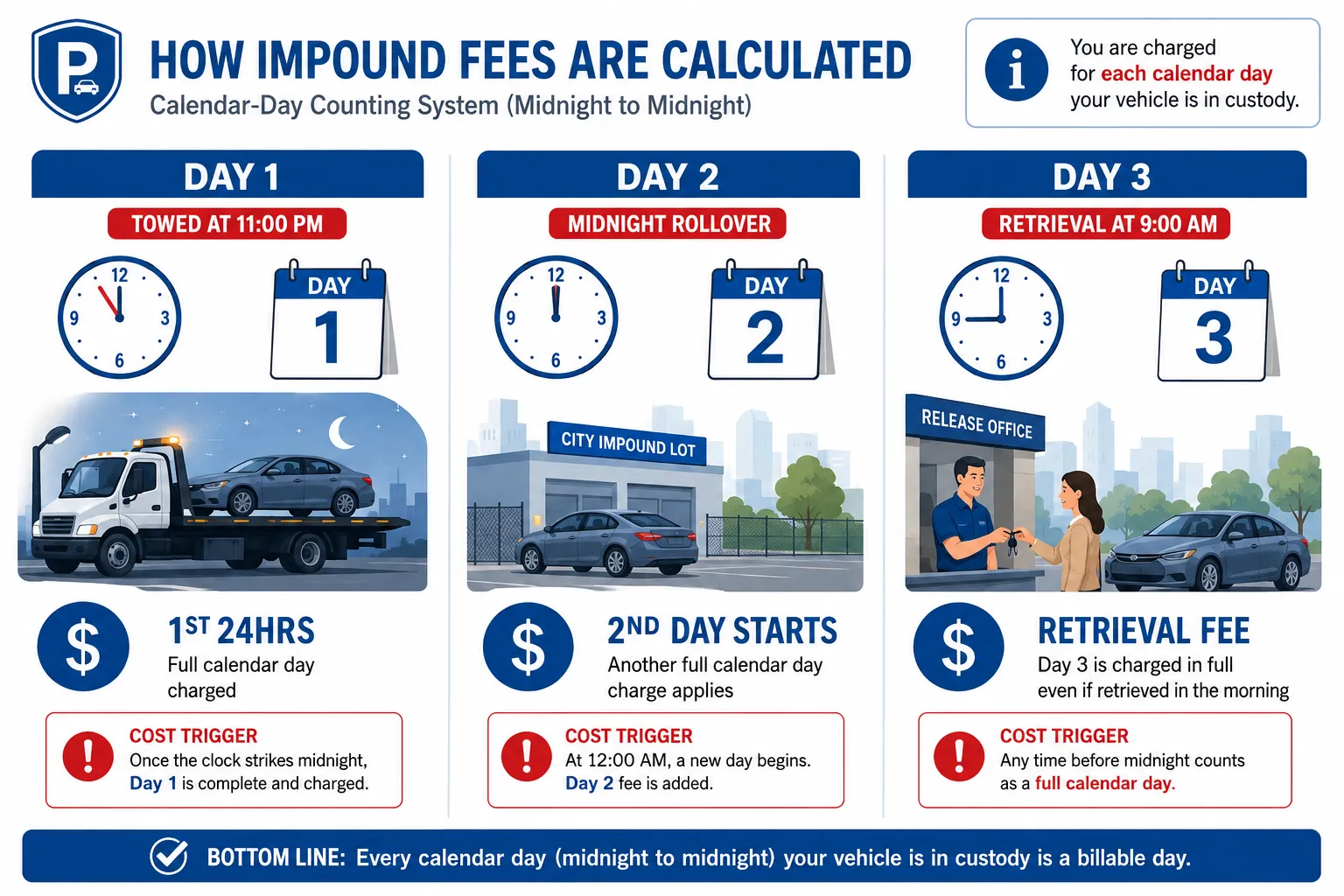
    Every hour your vehicle sits in an impound lot costs money. Calendar-day counting means towing at 11 PM triggers a full day’s fee, and retrieval the next morning adds a second complete charge. Across New York State, daily storage rates range from $10 in smaller towns to $20 at official NYC facilities, with private operators charging different maximums depending on local regulations.

    Key Takeaways

    • NYC NYPD tow pounds charge $20 per day for overnight storage; private NYC tow operators are capped at $15 daily for passenger vehicles under current rules
    • Calendar-day counting means partial days equal full charges, towing late at night and retrieving early morning can trigger two full daily fees
    • Proposed NYC legislation (Intro 545-2024) would raise private lot maximums to $45 per day, nearly tripling current caps
    • Outside NYC, daily impound fees vary widely: Rochester charges $15, Buffalo $10-15, and smaller municipalities set their own rates
    • Total impound costs include towing fees ($185-370 NYC), storage per day, and administrative charges, multi-day impounds quickly exceed $500

    Official NYC Impound Fee Per Day: NYPD Tow Pounds

    NYPD-operated tow pounds charge $20 per day for overnight vehicle storage after the first 24 hours [1]. The initial tow includes the first day, but every subsequent calendar day adds $20 to your total bill. If your car was towed Monday evening and you retrieve it Wednesday morning, expect two full days of storage fees,$40 total, even if the vehicle sat for less than 48 hours.

    Official NYC Impound Fee Per Day: NYPD Tow Pounds

    Calendar-day counting is the critical detail most drivers miss. The clock doesn’t run on 24-hour increments from tow time. Instead, each midnight triggers a new daily charge. A vehicle towed at 11 PM Monday incurs Day 1 immediately; at 12:01 AM Tuesday, Day 2 begins; retrieval at 9 AM Tuesday still means paying for two complete days.

    NYPD facilities store vehicles towed for:

    • Alternate Side Parking violations
    • Fire hydrant blocking
    • Police investigations
    • Abandoned vehicle removal
    • Driving with suspended registration

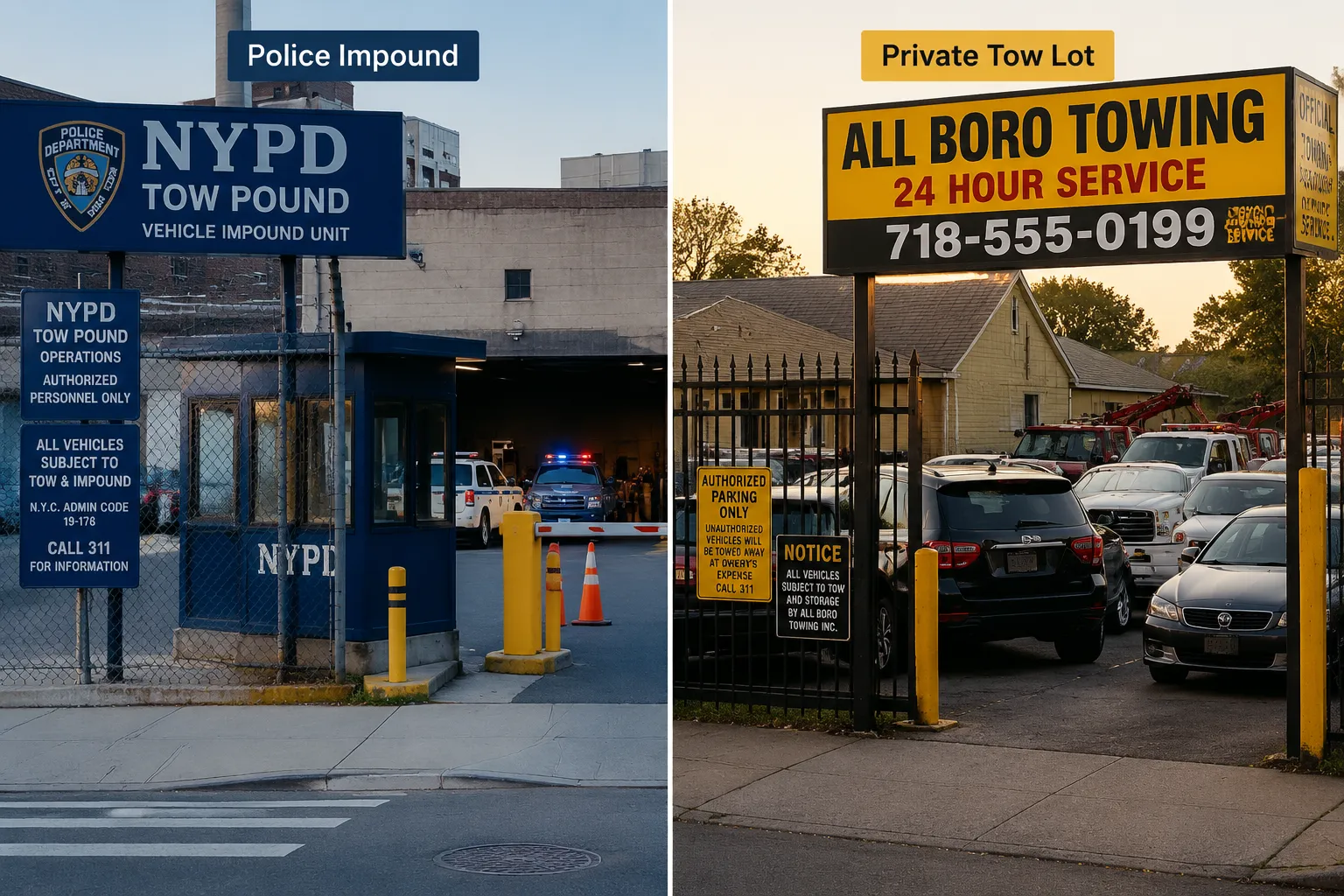
    The $20 daily rate applies uniformly across all five boroughs at official NYPD lots. Private towing companies operating under NYC contracts follow different rate structures, capped separately by Department of Consumer Affairs regulations [3].

    How Days Accumulate at NYC Tow Pounds

    Storage fees compound quickly. A typical three-day impound scenario:

    • Day 1 (tow date): Included in base tow fee
    • Day 2: $20 storage
    • Day 3: $20 storage
    • Total storage: $40 (plus $185+ tow fee)

    Weekends and holidays don’t pause the meter. If your vehicle is towed Friday night and you can’t retrieve it until Monday due to facility hours, you’re paying for Saturday, Sunday, and Monday, three additional days at $20 each [4].

    For vehicles booted then towed after November 2025 rule changes, storage rates increased to $30 per day at NYPD facilities, reflecting higher handling costs for booted vehicles [6]. Check the Towing & Impounds resource hub for current boot-to-tow procedures.

    Private Tow Lot Daily Fees in New York City

    Private towing companies in NYC operate under strict Department of Consumer Affairs caps. Current maximum rates for passenger vehicles are $15 per day for storage [3]. Commercial vehicles and oversized vehicles face higher daily rates, but standard cars, SUVs, and pickup trucks fall under the $15 passenger cap.

    These private operators handle:

    • Property owner-requested tows (illegal parking on private lots)
    • Commercial building tows
    • Parking garage violations
    • Shopping center enforcement

    The $15 daily maximum applies only to regulated private tows within NYC’s five boroughs. Facilities must display rate schedules prominently, and overcharges can be disputed through NYC 311 [3].

    Proposed legislation threatens major increases. NYC Council Intro 545-2024 would raise private lot storage caps to $45 per day,a 200% jump from current rates [8][9]. If passed, a four-day impound that currently costs $60 in storage ($15 × 4) would surge to $180 ($45 × 4). The bill aims to offset operator costs but would significantly impact drivers recovering vehicles after Alternate Side Parking violations or private property tows.

    Private Tow Lot Daily Fees in New York City

    How Much Is Impound Fee Per Day NY: Rates Outside NYC

    New York State municipalities set their own impound storage rates, creating wide variation:

    Rochester: The RPD Auto Impound charges $15 per day for vehicle storage [7]. Vehicles towed for parking violations, abandoned status, or police holds accumulate this daily fee starting the day after the tow.

    Buffalo: Storage rates range $10-15 per day depending on vehicle type and tow reason. Winter alternate parking enforcement generates high impound volume; check Buffalo’s live alternate parking status to avoid towing during snow emergencies.

    Smaller municipalities: Towns like Huntington charge $25 per day after an initial free period [5]. Marlborough sets rates at $10 per day for the first 30 days [10]. Always verify local rates immediately, smaller jurisdictions often lack online payment systems, requiring in-person retrieval during limited business hours.

    Upstate and suburban New York rates typically fall below NYC’s, but total costs still escalate quickly:

    Municipality Daily Storage Typical Tow Fee 3-Day Total
    NYC (NYPD) $20 $185 $225
    Rochester $15 $150 $180
    Buffalo $10-15 $125 $155-170
    Huntington $25 $175 $225

    Check your municipality’s official website or call the local police non-emergency line for exact current rates. Many upstate cities suspend Alternate Side Parking on holidays, reducing winter tow risk.

    Total Cost Breakdown: Towing Plus Daily Storage

    Understanding how much is impound fee per day NY requires calculating the complete retrieval cost:

    Base towing fees (NYC):

    • Standard passenger vehicle: $185 [3]
    • Larger vehicles/commercial: $370+
    • Booted vehicle tow: Additional $136 boot removal fee [6]

    Daily storage fees:

    • NYPD pound: $20/day after first 24 hours
    • Private NYC lot: $15/day (current cap)
    • Upstate municipalities: $10-25/day

    Administrative/processing fees:

    • NYC: Varies by violation type
    • Some municipalities: $25-50 administrative charge

    Real-world scenarios:

    Scenario 1: ASP violation, 2-day NYC impound

    • Tow fee: $185
    • Storage (1 additional day): $20
    • Parking ticket: $65
    • Total: $270

    Scenario 2: Private lot tow, 4-day hold

    • Tow fee: $185
    • Storage (3 additional days): $45
    • Total: $230

    Scenario 3: Booted then towed, 3-day NYPD hold

    • Boot removal: $136
    • Tow fee: $185
    • Storage (2 additional days, higher rate): $60
    • Total: $381

    Payment must be made in full before vehicle release. Most facilities accept credit cards, but some upstate lots require cash or certified checks. Bring your driver’s license, vehicle registration, and proof of insurance to expedite retrieval.

    Disputes over unfair towing or excessive fees should be filed immediately. Review the Tickets & Disputes guide for NYC challenge procedures, or consult your municipality’s consumer affairs office for local processes.

    How to Minimize Impound Storage Costs

    Act immediately. Every delay adds a full day’s charge. If towed overnight, retrieve your vehicle first thing the next morning to avoid a second calendar day.

    Verify tow location fast. NYC drivers can find their towed car through the official NYPD portal or by calling 311. Upstate residents should contact local police non-emergency lines. Faster location means faster retrieval.

    Understand facility hours. NYPD pounds operate limited hours; arriving after closing means waiting until the next business day, and paying for that extra day. Call ahead to confirm hours and required documentation.

    Prevent towing in the first place:

    Know your rights. NYC law requires tow operators to accept credit cards and provide itemized receipts [3]. Overcharges, damaged vehicles, or missing personal property should be documented and reported immediately.

    For chronic parking challenges in dense neighborhoods like Williamsburg or Astoria, monthly garage rates often cost less than accumulated tickets and impound fees. Compare parking garage rates across NYC to find cost-effective alternatives.

    What Happens If You Can’t Pay Impound Fees

    Unpaid impound fees trigger escalating consequences:

    Lien process: After 10-30 days (varies by municipality), the tow facility can file a lien against your vehicle. You remain responsible for accumulating daily storage fees during this period.

    Auction sale: If fees remain unpaid for 30-90 days, the facility may auction your vehicle to recover costs. Sale proceeds cover towing, storage, and administrative fees; any surplus (rare) is theoretically returned to the owner, but auction prices typically fall below total accumulated charges.

    Credit impact: Unpaid towing and storage fees can be sent to collections, damaging your credit score for years.

    Registration holds: New York DMV may place a registration suspension on your license if towing-related fines go unpaid, preventing vehicle registration renewal.

    If you genuinely cannot afford retrieval costs, contact the tow facility immediately to discuss payment plans. Some NYC facilities and upstate operators offer installment options for hardship cases, though this is not guaranteed. Legal aid organizations may assist with disputes over improper tows.

    Abandoning a vehicle to avoid fees is never advisable, you lose the vehicle’s value, damage your credit, and may face additional fines or registration consequences.

    Proposed NYC Rate Increases: What to Expect

    NYC Council Intro 545-2024, currently under review, would dramatically increase private tow lot maximums [8][9]:

    Proposed new daily storage caps:

    • Passenger vehicles: $45/day (up from $15)
    • Commercial vehicles: $60/day (up from $20)
    • Motorcycles: $30/day (up from $10)

    Projected impact:

    A typical 5-day impound under proposed rates:

    • Tow fee: $185
    • Storage (4 days × $45): $180
    • Total: $365 (vs. $245 under current rates)

    The legislation also proposes raising base tow fees and eliminating some consumer protections around rate transparency. Industry advocates argue current caps haven’t increased since 2010 and don’t cover operating costs; consumer groups counter that tripling rates will disproportionately harm low-income drivers already struggling with parking enforcement in areas with limited off-street parking.

    Timeline: The bill is in committee as of early 2026. If passed, new rates could take effect within 60-90 days of signing. Track the legislation through NYC Council’s public portal and consider submitting public comments if the increases would impact your household.

    Until new rates are enacted, current caps remain in force. Verify charges on your impound receipt match legal maximums, and report overcharges to NYC Department of Consumer Affairs.

    Conclusion

    How much is impound fee per day NY ranges from $10 in smaller municipalities to $20 at NYPD tow pounds, with private NYC operators currently capped at $15 daily. Calendar-day counting means even short impounds trigger multiple full-day charges, and proposed legislation could triple private lot rates to $45 per day by 2027.

    Take action now:

    • Check Real-Time Status daily using Park Rules Live to avoid Alternate Side Parking violations
    • Locate towed vehicles immediately to minimize storage days
    • Understand your municipality’s rates before parking in high-enforcement zones
    • Explore monthly garage options if street parking repeatedly risks towing
    • Document all charges and dispute overcharges through official channels

    Every day counts when your vehicle is impounded. Retrieve it fast, know your rights, and use real-time parking tools to avoid towing in the first place. For ongoing updates on ASP suspensions, parking regulations, and towing procedures across New York State, bookmark Park Rules Live’s comprehensive guides and set mobile alerts for your neighborhood.

    SEO Meta Title: NY Impound Fee Per Day: 2026 Official Rates & Cost Guide

    SEO Meta Description: Learn how much impound fees cost per day in NY. NYC charges $20/day at NYPD pounds, $15 at private lots. Rates, total costs, and 2026 changes explained.

    References

    [1] Towed Vehicles – https://www.nyc.gov/site/nypd/services/vehicles-property/towed-vehicles.page

    [2] New York – https://towingcosts.com/impound-fees/new-york

    [3] Shopping Services Towing – https://www.nyc.gov/site/dca/consumers/shopping-services-towing.page

    [4] Article – https://portal.311.nyc.gov/article/?kanumber=KA-02149

    [5] huntingtonny.gov – https://www.huntingtonny.gov/311/knowledgebase/article/1409

    [6] What To Do If Your Car Is Towed In Nyc – https://towtruck.nyc/blog/what-to-do-if-your-car-is-towed-in-nyc/

    [7] Rpd Auto Impound – https://www.cityofrochester.gov/departments/police/rpd-auto-impound

    [8] 0545 2024+ – https://intro.nyc/0545-2024+

    [9] Legislationdetail – https://legistar.council.nyc.gov/LegislationDetail.aspx?ID=6180311&GUID=F56DF829-8359-489B-8C71-2E9476512A75&Options=&Search=

    [10] Towing Storage Fees – https://www.townofmarlboroughny.gov/2282/Towing-Storage-Fees

  • How Much Are Repossession Fees in NY: Official 2026 Cost Breakdown

    How Much Are Repossession Fees in NY: Official 2026 Cost Breakdown

    New York law does not cap repossession fees at a fixed dollar amount. Instead, lenders and repossession agents may charge you only «reasonable expenses» for taking, storing, and selling your vehicle, and those costs can climb quickly if you don’t act fast. Understanding how much are repossession fees in NY means knowing what charges are legal, what you must pay to redeem your car, and how to challenge unfair costs before they drain your wallet.

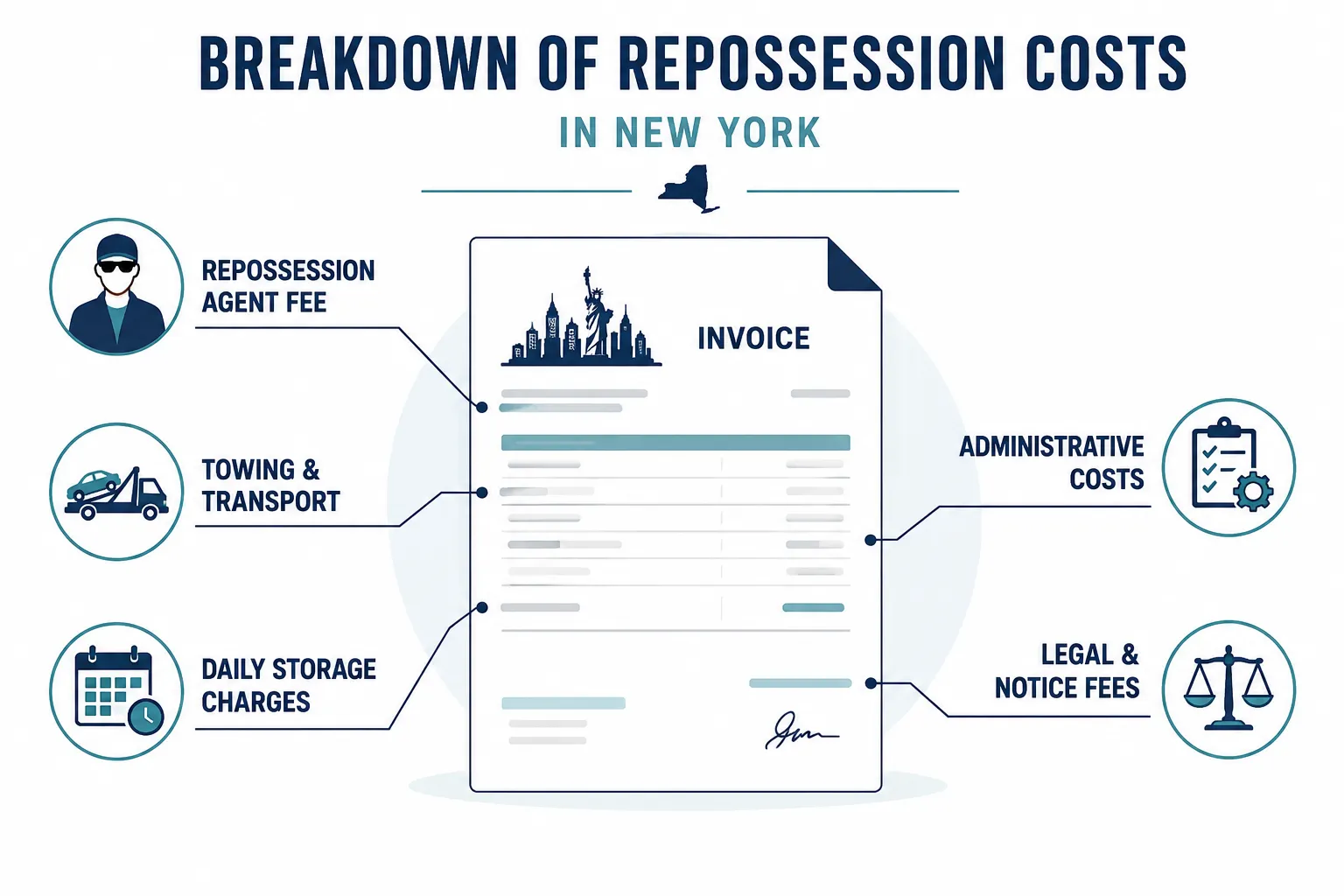
    Repossession fees in New York typically include the agent’s pickup charge (often $200,$500), towing and transport, daily storage (commonly $25,$75 per day), administrative costs, and any legal or notice expenses the lender incurred [1][4]. Because storage accrues daily, a vehicle held for two weeks can accumulate $350,$1,050 in storage alone. This guide breaks down every component of how much are repossession fees in NY, explains your legal rights under New York’s Uniform Commercial Code, and shows you how to retrieve your vehicle or dispute excessive charges.

    Key Takeaways

    • New York law requires repossession fees to be «reasonable» but sets no fixed dollar cap; typical agent fees range $200,$500, plus towing and storage.
    • Daily storage charges of $25,$75 accrue from the moment your car is impounded, making early redemption critical to avoid mounting costs.
    • You have the right to redeem your vehicle by paying the full loan balance, all repossession expenses, and any accrued interest before the lender sells it.
    • Lenders must send you a written notice listing the total redemption amount, including every fee, within a legally mandated timeframe.
    • If fees appear excessive or undocumented, you can challenge them in court; New York’s UCC Article 9 requires all charges to be commercially reasonable.

    What Are Repossession Fees in New York?

    Repossession fees are the costs a lender passes to you after hiring an agent to seize, tow, store, and prepare your vehicle for sale. In New York, these fees must be «reasonable» under Article 9 of the Uniform Commercial Code [1][6]. The law does not publish a schedule of maximum charges; instead, courts evaluate whether each expense reflects actual, necessary costs incurred by the lender.

    Common repossession-related charges include:

    • Repossession agent fee: The flat charge for locating and taking possession of your vehicle, typically $200,$500 depending on the difficulty of the pickup [4][10].
    • Towing and transport: The cost to haul your car from the street or driveway to the impound lot, often $100,$300 based on distance and vehicle size.
    • Daily storage: A per-day fee for holding your vehicle in a secure facility, ranging $25,$75 per day [1][4]. Storage begins the day the car arrives and continues until you redeem it or the lender sells it.
    • Administrative and processing costs: Paperwork, title searches, lien filings, and notice preparation, usually $50,$150 total [8].
    • Legal and notice expenses: Certified mail, publication costs if required, and attorney fees if the lender obtained a court order (rare in voluntary-lien repos but possible in breach-of-peace disputes).

    Because storage accrues daily, the total amount you owe grows every 24 hours your vehicle remains impounded. A car held for 10 days at $50/day adds $500 in storage alone, on top of the initial agent and towing fees.

    What Are Repossession Fees in New York?

    How Much Are Repossession Fees in NY: Typical Cost Ranges

    While New York does not mandate a fee schedule, industry practice and consumer reports reveal consistent ranges for how much are repossession fees in NY in 2026:

    Fee Component Typical Range Notes
    Repossession agent pickup $200,$500 Higher for hard-to-locate vehicles or after-hours recovery
    Towing and transport $100,$300 Distance, vehicle weight, and flatbed vs. wheel-lift affect cost
    Daily storage $25,$75/day Begins immediately; can exceed $1,000 after two weeks
    Administrative costs $50,$150 Title search, lien filing, notice preparation
    Legal/notice expenses $50,$200 Certified mail, publication, attorney fees if litigation occurred

    Real-world example: A borrower in New York City whose sedan was repossessed and held for 14 days faced a redemption bill of $3,200: $400 agent fee, $250 towing, $700 storage (14 days × $50), $100 administrative, $75 certified-mail notices, plus $1,675 in past-due loan payments and interest [4]. The storage component alone accounted for nearly one-quarter of the total redemption cost.

    Lenders often contract with repossession companies that charge the lender a wholesale rate, then the lender invoices you for the full retail amount plus markup [10]. New York law permits recovery of actual expenses but forbids padding fees beyond what the lender truly paid unless the charge reflects genuine administrative overhead [1][6].

    What You Must Pay to Redeem Your Repossessed Vehicle

    Under New York UCC § 9-623, you have an absolute right to redeem your vehicle at any time before the lender sells it [9]. To redeem, you must pay:

    1. The entire outstanding loan balance (not just past-due installments).
    2. All reasonable repossession expenses itemized by the lender.
    3. Accrued interest and late fees through the redemption date.
    4. Any attorney fees or court costs if specified in your loan contract and actually incurred.

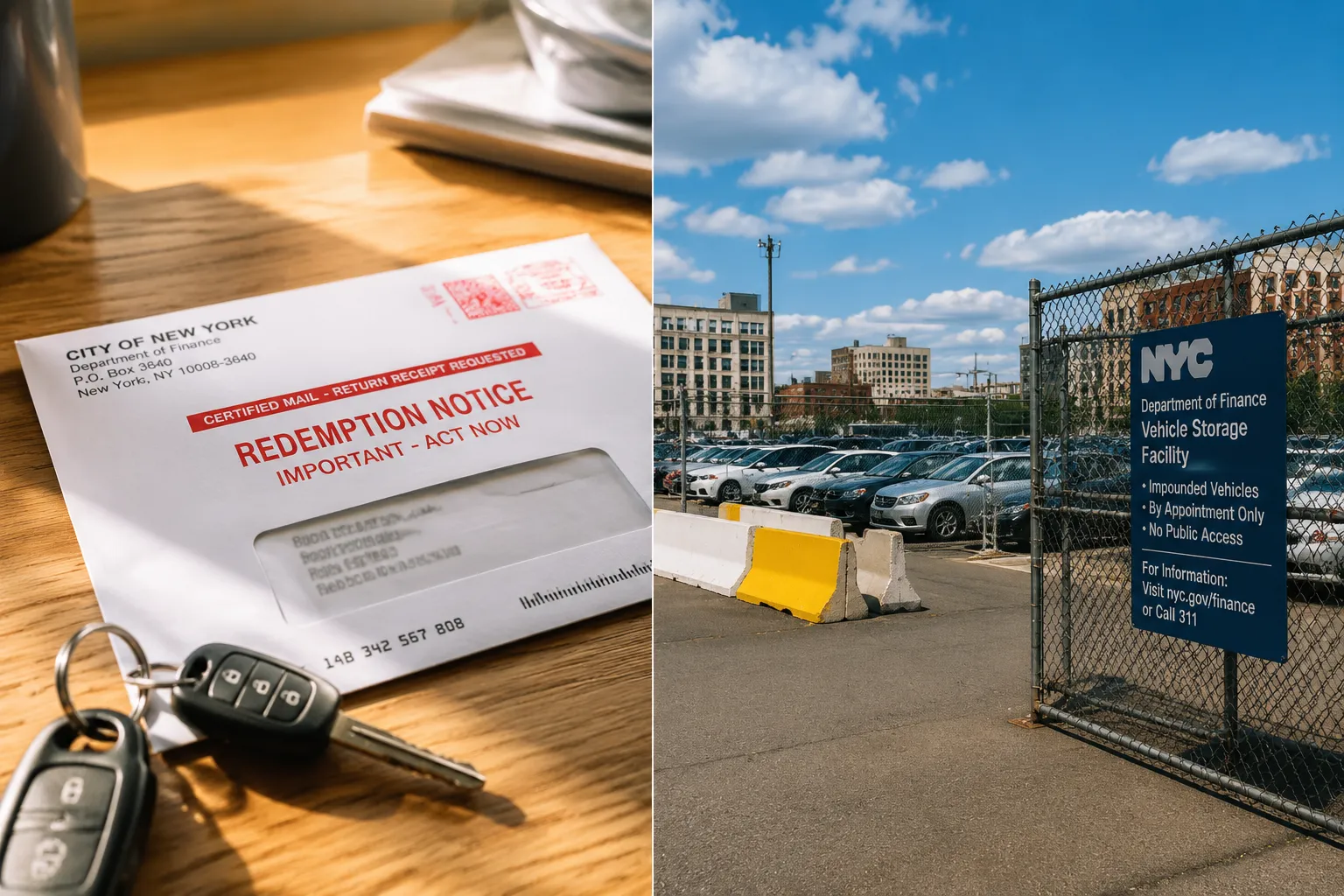
    The lender must provide you with a written notice of redemption amount that lists every fee and the total sum required [8]. This notice typically arrives by certified mail within 5-10 business days of repossession. If the lender fails to send the notice or inflates charges, you may challenge the redemption figure in court before paying.

    Key deadlines:

    • You can redeem until the lender completes the sale (auction or private sale).
    • Once the vehicle is sold, your redemption right expires; you can only pursue a deficiency-balance dispute if the sale proceeds fall short of your loan balance [2][4].

    Paying the redemption amount in full immediately stops storage fees and returns your car. Many New York borrowers negotiate partial payment plans with lenders before the sale deadline, though lenders are not legally required to accept installment redemption [6].

    If you cannot afford the full redemption cost, explore off-street parking options and garage rate comparisons to avoid additional Alternate Side Parking violations while you resolve the repossession.

    What You Must Pay to Redeem Your Repossessed Vehicle

    How Repossession Fees Are Applied After Sale

    If you do not redeem your vehicle, the lender will sell it at public auction or through a private sale. New York UCC § 9-615 governs how sale proceeds are distributed [1][6]:

    1. Reasonable expenses of repossession, storage, and sale are deducted first.
    2. The outstanding loan balance (principal, interest, late fees) is paid second.
    3. Any surplus goes to you or to junior lienholders (rare in auto repos).
    4. Any deficiency (shortfall) may be collected from you if your loan contract permits and the lender provides proper notice [2][4].

    Example: Your loan balance is $8,000. Repossession and storage fees total $1,200. The lender sells your car for $6,500. The $1,200 in fees is paid first, leaving $5,300 to apply against your $8,000 balance. You still owe a $2,700 deficiency, which the lender can pursue through collections or lawsuit [4].

    Lenders must conduct every sale in a «commercially reasonable» manner, adequate notice, fair market advertising, and a price reflecting actual market value [6][8]. If the sale was rushed, underpriced, or conducted without proper notice, you can challenge the deficiency in court and argue that inflated repossession fees reduced the net proceeds unfairly.

    Legal Protections and How to Challenge Excessive Fees

    New York’s UCC Article 9 and consumer-protection case law provide several defenses against unreasonable repossession fees:

    • Reasonable-expense standard: Every fee must reflect actual costs. If a lender charges $600 for a $300 tow, you can demand documentation and dispute the excess [1][6].
    • Itemized notice requirement: The redemption notice must list each fee separately. Lump-sum «repossession costs» without detail may be unenforceable [8].
    • Commercially reasonable conduct: Courts will void fees tied to improper procedures, e.g., storing your car at a facility owned by the lender’s affiliate and charging above-market rates [6].
    • Breach-of-peace prohibition: If the repo agent damaged your property, threatened you, or entered a locked garage without permission, the entire repossession may be invalid, and you owe nothing [4][7].

    Steps to challenge fees:

    1. Request an itemized invoice from the lender showing every charge, the service provider, and the date incurred.
    2. Compare charges to market rates: Call local tow companies and storage lots to verify typical costs in your area.
    3. Document any procedural violations: Photos of damage, witness statements, or police reports if the agent acted improperly.
    4. File a motion in court if the lender sues for a deficiency; assert excessive fees as an affirmative defense and demand proof of reasonableness [2][6].
    5. Consult a consumer-rights attorney: Many New York legal-aid organizations offer free consultations on repossession disputes [3].

    If you successfully prove fees were inflated, the court may reduce your redemption amount or deficiency balance by the excess. In egregious cases, such as a breach-of-peace repo, you may recover damages from the lender [4][6].

    For additional guidance on disputing unfair municipal charges, see our guide to fighting a double parking ticket in NYC, which outlines similar documentation and hearing strategies.

    Avoiding Repossession Fees: Proactive Steps

    The best way to minimize how much are repossession fees in NY cost you is to prevent repossession entirely or act immediately once it occurs:

    • Communicate with your lender early: Most New York lenders will negotiate a payment plan, deferment, or loan modification if you contact them before you miss multiple payments [8].
    • Understand your grace period: Review your contract to know how many days late trigger repossession; New York law does not require lenders to wait a specific number of days after default [4][6].
    • Check Alternate Side Parking rules: If your car is parked on a New York City street, ensure compliance with Alternate Side Parking to avoid towing that compounds your financial stress. Use real-time ASP status tools to stay informed.
    • Redeem within 48 hours if possible: Every day in storage adds $25,$75 to your bill. Borrowing from family or using a credit card to pay the redemption amount immediately can save hundreds in storage fees.
    • Explore off-street parking: If you’re at risk of repo, move your vehicle to a secure garage. Compare rates across NYC parking garages to find affordable monthly options that keep your car out of sight.
    • Know your rights: Repo agents cannot break into your locked garage, use force, or threaten you. If they do, document everything and contact an attorney immediately [4][7].

    New York credit unions and consumer lenders are required to follow fair repossession guidelines, including reasonable notice and transparent fee disclosure [8]. If your lender is a federally chartered institution, you can also file a complaint with the Consumer Financial Protection Bureau.

    For neighborhood-specific parking resources, explore Parking in Brooklyn, Parking in Manhattan, and Parking in the Bronx to secure your vehicle and avoid both municipal towing and private repossession.

    Conclusion

    How much are repossession fees in NY depends on the agent’s pickup charge, towing distance, daily storage rates, and administrative costs, all of which must be «reasonable» under New York law but are not capped at fixed amounts. Typical total fees range from $500 to $1,500 or more, with storage accruing $25,$75 per day. You have the legal right to redeem your vehicle by paying the full loan balance plus all documented expenses before the lender sells it, and you can challenge any fee that appears excessive or unsupported.

    Take action now:

    • Request an itemized redemption notice from your lender immediately.
    • Compare each charge to local market rates and demand documentation.
    • Redeem your vehicle within days to stop storage fees from mounting.
    • Consult a consumer-rights attorney if fees appear inflated or the repossession violated New York’s breach-of-peace rules.
    • Use real-time Alternate Side Parking status and citywide parking resources to keep your car secure and compliant, reducing the risk of both municipal towing and private repossession.

    Understanding your rights and acting quickly are the most effective ways to minimize repossession costs and protect your financial future in New York.

    References

    [1] Repo Laws In New York On Debt Collection Fees – https://www.daeryunlaw.com/us/insights/repo-laws-in-new-york-on-debt-collection-fees [2] Repossession – https://www.nycbar.org/get-legal-help/article/debts-debt-collection/repossession/ [3] Automobiles – http://161.11.225.182/assisting/clhm/automobiles.htm [4] Can They Repossess My Car In New York – https://rausarusso.com/blog/can-they-repossess-my-car-in-new-york [6] Repossession Laws In New York – https://rightsprotect.com/illegal-repossessions-of-vehicles/repossession-laws-by-state/repossession-laws-in-new-york/ [7] law.justia – https://law.justia.com/codes/new-york/vat/title-4/article-17/425/ [8] Repossession Guidelines – https://nycua.org/supporting/compliance/compliance-corner/repossession-guidelines [9] law.justia – https://law.justia.com/codes/new-york/pep/article-9/316/ [10] New York Repossession – http://newyork-repo.com/new-york-repossession.htm

  • How to Plead Not Guilty NYC Parking Tickets: Official 2026 Guide

    How to Plead Not Guilty NYC Parking Tickets: Official 2026 Guide

    New York City issues more than 10 million parking tickets annually, generating over $600 million in revenue. Every single one of those citations carries a 30-day window to contest, and most drivers never use it. Understanding how to plead not guilty NYC parking tickets can save hundreds of dollars and protect your driving record from unfair citations.

    This guide walks through every official method to dispute NYC parking violations in 2026, from online hearings to in-person appeals, with real-time deadlines and step-by-step instructions.

    Key Takeaways

    • Plead not guilty within 30 days of the ticket date to avoid automatic judgment and penalties
    • Three official dispute methods exist: online (fastest), mail, and in-person at DOF Business Centers
    • Online disputes through NYC.gov offer the quickest resolution, often within 60-90 days
    • After-judgment options exist but are limited to specific circumstances like proof of payment or procedural errors
    • Missing the 30-day window triggers default judgment, late fees, and potential vehicle registration suspension

    Understanding NYC Parking Ticket Disputes

    Understanding NYC Parking Ticket Disputes

    Pleading not guilty to an NYC parking ticket means formally requesting a hearing with the Department of Finance (DOF) to contest the violation. This is not the same as New York State traffic tickets handled by the Traffic Violations Bureau, parking violations fall under city jurisdiction with separate rules and procedures [1].

    The DOF operates the entire parking violation dispute system. When you plead not guilty, you trigger an administrative hearing process where an Administrative Law Judge reviews your evidence and defense.

    Critical deadline: 30 days from the violation date.

    Miss this window, and the city enters a default judgment against you. Penalties escalate, and your options narrow dramatically [5].

    Why the 30-Day Rule Matters

    The 30-day clock starts ticking the moment the agent writes the ticket, not when you discover it on your windshield. For mailed violations (camera tickets, registration issues), the clock begins on the issue date printed on the notice [1].

    After 30 days without a plea:

    • Default judgment enters automatically
    • Late penalties add 10% to the fine
    • The violation becomes a debt eligible for collections
    • Your vehicle registration can be suspended
    • Boot and tow risk increases significantly [9]

    Check your Alternate Side Parking status regularly to avoid violations during street cleaning, one of the most common citation triggers across all five boroughs.

    How to Plead Not Guilty NYC Parking Tickets Online

    How to Plead Not Guilty NYC Parking Tickets Online

    The online dispute method offers the fastest, most efficient path to contest NYC parking tickets in 2026. The entire process happens through the official NYC.gov portal, with digital evidence uploads and email notifications [2].

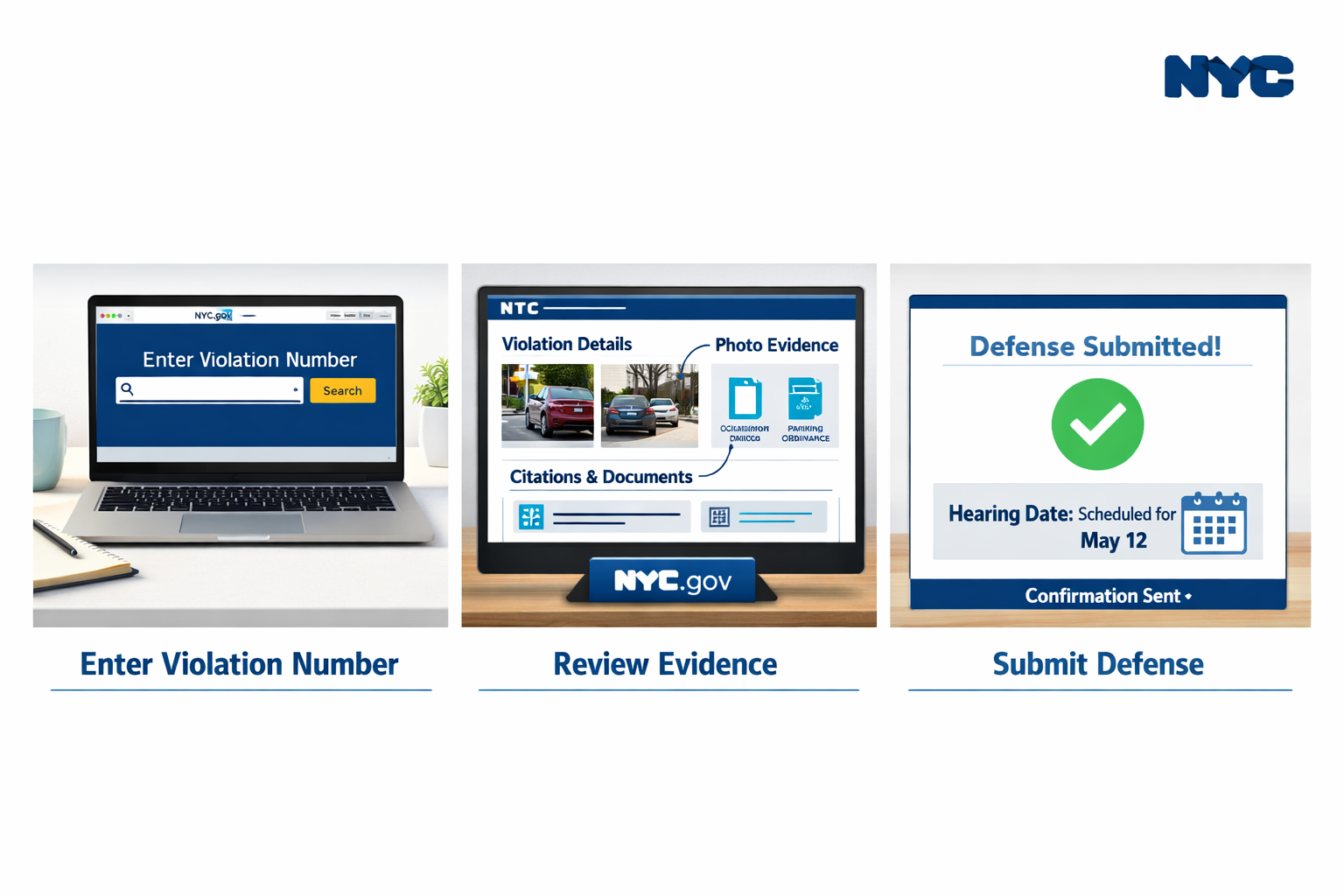
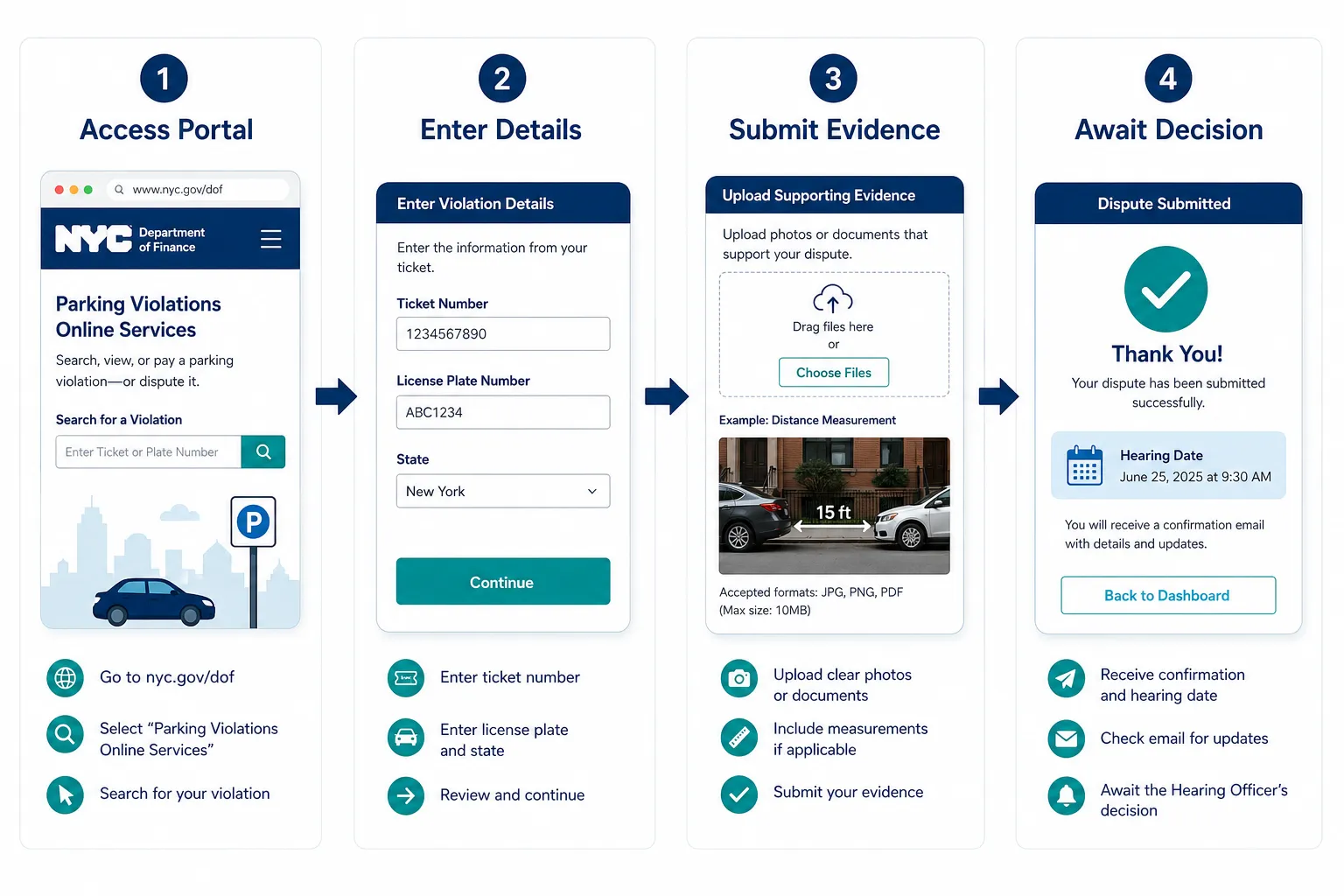
    Step-by-Step Online Dispute Process

    1. Access the Official Portal

    Navigate to the NYC Department of Finance dispute page at nyc.gov/finance. Locate the «Dispute a Parking Ticket» section and click «Dispute Online» [2].

    2. Enter Your Violation Information

    Input the violation number (printed on your ticket) or your license plate number. The system retrieves your citation details from the city database [3].

    3. Review Violation Details

    Verify the ticket information: date, time, location, violation code, and fine amount. Confirm the violation is still within the 30-day dispute window [5].

    4. Select Your Defense

    Choose from pre-populated defense categories or select «Other» to write a custom explanation. Common defenses include:

    • Meter was broken or malfunctioning
    • Signs were missing, obscured, or contradictory
    • Vehicle was stolen or used without permission
    • Alternate Side Parking was suspended that day
    • Registration or inspection was valid despite agent error

    5. Upload Supporting Evidence

    Attach up to three digital files: photos of signs, meter receipts, registration documents, or proof of suspension. Accepted formats: JPG, PNG, PDF (max 2MB per file) [2].

    6. Submit and Confirm

    Review your submission. The system generates a confirmation number. Save this, you’ll need it to track your hearing status.

    7. Await Decision

    The DOF typically renders decisions within 60-90 days. You’ll receive email notification if you provided an address. Check hearing status anytime using your confirmation number [5].

    Online Dispute Advantages

    • Speed: Fastest processing time, often 30-60 days quicker than mail
    • Convenience: Submit 24/7 from any device
    • Evidence: Upload photos and documents directly
    • Tracking: Real-time status updates via confirmation number
    • Confirmation: Immediate digital receipt of submission

    For drivers managing multiple vehicles or commercial fleets, bookmark the Tickets & Disputes resource hub for violation-specific defense strategies.

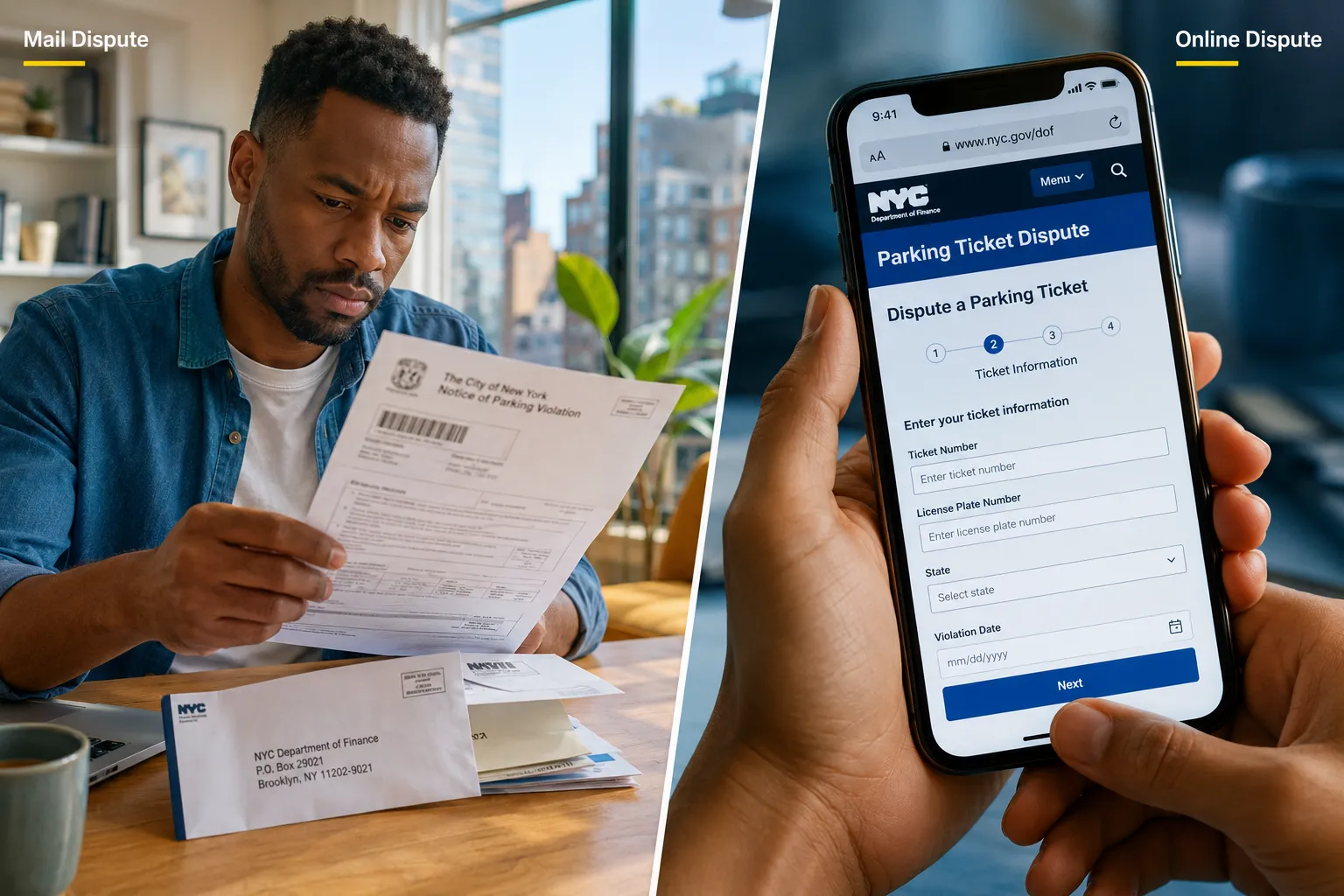
    How to Plead Not Guilty by Mail

    Mail disputes remain a viable option for drivers who prefer paper documentation or lack reliable internet access. The process requires more time, expect 90-120 days for resolution, but follows straightforward procedures [10].

    Mail Dispute Requirements

    What to Include:

    • Original ticket or a clear photocopy
    • Written explanation of your defense (typed or legibly handwritten)
    • Supporting evidence: photos, receipts, documents (copies, not originals)
    • Your contact information: name, address, phone, email (optional but recommended)

    Where to Mail:

    NYC Department of Finance P.O. Box 29021 New York, NY 10087-9021 [10]

    Postmark Deadline:

    Your envelope must be postmarked within 30 days of the violation date. Use certified mail with return receipt if you want proof of delivery [10].

    Mail Dispute Best Practices

    Be Specific: Reference the exact violation code and explain why it doesn’t apply. Vague statements like «This ticket is unfair» rarely succeed.

    Organize Evidence: Number each piece of evidence and reference it in your written defense. Example: «Photo 1 shows the missing parking sign at the cited location.»

    Keep Copies: Photocopy everything before mailing. The DOF does not return submitted materials.

    Track Delivery: Use USPS tracking to confirm arrival. The DOF processes mail disputes in order of receipt [10].

    For alternate side parking violations specifically, reference the official suspension calendar. Many successful disputes hinge on proving ASP was suspended due to holidays or weather, verify the live suspension status before submitting your defense.

    How to Plead Not Guilty in Person

    In-person disputes allow face-to-face interaction with DOF staff and immediate confirmation of submission. This method works best for complex cases requiring detailed explanation or for drivers who need assistance with the process [4].

    DOF Business Center Locations

    Manhattan 66 John Street, 3rd Floor New York, NY 10038 Monday-Friday, 8:30 AM – 4:30 PM [6]

    Brooklyn 210 Joralemon Street, 4th Floor Brooklyn, NY 11201 Monday-Friday, 8:30 AM – 4:30 PM [6]

    Queens 144-06 94th Avenue Jamaica, NY 11435 Monday-Friday, 8:30 AM – 4:30 PM [6]

    Bronx 1932 Arthur Avenue, Room 101 Bronx, NY 10457 Monday-Friday, 8:30 AM – 4:30 PM [6]

    Staten Island 350 St. Marks Place, 1st Floor Staten Island, NY 10301 Monday-Friday, 8:30 AM – 4:30 PM [6]

    In-Person Dispute Process

    1. Bring Required Documents

    • Original parking ticket
    • Government-issued photo ID
    • Vehicle registration
    • Supporting evidence (photos, receipts, documents)

    2. Arrive During Business Hours

    Wait times vary by location and time of day. Mornings (8:30-10:00 AM) typically see shorter lines. Avoid lunch hours (12:00-2:00 PM) [4].

    3. Submit Your Plea

    DOF staff will process your not-guilty plea, review your evidence for completeness, and provide a hearing confirmation receipt [4].

    4. Receive Confirmation

    You’ll get a paper receipt with your hearing number. Keep this, it’s your only proof of submission for in-person disputes.

    For drivers dealing with double parking violations, in-person submission allows you to explain complex scenarios like emergency situations or contradictory signage that may not translate well in written form.

    After-Judgment Options: Contesting Old Tickets

    Missed the 30-day window? Limited options exist to reopen closed cases, but success rates drop significantly once default judgment enters [5].

    Grounds for After-Judgment Review

    Valid Reasons:

    • Proof of Payment: You paid the ticket, but the system shows it as unpaid
    • Procedural Error: The DOF failed to notify you properly (wrong address, no notice sent)
    • Identity Theft: Someone else received the ticket using your plate/registration
    • Stolen Vehicle: The car was reported stolen at the time of violation
    • Duplicate Ticket: You already paid or disputed the same violation [5]

    Invalid Reasons:

    • «I forgot to respond»
    • «I didn’t see the ticket on my windshield»
    • «I was too busy»

    The DOF does not accept these as grounds for reopening [5].

    How to Request After-Judgment Review

    Online: Use the same dispute portal, but select «Request After-Judgment Review» and provide documentation proving one of the valid grounds [2].

    Mail: Send your request to the same P.O. Box address with clear explanation and supporting proof [10].

    In Person: Visit any DOF Business Center with documentation. Staff can review eligibility immediately [4].

    Critical: After-judgment reviews do not stop collections, boot/tow actions, or registration suspensions. If your case is in collections, contact the DOF Collections Unit directly at (212) 232-3550 [9].

    NYC Parking Ticket Dispute Success Strategies

    Winning your dispute requires more than just pleading not guilty, you need a defensible argument backed by evidence.

    Strongest Defense Categories

    1. Defective or Missing Signs

    Photograph the exact location showing:

    • Missing regulatory signs
    • Obstructed or damaged signs
    • Contradictory signage (two signs with conflicting rules)
    • Faded or illegible text

    Include street address, cross streets, and timestamp on photos.

    2. Meter Malfunctions

    Document:

    • Error messages on meter screen
    • Receipt showing payment but ticket issued anyway
    • Broken card reader or coin slot
    • Meter number and location

    Report the broken meter to 311 immediately, your service request number strengthens your case [7].

    3. Alternate Side Parking Suspensions

    Prove ASP was suspended:

    • Official NYC suspension calendar printout
    • Weather emergency declarations
    • Holiday schedule confirmation

    Cross-reference the official ASP status for the violation date. Many successful disputes stem from agent error during suspended periods.

    4. Registration/Inspection Valid

    Attach:

    • DMV registration receipt showing valid dates
    • Inspection sticker photo with visible expiration
    • Renewal confirmation if recently updated

    Agent misreads or data entry errors cause thousands of invalid tickets annually.

    5. Commercial/Delivery Exceptions

    For commercial drivers:

    • Placard photos (if authorized)
    • Delivery documentation (time-stamped)
    • Loading zone regulations for that location

    Review parking options across NYC boroughs to identify legal commercial loading zones for future deliveries.

    Evidence Quality Matters

    Strong Evidence:

    • Time-stamped photos from the violation date
    • Official documents (DMV records, suspension calendars)
    • Meter receipts with matching date/time
    • 311 service requests filed before or on violation date

    Weak Evidence:

    • Photos taken days or weeks after the violation
    • Generic statements without proof
    • Blurry or unclear images
    • Hearsay or witness statements without documentation

    Common NYC Parking Violations and Defenses

    Different violation codes require tailored defense strategies.

    Violation Code 21 (Street Cleaning/ASP): Prove ASP was suspended or signs were missing. Check the real-time ASP status for the date in question.

    Violation Code 38 (Meter Expired): Show meter malfunction, valid receipt, or broken equipment. Report meter issues to 311 immediately.

    Violation Code 71 (No Inspection): Provide proof of valid inspection or recent renewal not yet updated in city database.

    Violation Code 14 (No Standing): Demonstrate emergency situation, contradictory signage, or that you were actively loading/unloading (commercial only).

    Violation Code 20 (No Parking): Photograph missing or obscured signs, or prove the restriction didn’t apply at that time/day.

    For comprehensive violation-specific strategies, explore the Parking Education Hub resources.

    Hearing Process and What to Expect

    After submitting your not-guilty plea, the DOF schedules an administrative hearing. In 2026, most hearings occur remotely via online portal [5].

    Hearing Format

    Online Hearing (Default): An Administrative Law Judge reviews your written defense and evidence. No live appearance required. Decision arrives via mail and email within 30-60 days of submission [5].

    In-Person Hearing (By Request): Available for complex cases. You appear before a judge, present evidence, and answer questions. Must be specifically requested, not automatic [4].

    What Judges Evaluate

    • Violation Elements: Did the agent correctly cite the violation code and location?
    • Evidence Quality: Are your photos clear, dated, and relevant?
    • Regulatory Compliance: Were proper signs posted per NYC traffic regulations?
    • Credibility: Does your explanation logically match the evidence?

    Possible Outcomes

    Dismissed: Violation dismissed entirely. No payment required. Record cleared.

    Guilty: Violation upheld. Original fine due within 30 days. No additional penalties if paid promptly.

    Reduced: Fine reduced (rare). Partial payment required.

    After the Decision

    If You Win: No action needed. The violation disappears from your record.

    If You Lose: Pay the original fine within 30 days to avoid late penalties. You can appeal the decision to the Appeals Board within 30 days if you believe the judge made a legal error [5].

    Appeals Board: Reviews legal and procedural errors only, not new evidence. Appeals rarely succeed but remain an option for egregious mistakes.

    Additional Resources and Assistance

    Official NYC Resources

    DOF Parking Violations Hotline: (212) 504-4115 Monday-Friday, 8:30 AM – 4:30 PM [6]

    311 Service: Dial 311 (or 212-NEW-YORK outside NYC) for general parking questions, meter malfunctions, and sign issues [7].

    NYC.gov Finance Portal: Access all dispute tools, payment options, and hearing status at nyc.gov/finance [1].

    Advocacy and Legal Help

    NYC Legal Aid: Provides free assistance for low-income residents facing parking debt or collections issues. Visit legalaidnyc.org for eligibility.

    Parking Ticket Advocacy Services: Several private companies offer dispute assistance for a fee. Research thoroughly, many charge 30-50% of the ticket value.

    Real-Time Parking Tools

    ASP Status Trackers: Monitor live alternate side parking suspensions across NYC to avoid violations before they happen.

    Neighborhood-Specific Guides: Check ASP rules for Yonkers, Mount Vernon, and other municipalities with unique regulations.

    Off-Street Parking: Compare garage rates across Brooklyn, Bronx, Queens, and Manhattan to find cost-effective alternatives to street parking.

    Mobile Apps: Use NYC’s best parking apps to locate legal spots, track meter time, and receive ASP alerts in real time.

    Conclusion

    Understanding how to plead not guilty NYC parking tickets protects your wallet and driving record from unfair citations. The 30-day deadline is absolute, submit your dispute online, by mail, or in person before it expires. Gather strong evidence, choose the defense category that matches your situation, and use official NYC resources to track your hearing status.

    Take Action Now:

    1. Check if your ticket is within the 30-day dispute window
    2. Gather evidence: photos, receipts, official documents
    3. Submit your not-guilty plea via the fastest method (online recommended)
    4. Monitor real-time ASP status to prevent future violations
    5. Explore borough-specific parking resources for legal alternatives

    Avoid fines and towing by staying informed. Use suspension calendars, ASP trackers, and the Parking Education Hub to navigate NYC’s complex parking regulations with confidence.

    References

    [1] Dispute A Ticket – https://www.nyc.gov/site/finance/vehicles/dispute-a-ticket.page

    [2] Dispute Web – https://www.nyc.gov/site/finance/vehicles/dispute-web.page

    [3] Searchviolation – https://nycserv.nyc.gov/HBWNonCommercial/dispute/searchViolation.action

    [4] Dispute Person – https://www.nyc.gov/site/finance/vehicles/dispute-person.page

    [5] Dispute A Ticket Faqs – https://www.nyc.gov/site/finance/vehicles/dispute-a-ticket-faqs.page

    [6] Contact Us – https://www.nyc.gov/site/finance/about/contact-us.page

    [7] Article – https://portal.311.nyc.gov/article/?kanumber=KA-02348

    [9] Collections – https://www.nyc.gov/site/finance/pay-now/collections.page

    [10] Dispute Mail – https://www.nyc.gov/site/finance/vehicles/dispute-mail.page

  • How Much Parking Ticket NYC: Official 2026 Fine Amounts & Penalty Guide

    How Much Parking Ticket NYC: Official 2026 Fine Amounts & Penalty Guide

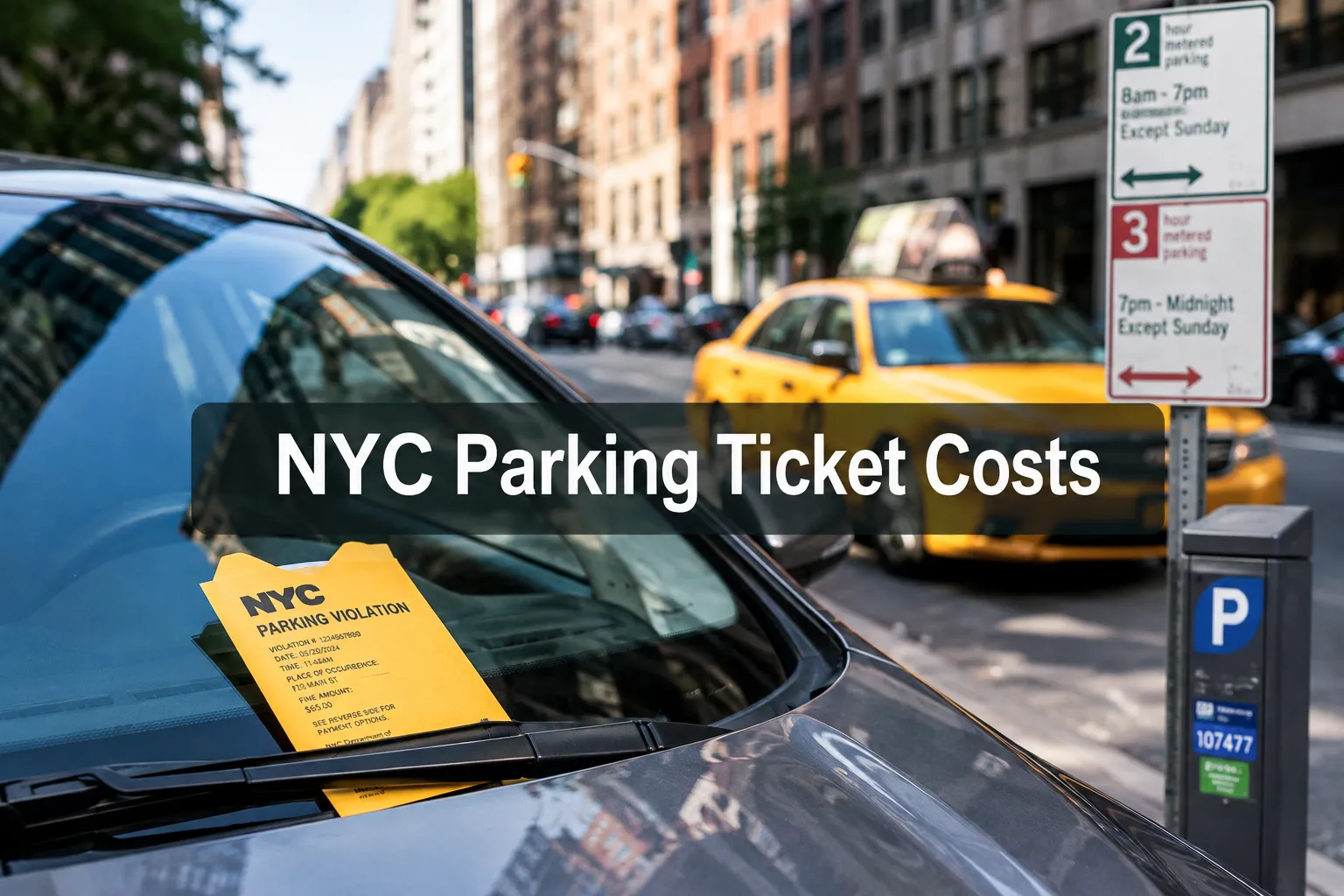
    New York City issued more than 10 million parking tickets in the past year, and each violation carries a precise dollar amount set by the Department of Finance. Understanding how much parking ticket NYC violations cost, and how penalties escalate, is essential to avoid fines and towing.

    This guide breaks down official 2026 fine amounts for every common parking violation, explains the Manhattan versus outer-borough pricing difference, and shows exactly when late penalties, interest, and enforcement actions kick in. Check status now to stay ahead of citations.

    Key Takeaways

    • NYC parking fines range from $35 to over $250 depending on violation type and borough, with Manhattan carrying higher fines for expired meters and double parking.
    • All posted fine amounts include a mandatory $15 New York State Criminal Justice surcharge, no separate payment required.
    • Unpaid tickets trigger escalating penalties: $10 on day 31, $30 on day 61, and $60 on day 91, plus daily interest after judgment around day 100.
    • Once judgment debt reaches $350 or more, NYC can boot or tow your vehicle and pursue aggressive collection actions.
    • Real-time Alternate Side Parking status checks and official suspension calendars help drivers avoid the most common $65 street-cleaning violations.

    How Much Parking Ticket NYC: Common Violation Fine Amounts in 2026

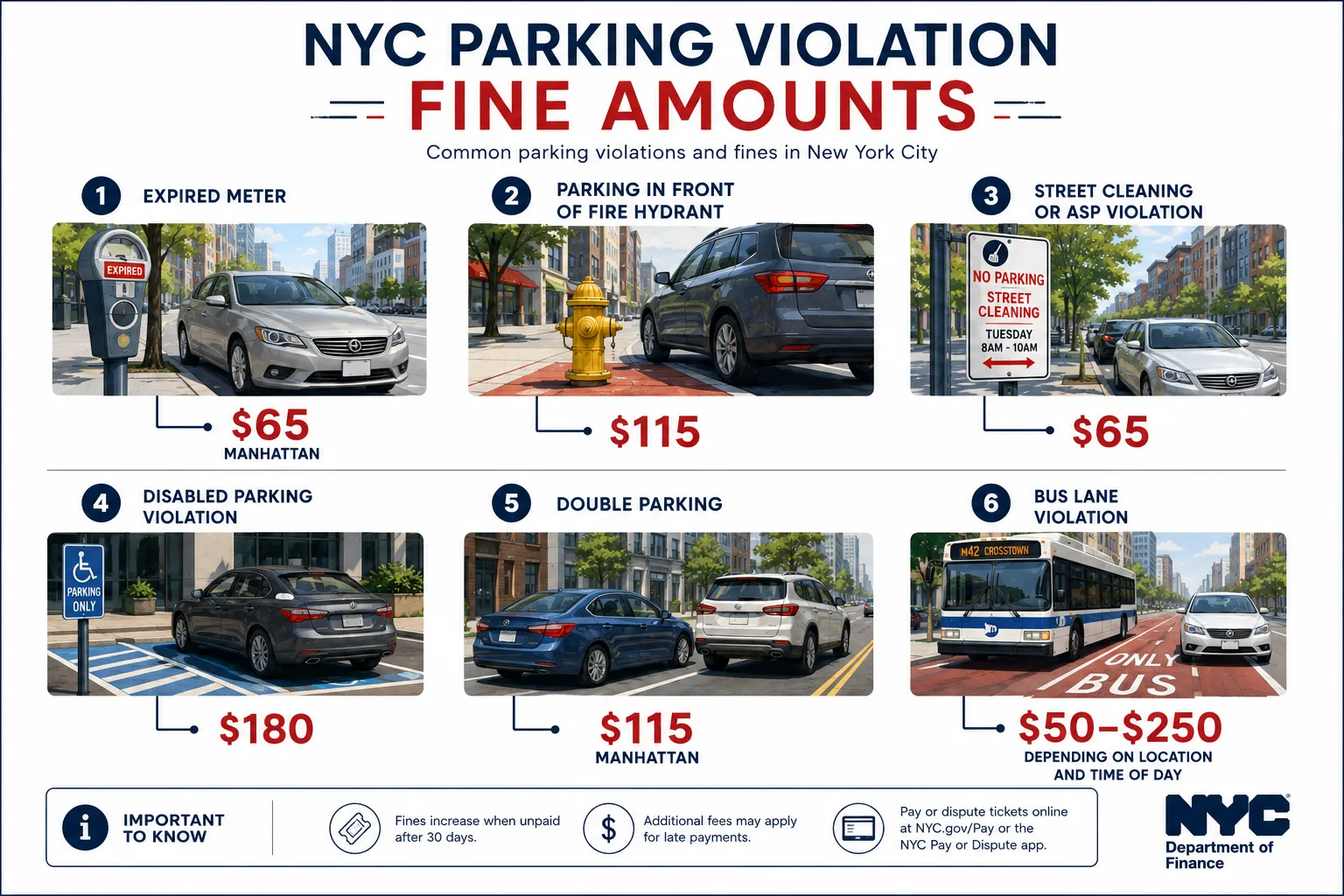
    NYC parking fines are set by violation code and vary by borough. The Department of Finance publishes the official schedule, last updated mid-2026, covering more than 100 distinct violations.[1][2][4][8]

    Most frequent violations and their 2026 fines:

    • Expired meter (muni-meter): $65 in Manhattan, $35 in Bronx, Brooklyn, Queens, and Staten Island[1][4][8]
    • Street cleaning / Alternate Side Parking: $65 citywide[1][4][8]
    • Fire hydrant (within 15 feet): $115[1][4][8]
    • Double parking: $115 in Manhattan, $65 in outer boroughs[1][4]
    • Bus stop / bus lane (standing): $115[1][4][8]
    • No standing / no stopping (general): $100 base fine under 2025 rule amendments[7][10][13]
    • Crosswalk or sidewalk parking: $115[1][4][8]
    • Disabled parking without permit: $180[1][4][8]
    • Misuse of disabled parking permit: $250+[1][4][8]
    How Much Parking Ticket NYC: Common Violation Fine Amounts in 2026

    All fines listed by NYC DOF already include the $15 New York State Criminal Justice surcharge, drivers pay the posted amount with no additional state fee.[2] This built-in surcharge applies to every parking ticket issued in the five boroughs.

    For commercial fleets and high-volume violators, DOF offers Stipulated Fine and Commercial Abatement Programs that provide discounted «program timely payment» rates when companies enroll and pay promptly.[5][11] Industry guidance emphasizes these programs as cost-saving tools for businesses operating citywide.

    Explore the official NYC Parking Directory to locate off-street parking options and compare garage rates across all boroughs, helping you avoid street violations entirely.

    Manhattan vs. Outer Boroughs: Why Fine Amounts Differ

    Manhattan parking fines are consistently higher than those in the Bronx, Brooklyn, Queens, and Staten Island for the same violation codes. The differential reflects congestion, parking scarcity, and enforcement intensity in the central business district.[1][4][8]

    Key examples of the Manhattan premium:

    Violation Type Manhattan Fine Outer Boroughs Fine
    Expired meter $65 $35
    Double parking $115 $65

    This two-tier structure means a driver who forgets to feed the meter in Midtown pays nearly double what the same lapse costs in Astoria or Park Slope. For repeat offenders and commercial operators, the Manhattan premium adds up quickly.[1][4][11]

    Check the real-time Alternate Side Parking status for NYC before parking on any street-cleaning day. ASP violations are $65 citywide and among the most frequently issued tickets, especially during the twice-weekly sweeping cycles.[1][4][8]

    Understanding these borough-specific fine schedules helps drivers budget accurately and prioritize off-street parking in high-cost zones. Review parking garages and savings articles to find competitive monthly and daily rates that eliminate citation risk.

    Unpaid Parking Tickets: Penalties, Interest, and Enforcement Timelines

    Ignoring a parking ticket triggers a cascade of additional charges and enforcement actions. The Office of the Parking Summons Advocate (OPSA) details the exact penalty schedule for 2026.[6]

    Penalty escalation timeline:

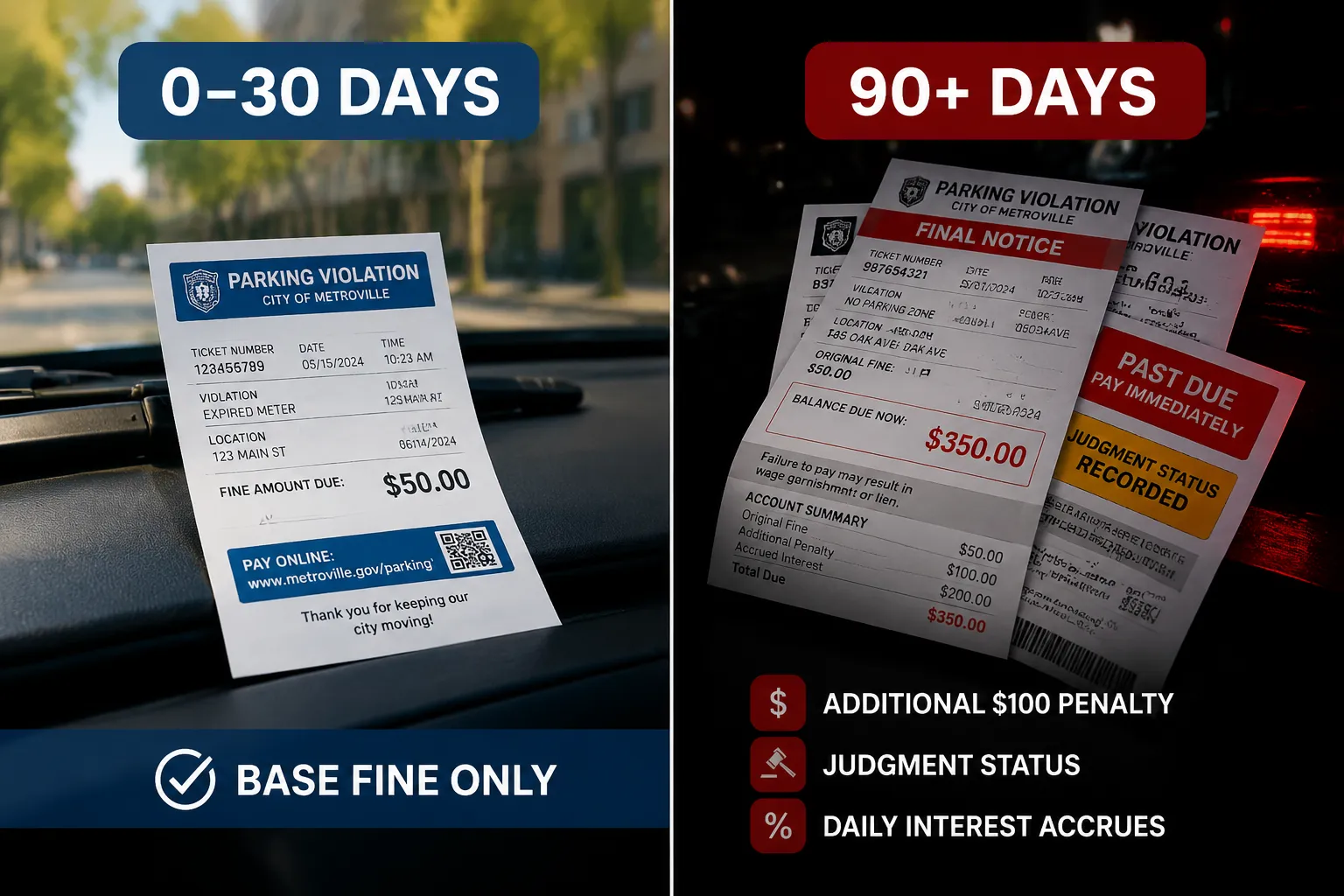
    • Day 0-30: Base fine only (no additional penalty)
    • Day 31: $10 penalty added to outstanding balance[6]
    • Day 61: Additional $30 penalty (total $40 in penalties)[6]
    • Day 91: Additional $60 penalty (total $100 in penalties)[6]
    • Day 100 (approximately): Ticket enters judgment; daily interest begins accruing on the full balance[6][3]
    Unpaid Parking Tickets: Penalties, Interest, and Enforcement Timelines

    For camera-based violations, including certain red-light and speed-camera tickets, a separate $25 penalty is added if the ticket remains unanswered after 30 days.[6][9][3] This camera penalty is distinct from the standard parking-ticket penalty schedule and applies before judgment.

    Once total judgment debt from unpaid tickets reaches $350 or more, NYC can boot or tow the vehicle and pursue other enforcement measures.[6] Judgment debt includes the original fine, all accrued penalties, and interest, making even a few ignored tickets a serious financial liability.

    Drivers facing unfair parking citations should consult the guide on how to fight a double parking ticket in NYC for step-by-step dispute instructions and evidence requirements. The Parking Education Hub provides templates and strategies to challenge incorrect violations before they enter judgment.

    Bus Lane, Disabled Parking, and High-Cost Violations

    Certain violation categories carry significantly higher fines due to safety, accessibility, and enforcement priorities.[1][4][8][11]

    High-cost violation categories in 2026:

    • Disabled parking without valid permit: $180[1][4][8]
    • Misuse of disabled parking permit: $250+[1][4][8]
    • Bus lane camera violations (escalating schedule): $50 first offense, rising to $250 per vehicle within a rolling 12-month period[11]
    • Blocking fire hydrant (within 15 feet): $115[1][4][8]
    • Commercial vehicle violations (repeat offenses): Subject to stipulated fine schedules and potential fleet sanctions[5][11]

    Bus-lane camera enforcement has become a major cost center for commercial fleets operating in Manhattan. The escalating fine structure, starting at $50 and climbing to $250 for repeat offenses within 12 months, means a single vehicle can rack up thousands in fines annually.[11] Fleet managers should review real-time bus-lane maps and adjust routes to avoid camera zones.

    Disabled parking violations are among the most expensive tickets NYC issues, reflecting the city’s commitment to accessibility compliance. Parking in a disabled bay without a valid permit costs $180, while fraudulent use of a permit can exceed $250 and trigger additional legal consequences.[1][4][8]

    For drivers seeking legitimate off-street options near high-enforcement zones, explore facilities like Stable Car Parking in Brooklyn, MPG Parking in the Bronx, and Astoria Parking Management in Queens to secure predictable daily or monthly rates.

    Alternate Side Parking Violations: The $65 Ticket You Can Avoid

    Alternate Side Parking (ASP) violations account for a substantial share of NYC’s annual parking-ticket volume. Street-cleaning rules require drivers to move vehicles twice weekly on most residential blocks, and failure to comply results in a $65 fine citywide.[1][4][8]

    How to avoid ASP tickets:

    • Check real-time status daily: ASP rules are suspended on most major holidays and occasionally for special events. Verify the live NYC Alternate Side Parking status before leaving your car overnight.
    • Review suspension calendars: Official city suspension calendars list all scheduled ASP holidays and rule changes for the year.
    • Set alerts: Real-time ASP alerts notify drivers the night before enforcement resumes, preventing surprise tickets after holiday weekends.
    • Understand neighborhood schedules: ASP times vary by block. Read posted signs carefully and note the exact hours when parking is prohibited.

    Learn the complete ruleset in the guide Know All About Alternate Side Parking Rules in NYC, which covers sign interpretation, grace periods, and common enforcement traps.

    For drivers in neighboring municipalities, check the live status pages for Yonkers, Mount Vernon, Buffalo, Rochester, and Albany to stay current with regional ASP rules and winter parking restrictions.

    Tickets & Disputes: Fighting Unfair Parking Citations

    Not every parking ticket is valid. Drivers have the right to dispute citations through NYC’s online hearing system, and many violations are dismissed when proper evidence is submitted.[6]

    Common grounds for dispute:

    • Incorrect license plate or vehicle description
    • Defective or missing parking signs at the violation location
    • Valid meter receipt or parking permit not noted by enforcement officer
    • Vehicle was legally parked during the cited time (photographic evidence required)
    • Medical emergency or other documented extenuating circumstance

    The Office of the Parking Summons Advocate (OPSA) provides free guidance on the dispute process, including how to request an in-person or virtual hearing and what documentation strengthens a case.[6] Submitting a dispute before the ticket enters judgment prevents penalties and interest from accruing during the review period.

    For detailed dispute strategies and templates, consult the Parking Education Hub resources on Tickets & Disputes. These guides walk drivers through evidence collection, hearing preparation, and appeal procedures for both standard parking violations and camera-based tickets.

    Towing & Impounds: What Happens When Judgment Debt Hits $350

    Unpaid parking tickets don’t just accumulate penalties, they can result in your vehicle being booted or towed. Once judgment debt reaches $350 or more, NYC enforcement agents can immobilize or impound the car.[6]

    Enforcement actions for judgment debt:

    • Booting: A steel clamp is attached to the wheel, preventing the vehicle from moving. Removal requires full payment of outstanding fines, penalties, interest, and a boot-removal fee.
    • Towing: The vehicle is towed to a city impound lot. Owners must pay all judgment debt plus towing and storage fees, often several hundred dollars, to recover the car.
    • Registration suspension: New York State DMV can suspend vehicle registration for unpaid parking-ticket debt, making it illegal to drive the car even if it’s not booted or towed.

    Towing and impound fees add substantial cost on top of the original fines. Daily storage charges accrue until the vehicle is claimed, and delays can push total recovery costs into the thousands.[6]

    To avoid these enforcement actions, pay or dispute tickets promptly. Use the official NYC parking-ticket lookup tool to check your vehicle’s outstanding balance and judgment status. If you’re already facing a boot or tow, contact OPSA immediately to explore payment plans or hardship relief options.[6]

    Conclusion

    Understanding how much parking ticket NYC violations cost in 2026, and how penalties escalate, empowers drivers to avoid fines and towing. NYC parking fines range from $35 for an expired meter in the outer boroughs to over $250 for disabled-parking permit misuse, with Manhattan carrying a premium for most violations. Every posted fine includes the $15 state surcharge, and unpaid tickets trigger $10, $30, and $60 penalties at 31, 61, and 91 days, plus daily interest after judgment.

    Take action now:

    • Check the real-time Alternate Side Parking status daily to avoid the most common $65 street-cleaning tickets.
    • Explore the NYC Parking Directory to locate off-street garages and lots with competitive rates across all five boroughs.
    • Dispute unfair citations immediately using the resources in the Parking Education Hub before penalties and interest accrue.
    • Set up real-time alerts and review official suspension calendars to stay ahead of rule changes and holiday suspensions.

    Avoid fines and towing by staying informed with official, real-time parking status and accurate fine schedules. Locate your nearest garage, check today’s ASP status, and protect your vehicle from costly citations and impounds.

    References

    [1] Fines – https://www.19pine.ai/parking-tickets/us/new-york/new-york-city/fines [2] Services Violation Codes – https://www.nyc.gov/site/finance/vehicles/services-violation-codes.page [3] Parking And Camera Tickets – https://www.nyc.gov/main/services/parking-and-camera-tickets [4] Nyc Parking Tickets – https://nyc-parks.com/nyc-parking-tickets [5] Stipulated Fines Fee Schedule – https://www.nyc.gov/assets/finance/downloads/pdf/tax_and_parking_program_operations/stipulated-fines-fee-schedule.pdf [6] Opsa – https://www.nyc.gov/site/finance/vehicles/opsa.page [7] 0 0 0 146073 – https://codelibrary.amlegal.com/codes/newyorkcity/latest/NYCrules/0-0-0-146073 [8] New York Parking Tickets – https://www.newyorksafetycouncil.com/articles/new-york-parking-tickets/ [9] Parking Brochure – https://www.nyc.gov/assets/finance/downloads/pdf/brochures/parking_brochure.pdf [10] Rule Pvfines902 – https://www.nyc.gov/assets/finance/downloads/pdf/01pdf/rule_pvfines902.pdf [11] Fleet data and commercial parking-ticket analysis (2026 industry reports and DOF commercial program materials)

  • Free Street Parking Map NYC: Find Legal Spots & Avoid Tickets in 2026

    Free Street Parking Map NYC: Find Legal Spots & Avoid Tickets in 2026

    New York City drivers paid over $565 million in parking fines in 2025. Most violations stem from confusion over where and when street parking is actually free. No single official «free street parking map NYC» exists from the city government, but multiple tools now decode the complex web of signs, meters, and Alternate Side Parking rules to reveal thousands of legal, no-cost curb spaces across all five boroughs.

    Finding free street parking in NYC requires understanding three moving parts: posted sign regulations, real-time Alternate Side Parking suspensions, and meter enforcement schedules. This guide breaks down the best free street parking map NYC resources, explains how to use official DOT data alongside third-party tools, and shows exactly when and where you can park without paying, or getting ticketed.

    Key Takeaways

    • NYC DOT’s Parking Regulations Map at nycdotsigns.net is the authoritative source for all street parking signs and rules, but third-party apps like SpotAngels and FreeParkNYC overlay this data into user-friendly free parking maps
    • Free street parking is rare in Manhattan’s core (Times Square, Midtown, Upper East/West Sides) where most curbs are metered; residential outer-borough blocks offer the most consistent free options
    • Alternate Side Parking and meters are suspended every Sunday citywide, creating predictable weekly free-parking windows on thousands of blocks
    • Real-time ASP status via NYC311 Online, the NYC311 app, or @NYCASP is critical because day-of suspensions (snow, holidays) can instantly convert regulated spaces into legal free parking
    • Always cross-check any free street parking map NYC tool against physical street signs, posted regulations are the final legal authority

    Understanding NYC’s Official Parking Data Sources

    The NYC Department of Transportation maintains the Parking Regulations Map (nycdotsigns.net), which digitizes every parking sign across the city’s 6,300 miles of curb.[13][14] This interactive map displays sign locations, regulation types, and enforcement hours block-by-block. It’s the foundation all third-party free street parking map NYC tools build upon.

    How to Use the Official DOT Map:

    • Enter your destination address or zoom to your target neighborhood
    • Click any curb segment to view active parking regulations
    • Review the street sign legend to decode restriction types (meter zones, ASP days, time limits)
    • Cross-reference with the official ASP suspension calendar for current-year holidays

    The DOT map shows what’s posted, but it doesn’t highlight «free» zones in green or filter by your arrival time. That’s where specialized tools come in.

    Official Alternate Side Parking Calendar:

    NYC DOT publishes an annual ASP suspension calendar listing every legal and religious holiday when street cleaning rules don’t apply.[9][5] In 2026, ASP is suspended on 32 scheduled dates, plus every Sunday year-round. When ASP is suspended but meters remain in effect, only non-metered residential blocks become free, a crucial distinction many drivers miss.

    Check real-time status daily via:

    • NYC311 Online or the NYC311 mobile app
    • @NYCASP on social media for same-day announcements
    • Park Rules Live’s live ASP status tracker for instant updates

    Snow operations frequently trigger multi-day ASP suspensions. In early 2026, NYC suspended ASP from January 31 through February 3, extended it February 8-10, again February 11-12 (snow plus Lincoln’s Birthday), February 12-14 and 16-18 (Presidents’ Day, Lunar New Year, Losar, Ash Wednesday), and February 23 through March 3 (Purim).[2][4][6][8][10] Meters stayed in effect during all these suspensions, so true free parking only expanded on unmetered blocks.[2][4][6][8][10]

    Best Free Street Parking Map NYC Tools for 2026

    Best Free Street Parking Map NYC Tools for 2026

    SpotAngels NYC Free Parking Map

    SpotAngels publishes a continuously updated 2026 NYC Free Parking Map that overlays parking rules on a live, color-coded map.[1] Free spots appear in green, metered zones in red, and time-restricted areas in yellow. The tool was last refreshed August 22, 2026, making it one of the most current citywide resources.[1]

    Key Features:

    • Time-based filtering: Enter your location, arrival time, and parking duration to see available spots and prices
    • Neighborhood coverage: Detailed maps for all five boroughs, with granular data for high-demand areas like the Upper East Side, Upper West Side, Downtown Brooklyn, and Astoria
    • Off-peak insights: Identifies blocks that are metered during business hours but free evenings, nights, and Sundays

    SpotAngels emphasizes that free on-street parking in Manhattan’s core (Times Square, Hudson Yards, Midtown) is extremely limited.[1] Most curb spaces are metered 8 AM, 10 PM Monday, Saturday, with only scattered free windows late at night or on Sundays. For consistent free options, focus on residential neighborhoods in the Bronx, Queens, Brooklyn, and Staten Island.

    Explore borough-specific parking resources:

    FreeParkNYC Maps

    FreeParkNYC offers two specialized tools:[3]

    1. NYC Parking Map: Color-coded display showing where and when street parking is allowed, with filters for time of day and day of week
    2. ASP Map: Dedicated visualization of alternate-side street cleaning schedules, helping drivers identify legal free-parking windows by matching their parking times to non-restricted periods

    Both maps use official DOT sign data but present it in a simplified, scannable format. The ASP map is particularly useful for understanding complex multi-day cleaning schedules in dense neighborhoods.

    How to Maximize Free Parking with FreeParkNYC:

    • Select your target neighborhood and intended parking duration
    • Use the ASP map to find blocks where cleaning occurs on days you won’t be parked
    • Verify that the block has no meters (check the NYC Parking Map or physical signs)
    • Confirm same-day ASP status via NYC311 before leaving your vehicle

    NYC DOT Parking Regulations Map & Sign Legend

    For absolute accuracy, always cross-reference third-party maps with the official DOT Parking Regulations Map.[13][14] Posted street signs are the final legal authority. If a free street parking map NYC tool shows a green «free» zone but the physical sign says «No Standing 8 AM, 6 PM,» the sign wins.

    Critical Sign-Reading Tips:

    • «No Standing Except Trucks Loading/Unloading» means passenger cars cannot park, even if a map shows the block as unrestricted
    • Meter hoods or bagged meters do not automatically make a space free, check for temporary «No Parking» signs
    • Overlapping regulations (e.g., ASP + meter + 2-hour limit) all apply simultaneously; you must satisfy every restriction

    Learn to decode complex sign combinations in our guide to Alternate Side Parking rules in NYC.

    Where Free Street Parking Actually Exists in NYC

    Where Free Street Parking Actually Exists in NYC

    Manhattan:

    Free curb parking in Manhattan is concentrated in upper residential neighborhoods (Washington Heights, Inwood, East Harlem) and becomes available evenings/nights in the Lower East Side and parts of the West Village. Midtown, the Financial District, and the Upper East/West Side cores are almost entirely metered.[1]

    Brooklyn:

    Outer Brooklyn neighborhoods, Bensonhurst, Bay Ridge, Sheepshead Bay, Canarsie, offer extensive free residential parking with standard ASP rules. Williamsburg, DUMBO, Park Slope, and Downtown Brooklyn are heavily metered, with free options limited to side streets during off-peak hours.[1]

    Queens:

    Queens has the most abundant free street parking citywide. Flushing, Astoria (away from the waterfront), Jackson Heights, Forest Hills, and eastern neighborhoods like Bayside and Bellerose feature thousands of unmetered residential blocks. Check ASP schedules carefully, many blocks alternate Monday/Thursday and Tuesday/Friday.[1]

    Discover neighborhood parking options:

    Bronx:

    The Bronx offers widespread free parking in residential areas like Pelham Bay, Morris Park, Fordham, and Riverdale. Commercial corridors (Fordham Road, Grand Concourse) have meters, but side streets one block away are typically free with ASP.[1]

    Browse Bronx parking facilities:

    Staten Island:

    Staten Island has the least restrictive parking in NYC. Most residential streets are free with minimal or no ASP. Metered zones exist only in commercial centers like St. George and along the North Shore near the ferry terminal.[1]

    Explore Staten Island options:

    Avoiding Fines and Towing: Real-Time Status is Essential

    Even the best free street parking map NYC tool can’t prevent tickets if you ignore real-time updates. ASP suspensions, snow emergencies, and special events change parking rules daily.

    Critical Real-Time Resources:

    • NYC311 Online & App: Official same-day ASP status, updated by 6 AM each morning[7][9]
    • @NYCASP: Social media alerts for suspensions and enforcement changes
    • Park Rules Live ASP Tracker: Instant status for NYC and surrounding cities like Yonkers, Mount Vernon, and Buffalo

    2026 ASP Suspension Pattern:

    NYC suspended ASP for 17 days between January 31 and March 3, 2026, due to snow operations and holidays.[2][4][6][8][10][11][12] However, meters remained in effect during nearly all these suspensions, meaning drivers on metered blocks still had to pay. Only unmetered residential streets gained true free parking during these windows.

    Fighting Unfair Parking Citations:

    If you receive a ticket despite parking legally during a suspension or in a properly signed free zone, use the NYC Parking Education Hub resources:

    Document the street signs, suspension notices, and your vehicle’s position with timestamped photos. Challenge tickets online via NYC DOT’s hearing system within 30 days.

    Conclusion

    Finding free street parking in NYC demands more than a static map. Combine official DOT data from the Parking Regulations Map with real-time ASP status from NYC311 and user-friendly tools like SpotAngels and FreeParkNYC. Focus your search on residential outer-borough neighborhoods, leverage Sunday’s citywide meter and ASP suspension, and always verify physical street signs before walking away from your vehicle.

    Action Steps:

    1. Bookmark the NYC DOT Parking Regulations Map and the 2026 ASP suspension calendar
    2. Download SpotAngels or FreeParkNYC to filter free zones by time and location
    3. Check NYC311 or @NYCASP every morning for same-day ASP status
    4. Photograph street signs and your parking spot to document compliance
    5. Explore off-street alternatives during high-demand periods via the NYC Parking Directory

    Avoid fines and towing by staying informed. Use these free street parking map NYC tools together, not in isolation, to navigate the city’s complex curb regulations and keep your vehicle legal, safe, and ticket-free in 2026.

    References

    [1] Nyc Free Parking Map – https://www.spotangels.com/blog/nyc-free-parking-map/

    [2] Suspension Of Alternate Side Parking Regulations Feb 23 26 – https://www.nyc.gov/html/dot/html/pr2026/suspension-of-alternate-side-parking-regulations-feb-23-26.shtml

    [3] freeparknyc – https://www.freeparknyc.com/

    [4] Suspension Of Alternate Side Parking Regulations Jan 31 26 – https://www.nyc.gov/html/dot/html/pr2026/suspension-of-alternate-side-parking-regulations-jan-31-26.shtml

    [5] Nyc Parking Calendar – https://www.assembly.state.ny.us/write/upload/req/nyc_parking_calendar.pdf?v=1778692896

    [6] Suspension Of Alternate Side Parking Regulations Feb 11 26 – https://www.nyc.gov/html/dot/html/pr2026/suspension-of-alternate-side-parking-regulations-feb-11-26.shtml

    [7] Alternate Side Parking – https://www.nyc.gov/html/dot/html/motorist/alternate-side-parking.shtml

    [8] Suspension Of Alternate Side Parking Regulations Feb 12 26 – https://www.nyc.gov/html/dot/html/pr2026/suspension-of-alternate-side-parking-regulations-feb-12-26.shtml

    [9] Asp Calendar 2026 – https://www.nyc.gov/html/dot/downloads/pdf/asp-calendar-2026.pdf

    [10] Suspension Of Alternate Side Parking Regulations Feb 8 26 – https://www.nyc.gov/html/dot/html/pr2026/suspension-of-alternate-side-parking-regulations-feb-8-26.shtml

  • How to Fight a Fire Hydrant Parking Ticket in NYC: Official 2026 Guide

    How to Fight a Fire Hydrant Parking Ticket in NYC: Official 2026 Guide

    NYC’s Department of Finance issued over 10 million parking tickets in 2025, with fire hydrant violations ranking among the most disputed citations. The $115 fine hits hard, especially when drivers believe they parked legally or when the distance measurement appears questionable.

    Learning how to fight a fire hydrant parking ticket in NYC starts with understanding the official rules and your dispute rights. The city requires 15 feet of clearance on either side of every hydrant, but enforcement officers sometimes make measurement errors or fail to document required elements on the summons.[1][3] Those mistakes create valid grounds for dismissal.

    This guide walks through the exact steps to challenge a fire hydrant ticket using NYC’s official dispute channels in 2026.

    Key Takeaways

    • Fire hydrant tickets (Violation 40) carry a $115 fine and require 15 feet clearance from the hydrant on either side
    • Contest tickets within 30 days of issuance through NYC DOF’s online portal, mobile app, mail, or in-person to avoid late penalties
    • The summons must specify the exact distance in feet your vehicle was from the hydrant, missing or inaccurate measurements are valid defenses
    • Submit photographic evidence showing measurements, timestamps, and street context to strengthen your dispute
    • Appeal unfavorable hearing decisions for a second review if the initial ruling goes against you

    Understanding NYC Fire Hydrant Parking Rules

    NYC law prohibits stopping, standing, or parking within 15 feet of a fire hydrant on either side.[1][3] This distance applies regardless of street design, including floating parking lanes next to protected bike lanes introduced in recent years.

    The NYC Department of Finance codes fire hydrant violations as «Violation 40» with a standard fine of $115 as of the August 2026 penalty schedule.[2] The violation applies 24 hours a day, seven days a week, with no exceptions for brief stops or emergency flashers.

    Critical measurement requirement: According to NYC DOF guidance updated July 24, 2026, every fire hydrant summons must specify how far, in feet, your vehicle was parked from the hydrant.[9] This required element becomes the foundation of many successful disputes when officers fail to document it or record inaccurate measurements.

    The 15-foot rule differs from other parking regulations. While Alternate Side Parking suspensions and street cleaning schedules vary by neighborhood and calendar, fire hydrant clearance requirements never change. Commercial delivery drivers and residents alike must maintain this distance at all times.

    Understanding NYC Fire Hydrant Parking Rules

    How to Fight a Fire Hydrant Parking Ticket in NYC: Step-by-Step Process

    Challenge unfair parking citations through NYC’s official dispute system. The process requires prompt action and proper documentation.

    Request a Hearing Within 30 Days

    Submit your dispute request within 30 days of the ticket issue date to avoid late penalties and preserve your appeal rights.[4][5][7][10] Missing this deadline triggers additional fines and eliminates your ability to contest the violation.

    NYC provides multiple official channels to request a hearing:

    Online Portal: Access the NYC DOF Dispute Web portal to enter your violation number and submit a written defense with supporting evidence.[4][8] The system accepts photo uploads showing distance measurements, timestamps, and street context.

    NYC Pay or Dispute Mobile App: Download the official app to dispute tickets directly from your phone, upload photos immediately after receiving the citation, and track your case status in real time.[6]

    By Mail: Send a written dispute letter to NYC Department of Finance, P.O. Box 29021, New York, NY 10087-9021. Include the violation number, license plate, defense statement, and copies of supporting photos.[5][7]

    In Person: Visit any NYC DOF business center to submit your dispute and speak with staff about evidence requirements.[5][10][11]

    The entire dispute process can be completed without appearing in person, making it convenient for drivers who work during business hours or live outside the city.[10][11]

    Build Your Defense with Required Evidence

    Strong fire hydrant defenses focus on measurement accuracy and summons defects. The burden of proof falls on you to demonstrate the vehicle was more than 15 feet from the hydrant.[13]

    Effective defense strategies:

    • Distance measurement evidence: Photograph your vehicle’s position relative to the hydrant immediately after receiving the ticket. Use a measuring tape to document the actual distance. If you can prove the car sat beyond 15 feet, the ticket must be dismissed.


    • Missing required elements: Review the summons for the distance specification required by NYC DOF.[9] If the officer failed to record how many feet your vehicle was from the hydrant, argue the ticket lacks a required element and should be dismissed.


    • Inaccurate measurements: Challenge the officer’s recorded distance with your own photographic evidence and measurements. Enforcement agents sometimes estimate distances without measuring, creating opportunities for successful disputes.


    • Obstructed or hidden hydrants: Document if snow, construction barriers, or overgrown vegetation obscured the hydrant from view. While not always successful, these defenses work when the hydrant was genuinely invisible to a reasonable driver.


    • Time and date verification: If the ticket shows an impossible time (you have proof you were elsewhere) or incorrect plate information, document these errors thoroughly.


    Build Your Defense with Required Evidence

    Submit Your Dispute Through Official Channels

    Access the NYC DOF searchViolation portal to begin your online dispute.[8] Enter the violation number from your ticket and follow the prompts to upload evidence and write your defense statement.

    Writing an effective dispute statement:

    Keep your written defense clear, factual, and specific. State the exact distance your vehicle was from the hydrant (with photo evidence). Reference the required elements guidance if the officer failed to document distance.[9] Avoid emotional language, focus on facts and measurements.

    The Office of the Parking Summons Advocate (OPSA) can help you understand your rights and evidence strategies for hydrant cases, according to their mission statement updated August 12, 2026.[15]

    Appeal Unfavorable Decisions

    If the initial hearing decision goes against you, NYC DOF’s dispute system confirms you have the right to appeal.[4][7] The appeal gives you a second chance to argue the hydrant rule was misapplied or the ticket’s required elements were defective.

    Submit your appeal through the same channels used for the initial dispute, online, by mail, or in person. Include any additional evidence you’ve gathered and address specific points from the hearing officer’s decision.

    Appeals work best when you can demonstrate clear errors in the original ruling or present new evidence that wasn’t available during the initial hearing.

    Common Mistakes That Weaken Your Fire Hydrant Ticket Defense

    Avoid these errors that reduce your chances of dismissal:

    Waiting too long to dispute: The 30-day window is firm. Late disputes face automatic penalties and limited review.[4][5][7][10]

    Failing to measure and photograph immediately: Distance evidence collected weeks after the ticket carries less weight than photos taken the same day.

    Arguing you were «only there for a minute»: Duration doesn’t matter. The 15-foot rule prohibits stopping, standing, and parking, even briefly.[2][3]

    Submitting blurry or unclear photos: Evidence must clearly show the hydrant, your vehicle, and the distance between them. Invest time in quality documentation.

    Ignoring required summons elements: Always check whether the officer documented the distance in feet. This required element, when missing, provides grounds for dismissal.[9]

    Giving up after an initial denial: Exercise your appeal rights. Many successful disputes win on appeal after presenting additional evidence or identifying errors in the first ruling.[4][7]

    Alternative Solutions: Avoid Fines and Towing Before They Happen

    Prevention beats disputing tickets after the fact. Use real-time parking information to avoid violations entirely.

    Check Real-Time Status for current Alternate Side Parking rules and suspension calendars that affect legal parking spots citywide. Understanding when street cleaning occurs helps you identify safe parking zones that keep you clear of hydrants and other restrictions.

    Explore off-street parking options in your neighborhood through the NYC Parking Directory. Garages and lots eliminate the risk of fire hydrant tickets entirely, especially in high-enforcement areas.

    Commercial delivery drivers operating across multiple boroughs benefit from checking Yonkers, Mount Vernon, and other municipal parking rules when making deliveries outside NYC proper.

    Study the complete guide to NYC parking regulations to understand how fire hydrant rules interact with other restrictions like street cleaning, commercial loading zones, and residential permit areas.

    Similar dispute strategies apply to other parking violations. Learn how to fight a double parking ticket in NYC using the same evidence-based approach.

    Conclusion

    Fighting a fire hydrant parking ticket in NYC requires quick action, precise evidence, and knowledge of official dispute procedures. Request your hearing within 30 days through the NYC DOF online portal, mobile app, mail, or in-person channels. Focus your defense on measurement accuracy, required summons elements, and photographic documentation proving your vehicle sat beyond the 15-foot legal threshold.

    Check the summons for the required distance specification, missing or inaccurate measurements create valid grounds for dismissal. Submit clear photos showing the hydrant, your vehicle, and the distance between them. Exercise your appeal rights if the initial decision goes against you.

    Take action now:

    • Access the NYC DOF Dispute Web portal to start your dispute today
    • Photograph your vehicle’s position relative to the hydrant before moving it
    • Measure the actual distance and document it thoroughly
    • Submit your dispute within 30 days to avoid late penalties
    • Check Real-Time Alternate Side Parking Status to prevent future violations

    The $115 fine and potential towing costs justify the effort to mount a proper defense. Thousands of NYC drivers successfully dispute fire hydrant tickets each year by following these official procedures and presenting strong evidence.

    References

    [1] Article – https://portal.311.nyc.gov/article/?kanumber=KA-01026

    [2] Services Violation Codes – https://www.nyc.gov/site/finance/vehicles/services-violation-codes.page

    [3] Parking Regulations – https://www.nyc.gov/html/dot/html/motorist/parking-regulations.shtml

    [4] Dispute Web – https://www.nyc.gov/site/finance/vehicles/dispute-web.page

    [5] Dispute A Ticket – https://www.nyc.gov/site/finance/vehicles/dispute-a-ticket.page

    [6] Nyc Pay Or Dispute – https://www.nyc.gov/site/finance/vehicles/nyc-pay-or-dispute.page

    [7] Dispute A Ticket Faqs – https://www.nyc.gov/site/finance/vehicles/dispute-a-ticket-faqs.page

    [8] Searchviolation – https://nycserv.nyc.gov/HBWNonCommercial/dispute/searchViolation.action

    [9] Required Elements In A Ticket – https://www.nyc.gov/site/finance/vehicles/required-elements-in-a-ticket.page

    [10] Parking And Camera Tickets – https://www.nyc.gov/main/services/parking-and-camera-tickets