Categoría: Towing & Impounds

  • How Much Is Impound Fee Per Day NY: 2026 Official Rate Guide

    How Much Is Impound Fee Per Day NY: 2026 Official Rate Guide

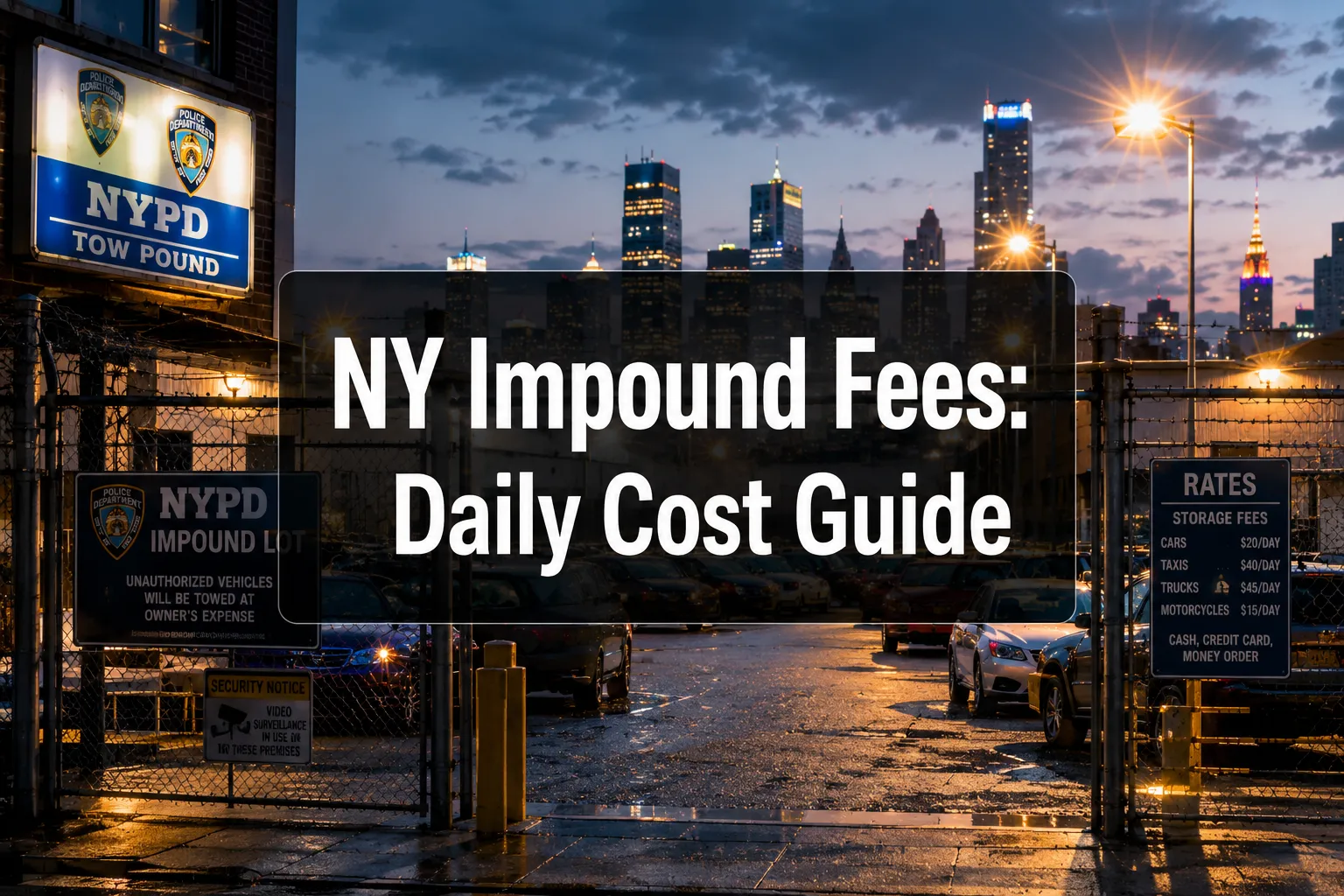
    New York drivers face $20 per day at NYPD tow pounds and up to $15 daily at private lots under current NYC regulations, but proposed legislation could triple those caps by 2027. Understanding how much is impound fee per day NY varies dramatically by municipality and tow type is critical to avoiding hundreds in unexpected storage charges.

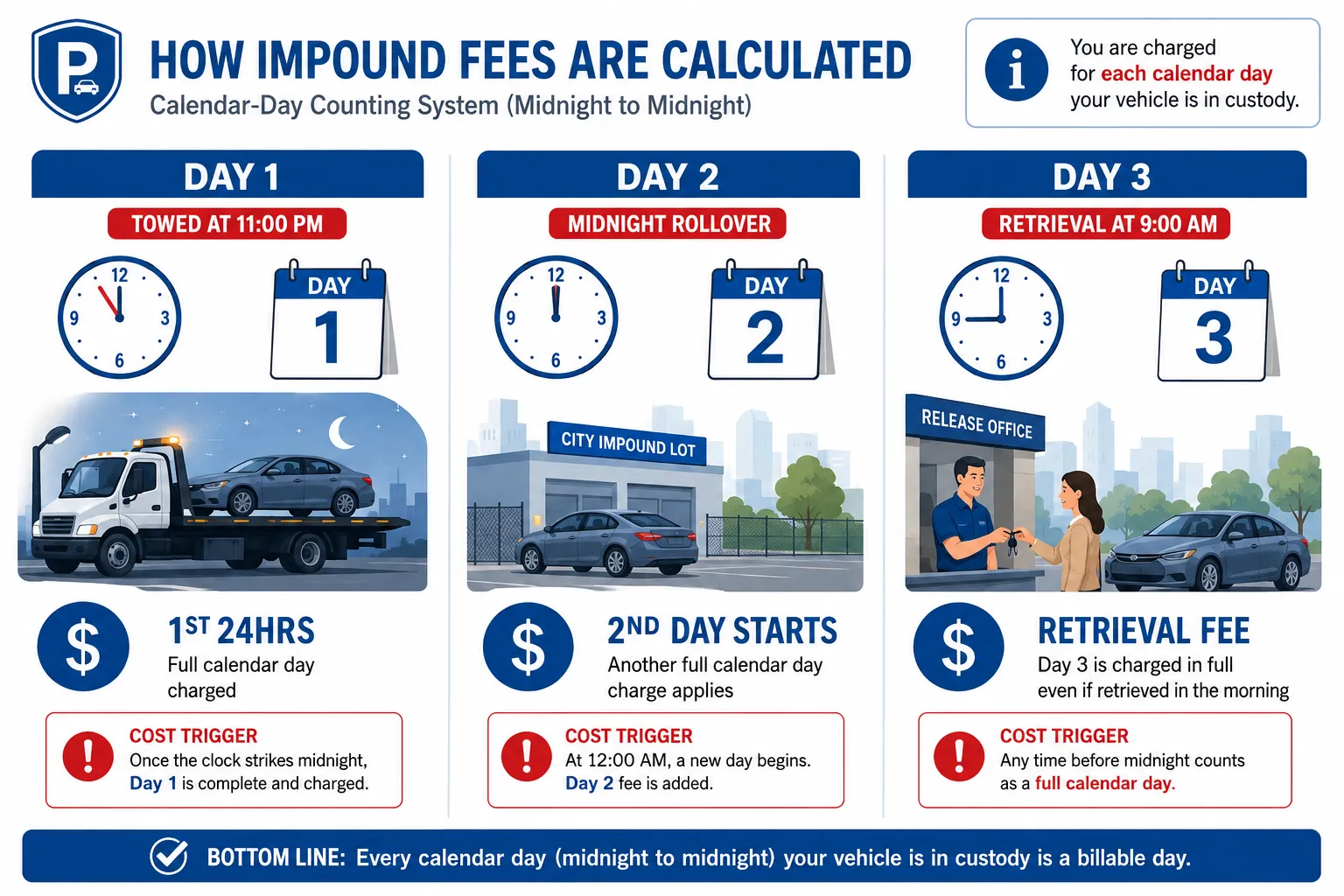
    Every hour your vehicle sits in an impound lot costs money. Calendar-day counting means towing at 11 PM triggers a full day’s fee, and retrieval the next morning adds a second complete charge. Across New York State, daily storage rates range from $10 in smaller towns to $20 at official NYC facilities, with private operators charging different maximums depending on local regulations.

    Key Takeaways

    • NYC NYPD tow pounds charge $20 per day for overnight storage; private NYC tow operators are capped at $15 daily for passenger vehicles under current rules
    • Calendar-day counting means partial days equal full charges, towing late at night and retrieving early morning can trigger two full daily fees
    • Proposed NYC legislation (Intro 545-2024) would raise private lot maximums to $45 per day, nearly tripling current caps
    • Outside NYC, daily impound fees vary widely: Rochester charges $15, Buffalo $10-15, and smaller municipalities set their own rates
    • Total impound costs include towing fees ($185-370 NYC), storage per day, and administrative charges, multi-day impounds quickly exceed $500

    Official NYC Impound Fee Per Day: NYPD Tow Pounds

    NYPD-operated tow pounds charge $20 per day for overnight vehicle storage after the first 24 hours [1]. The initial tow includes the first day, but every subsequent calendar day adds $20 to your total bill. If your car was towed Monday evening and you retrieve it Wednesday morning, expect two full days of storage fees,$40 total, even if the vehicle sat for less than 48 hours.
    Official NYC Impound Fee Per Day: NYPD Tow Pounds

    Calendar-day counting is the critical detail most drivers miss. The clock doesn’t run on 24-hour increments from tow time. Instead, each midnight triggers a new daily charge. A vehicle towed at 11 PM Monday incurs Day 1 immediately; at 12:01 AM Tuesday, Day 2 begins; retrieval at 9 AM Tuesday still means paying for two complete days.

    NYPD facilities store vehicles towed for:

    • Alternate Side Parking violations
    • Fire hydrant blocking
    • Police investigations
    • Abandoned vehicle removal
    • Driving with suspended registration

    The $20 daily rate applies uniformly across all five boroughs at official NYPD lots. Private towing companies operating under NYC contracts follow different rate structures, capped separately by Department of Consumer Affairs regulations [3].

    How Days Accumulate at NYC Tow Pounds

    Storage fees compound quickly. A typical three-day impound scenario:

    • Day 1 (tow date): Included in base tow fee
    • Day 2: $20 storage
    • Day 3: $20 storage
    • Total storage: $40 (plus $185+ tow fee)

    Weekends and holidays don’t pause the meter. If your vehicle is towed Friday night and you can’t retrieve it until Monday due to facility hours, you’re paying for Saturday, Sunday, and Monday, three additional days at $20 each [4].

    For vehicles booted then towed after November 2025 rule changes, storage rates increased to $30 per day at NYPD facilities, reflecting higher handling costs for booted vehicles [6]. Check the Towing & Impounds resource hub for current boot-to-tow procedures.

    Private Tow Lot Daily Fees in New York City

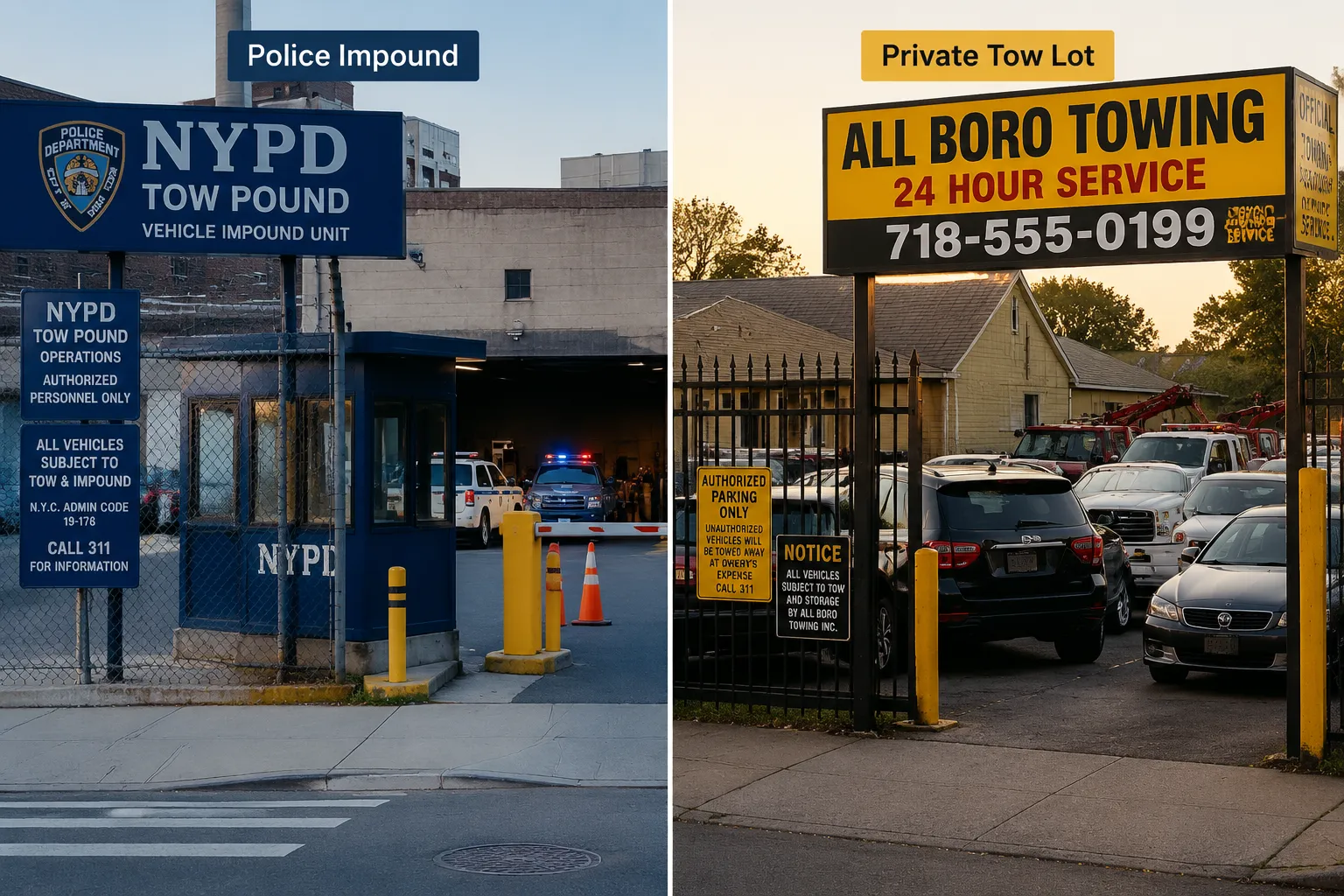
    Private towing companies in NYC operate under strict Department of Consumer Affairs caps. Current maximum rates for passenger vehicles are $15 per day for storage [3]. Commercial vehicles and oversized vehicles face higher daily rates, but standard cars, SUVs, and pickup trucks fall under the $15 passenger cap.

    These private operators handle:

    • Property owner-requested tows (illegal parking on private lots)
    • Commercial building tows
    • Parking garage violations
    • Shopping center enforcement

    The $15 daily maximum applies only to regulated private tows within NYC’s five boroughs. Facilities must display rate schedules prominently, and overcharges can be disputed through NYC 311 [3].

    Proposed legislation threatens major increases. NYC Council Intro 545-2024 would raise private lot storage caps to $45 per day,a 200% jump from current rates [8][9]. If passed, a four-day impound that currently costs $60 in storage ($15 × 4) would surge to $180 ($45 × 4). The bill aims to offset operator costs but would significantly impact drivers recovering vehicles after Alternate Side Parking violations or private property tows.
    Private Tow Lot Daily Fees in New York City

    How Much Is Impound Fee Per Day NY: Rates Outside NYC

    New York State municipalities set their own impound storage rates, creating wide variation:

    Rochester: The RPD Auto Impound charges $15 per day for vehicle storage [7]. Vehicles towed for parking violations, abandoned status, or police holds accumulate this daily fee starting the day after the tow.

    Buffalo: Storage rates range $10-15 per day depending on vehicle type and tow reason. Winter alternate parking enforcement generates high impound volume; check Buffalo’s live alternate parking status to avoid towing during snow emergencies.

    Smaller municipalities: Towns like Huntington charge $25 per day after an initial free period [5]. Marlborough sets rates at $10 per day for the first 30 days [10]. Always verify local rates immediately, smaller jurisdictions often lack online payment systems, requiring in-person retrieval during limited business hours.

    Upstate and suburban New York rates typically fall below NYC’s, but total costs still escalate quickly:

    Municipality Daily Storage Typical Tow Fee 3-Day Total
    NYC (NYPD) $20 $185 $225
    Rochester $15 $150 $180
    Buffalo $10-15 $125 $155-170
    Huntington $25 $175 $225

    Check your municipality’s official website or call the local police non-emergency line for exact current rates. Many upstate cities suspend Alternate Side Parking on holidays, reducing winter tow risk.

    Total Cost Breakdown: Towing Plus Daily Storage

    Understanding how much is impound fee per day NY requires calculating the complete retrieval cost:

    Base towing fees (NYC):

    • Standard passenger vehicle: $185 [3]
    • Larger vehicles/commercial: $370+
    • Booted vehicle tow: Additional $136 boot removal fee [6]

    Daily storage fees:

    • NYPD pound: $20/day after first 24 hours
    • Private NYC lot: $15/day (current cap)
    • Upstate municipalities: $10-25/day

    Administrative/processing fees:

    • NYC: Varies by violation type
    • Some municipalities: $25-50 administrative charge

    Real-world scenarios:

    Scenario 1: ASP violation, 2-day NYC impound

    • Tow fee: $185
    • Storage (1 additional day): $20
    • Parking ticket: $65
    • Total: $270

    Scenario 2: Private lot tow, 4-day hold

    • Tow fee: $185
    • Storage (3 additional days): $45
    • Total: $230

    Scenario 3: Booted then towed, 3-day NYPD hold

    • Boot removal: $136
    • Tow fee: $185
    • Storage (2 additional days, higher rate): $60
    • Total: $381

    Payment must be made in full before vehicle release. Most facilities accept credit cards, but some upstate lots require cash or certified checks. Bring your driver’s license, vehicle registration, and proof of insurance to expedite retrieval.

    Disputes over unfair towing or excessive fees should be filed immediately. Review the Tickets & Disputes guide for NYC challenge procedures, or consult your municipality’s consumer affairs office for local processes.

    How to Minimize Impound Storage Costs

    Act immediately. Every delay adds a full day’s charge. If towed overnight, retrieve your vehicle first thing the next morning to avoid a second calendar day.

    Verify tow location fast. NYC drivers can find their towed car through the official NYPD portal or by calling 311. Upstate residents should contact local police non-emergency lines. Faster location means faster retrieval.

    Understand facility hours. NYPD pounds operate limited hours; arriving after closing means waiting until the next business day, and paying for that extra day. Call ahead to confirm hours and required documentation.

    Prevent towing in the first place:

    Know your rights. NYC law requires tow operators to accept credit cards and provide itemized receipts [3]. Overcharges, damaged vehicles, or missing personal property should be documented and reported immediately.

    For chronic parking challenges in dense neighborhoods like Williamsburg or Astoria, monthly garage rates often cost less than accumulated tickets and impound fees. Compare parking garage rates across NYC to find cost-effective alternatives.

    What Happens If You Can’t Pay Impound Fees

    Unpaid impound fees trigger escalating consequences:

    Lien process: After 10-30 days (varies by municipality), the tow facility can file a lien against your vehicle. You remain responsible for accumulating daily storage fees during this period.

    Auction sale: If fees remain unpaid for 30-90 days, the facility may auction your vehicle to recover costs. Sale proceeds cover towing, storage, and administrative fees; any surplus (rare) is theoretically returned to the owner, but auction prices typically fall below total accumulated charges.

    Credit impact: Unpaid towing and storage fees can be sent to collections, damaging your credit score for years.

    Registration holds: New York DMV may place a registration suspension on your license if towing-related fines go unpaid, preventing vehicle registration renewal.

    If you genuinely cannot afford retrieval costs, contact the tow facility immediately to discuss payment plans. Some NYC facilities and upstate operators offer installment options for hardship cases, though this is not guaranteed. Legal aid organizations may assist with disputes over improper tows.

    Abandoning a vehicle to avoid fees is never advisable, you lose the vehicle’s value, damage your credit, and may face additional fines or registration consequences.

    Proposed NYC Rate Increases: What to Expect

    NYC Council Intro 545-2024, currently under review, would dramatically increase private tow lot maximums [8][9]:

    Proposed new daily storage caps:

    • Passenger vehicles: $45/day (up from $15)
    • Commercial vehicles: $60/day (up from $20)
    • Motorcycles: $30/day (up from $10)

    Projected impact:

    A typical 5-day impound under proposed rates:

    • Tow fee: $185
    • Storage (4 days × $45): $180
    • Total: $365 (vs. $245 under current rates)

    The legislation also proposes raising base tow fees and eliminating some consumer protections around rate transparency. Industry advocates argue current caps haven’t increased since 2010 and don’t cover operating costs; consumer groups counter that tripling rates will disproportionately harm low-income drivers already struggling with parking enforcement in areas with limited off-street parking.

    Timeline: The bill is in committee as of early 2026. If passed, new rates could take effect within 60-90 days of signing. Track the legislation through NYC Council’s public portal and consider submitting public comments if the increases would impact your household.

    Until new rates are enacted, current caps remain in force. Verify charges on your impound receipt match legal maximums, and report overcharges to NYC Department of Consumer Affairs.

    Conclusion

    How much is impound fee per day NY ranges from $10 in smaller municipalities to $20 at NYPD tow pounds, with private NYC operators currently capped at $15 daily. Calendar-day counting means even short impounds trigger multiple full-day charges, and proposed legislation could triple private lot rates to $45 per day by 2027.

    Take action now:

    • Check Real-Time Status daily using Park Rules Live to avoid Alternate Side Parking violations
    • Locate towed vehicles immediately to minimize storage days
    • Understand your municipality’s rates before parking in high-enforcement zones
    • Explore monthly garage options if street parking repeatedly risks towing
    • Document all charges and dispute overcharges through official channels

    Every day counts when your vehicle is impounded. Retrieve it fast, know your rights, and use real-time parking tools to avoid towing in the first place. For ongoing updates on ASP suspensions, parking regulations, and towing procedures across New York State, bookmark Park Rules Live’s comprehensive guides and set mobile alerts for your neighborhood.

    SEO Meta Title: NY Impound Fee Per Day: 2026 Official Rates & Cost Guide

    SEO Meta Description: Learn how much impound fees cost per day in NY. NYC charges $20/day at NYPD pounds, $15 at private lots. Rates, total costs, and 2026 changes explained.

    References

    [1] Towed Vehicles – https://www.nyc.gov/site/nypd/services/vehicles-property/towed-vehicles.page

    [2] New York – https://towingcosts.com/impound-fees/new-york

    [3] Shopping Services Towing – https://www.nyc.gov/site/dca/consumers/shopping-services-towing.page

    [4] Article – https://portal.311.nyc.gov/article/?kanumber=KA-02149

    [5] huntingtonny.gov – https://www.huntingtonny.gov/311/knowledgebase/article/1409

    [6] What To Do If Your Car Is Towed In Nyc – https://towtruck.nyc/blog/what-to-do-if-your-car-is-towed-in-nyc/

    [7] Rpd Auto Impound – https://www.cityofrochester.gov/departments/police/rpd-auto-impound

    [8] 0545 2024+ – https://intro.nyc/0545-2024+

    [9] Legislationdetail – https://legistar.council.nyc.gov/LegislationDetail.aspx?ID=6180311&GUID=F56DF829-8359-489B-8C71-2E9476512A75&Options=&Search=

    [10] Towing Storage Fees – https://www.townofmarlboroughny.gov/2282/Towing-Storage-Fees
  • How Much Are Repossession Fees in NY: Official 2026 Cost Breakdown

    How Much Are Repossession Fees in NY: Official 2026 Cost Breakdown

    New York law does not cap repossession fees at a fixed dollar amount. Instead, lenders and repossession agents may charge you only «reasonable expenses» for taking, storing, and selling your vehicle, and those costs can climb quickly if you don’t act fast. Understanding how much are repossession fees in NY means knowing what charges are legal, what you must pay to redeem your car, and how to challenge unfair costs before they drain your wallet.

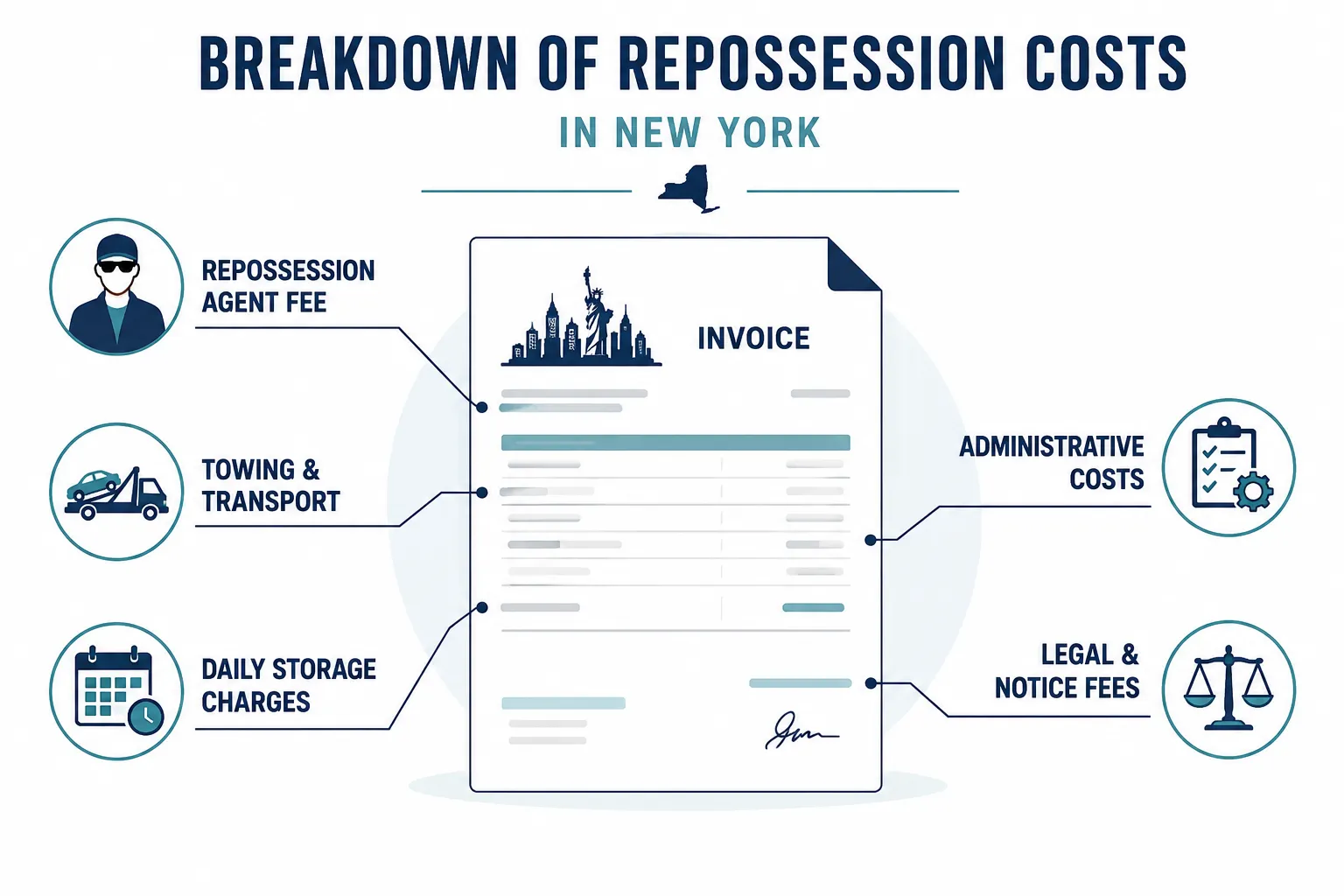
    Repossession fees in New York typically include the agent’s pickup charge (often $200,$500), towing and transport, daily storage (commonly $25,$75 per day), administrative costs, and any legal or notice expenses the lender incurred [1][4]. Because storage accrues daily, a vehicle held for two weeks can accumulate $350,$1,050 in storage alone. This guide breaks down every component of how much are repossession fees in NY, explains your legal rights under New York’s Uniform Commercial Code, and shows you how to retrieve your vehicle or dispute excessive charges.

    Key Takeaways

    • New York law requires repossession fees to be «reasonable» but sets no fixed dollar cap; typical agent fees range $200,$500, plus towing and storage.
    • Daily storage charges of $25,$75 accrue from the moment your car is impounded, making early redemption critical to avoid mounting costs.
    • You have the right to redeem your vehicle by paying the full loan balance, all repossession expenses, and any accrued interest before the lender sells it.
    • Lenders must send you a written notice listing the total redemption amount, including every fee, within a legally mandated timeframe.
    • If fees appear excessive or undocumented, you can challenge them in court; New York’s UCC Article 9 requires all charges to be commercially reasonable.

    What Are Repossession Fees in New York?

    Repossession fees are the costs a lender passes to you after hiring an agent to seize, tow, store, and prepare your vehicle for sale. In New York, these fees must be «reasonable» under Article 9 of the Uniform Commercial Code [1][6]. The law does not publish a schedule of maximum charges; instead, courts evaluate whether each expense reflects actual, necessary costs incurred by the lender.

    Common repossession-related charges include:

    • Repossession agent fee: The flat charge for locating and taking possession of your vehicle, typically $200,$500 depending on the difficulty of the pickup [4][10].
    • Towing and transport: The cost to haul your car from the street or driveway to the impound lot, often $100,$300 based on distance and vehicle size.
    • Daily storage: A per-day fee for holding your vehicle in a secure facility, ranging $25,$75 per day [1][4]. Storage begins the day the car arrives and continues until you redeem it or the lender sells it.
    • Administrative and processing costs: Paperwork, title searches, lien filings, and notice preparation, usually $50,$150 total [8].
    • Legal and notice expenses: Certified mail, publication costs if required, and attorney fees if the lender obtained a court order (rare in voluntary-lien repos but possible in breach-of-peace disputes).

    Because storage accrues daily, the total amount you owe grows every 24 hours your vehicle remains impounded. A car held for 10 days at $50/day adds $500 in storage alone, on top of the initial agent and towing fees.

    What Are Repossession Fees in New York?

    How Much Are Repossession Fees in NY: Typical Cost Ranges

    While New York does not mandate a fee schedule, industry practice and consumer reports reveal consistent ranges for how much are repossession fees in NY in 2026:

    Fee Component Typical Range Notes
    Repossession agent pickup $200,$500 Higher for hard-to-locate vehicles or after-hours recovery
    Towing and transport $100,$300 Distance, vehicle weight, and flatbed vs. wheel-lift affect cost
    Daily storage $25,$75/day Begins immediately; can exceed $1,000 after two weeks
    Administrative costs $50,$150 Title search, lien filing, notice preparation
    Legal/notice expenses $50,$200 Certified mail, publication, attorney fees if litigation occurred

    Real-world example: A borrower in New York City whose sedan was repossessed and held for 14 days faced a redemption bill of $3,200: $400 agent fee, $250 towing, $700 storage (14 days × $50), $100 administrative, $75 certified-mail notices, plus $1,675 in past-due loan payments and interest [4]. The storage component alone accounted for nearly one-quarter of the total redemption cost.

    Lenders often contract with repossession companies that charge the lender a wholesale rate, then the lender invoices you for the full retail amount plus markup [10]. New York law permits recovery of actual expenses but forbids padding fees beyond what the lender truly paid unless the charge reflects genuine administrative overhead [1][6].

    What You Must Pay to Redeem Your Repossessed Vehicle

    Under New York UCC § 9-623, you have an absolute right to redeem your vehicle at any time before the lender sells it [9]. To redeem, you must pay:

    1. The entire outstanding loan balance (not just past-due installments).
    2. All reasonable repossession expenses itemized by the lender.
    3. Accrued interest and late fees through the redemption date.
    4. Any attorney fees or court costs if specified in your loan contract and actually incurred.

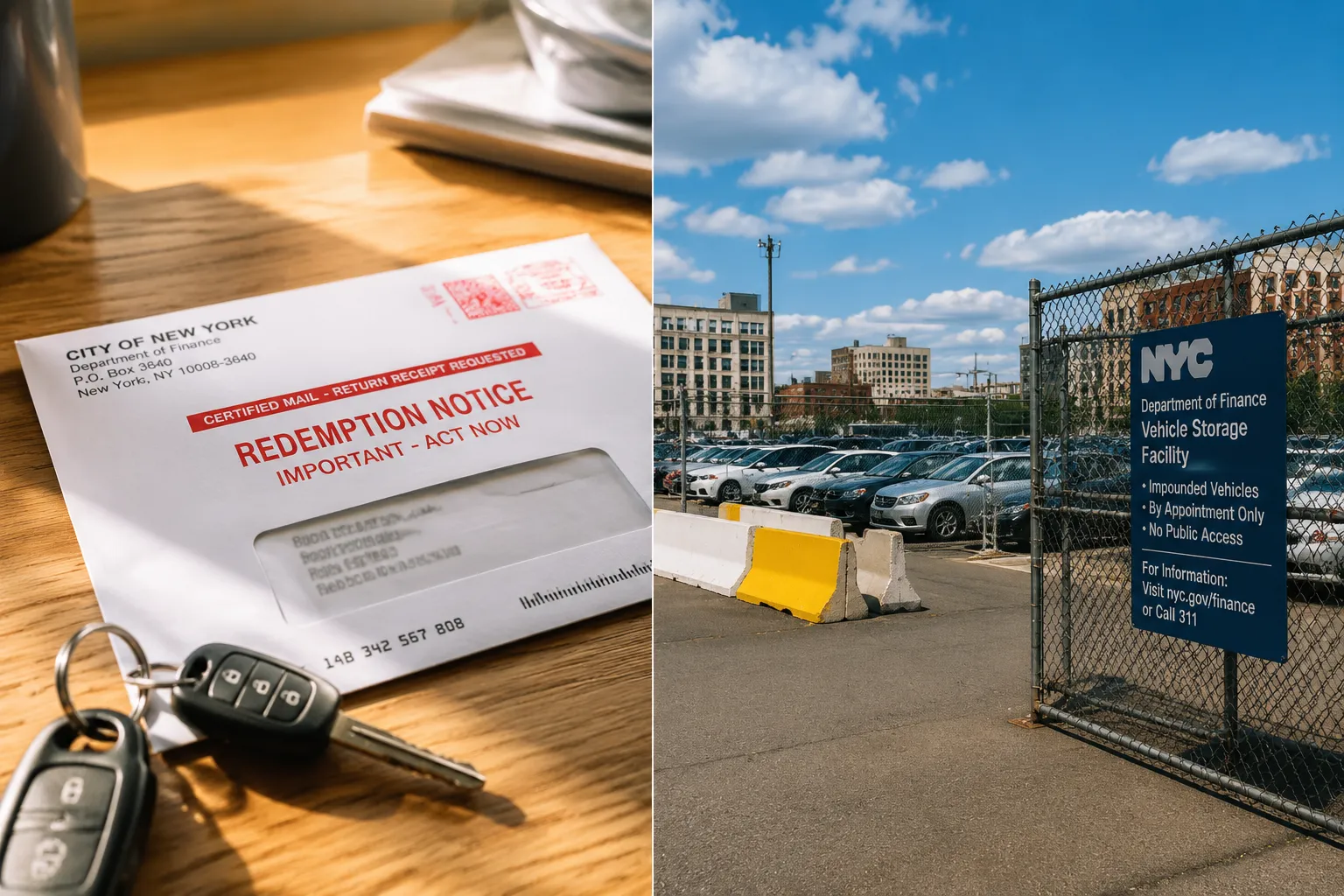
    The lender must provide you with a written notice of redemption amount that lists every fee and the total sum required [8]. This notice typically arrives by certified mail within 5-10 business days of repossession. If the lender fails to send the notice or inflates charges, you may challenge the redemption figure in court before paying.

    Key deadlines:

    • You can redeem until the lender completes the sale (auction or private sale).
    • Once the vehicle is sold, your redemption right expires; you can only pursue a deficiency-balance dispute if the sale proceeds fall short of your loan balance [2][4].

    Paying the redemption amount in full immediately stops storage fees and returns your car. Many New York borrowers negotiate partial payment plans with lenders before the sale deadline, though lenders are not legally required to accept installment redemption [6].

    If you cannot afford the full redemption cost, explore off-street parking options and garage rate comparisons to avoid additional Alternate Side Parking violations while you resolve the repossession.

    What You Must Pay to Redeem Your Repossessed Vehicle

    How Repossession Fees Are Applied After Sale

    If you do not redeem your vehicle, the lender will sell it at public auction or through a private sale. New York UCC § 9-615 governs how sale proceeds are distributed [1][6]:

    1. Reasonable expenses of repossession, storage, and sale are deducted first.
    2. The outstanding loan balance (principal, interest, late fees) is paid second.
    3. Any surplus goes to you or to junior lienholders (rare in auto repos).
    4. Any deficiency (shortfall) may be collected from you if your loan contract permits and the lender provides proper notice [2][4].

    Example: Your loan balance is $8,000. Repossession and storage fees total $1,200. The lender sells your car for $6,500. The $1,200 in fees is paid first, leaving $5,300 to apply against your $8,000 balance. You still owe a $2,700 deficiency, which the lender can pursue through collections or lawsuit [4].

    Lenders must conduct every sale in a «commercially reasonable» manner, adequate notice, fair market advertising, and a price reflecting actual market value [6][8]. If the sale was rushed, underpriced, or conducted without proper notice, you can challenge the deficiency in court and argue that inflated repossession fees reduced the net proceeds unfairly.

    Legal Protections and How to Challenge Excessive Fees

    New York’s UCC Article 9 and consumer-protection case law provide several defenses against unreasonable repossession fees:

    • Reasonable-expense standard: Every fee must reflect actual costs. If a lender charges $600 for a $300 tow, you can demand documentation and dispute the excess [1][6].
    • Itemized notice requirement: The redemption notice must list each fee separately. Lump-sum «repossession costs» without detail may be unenforceable [8].
    • Commercially reasonable conduct: Courts will void fees tied to improper procedures, e.g., storing your car at a facility owned by the lender’s affiliate and charging above-market rates [6].
    • Breach-of-peace prohibition: If the repo agent damaged your property, threatened you, or entered a locked garage without permission, the entire repossession may be invalid, and you owe nothing [4][7].

    Steps to challenge fees:

    1. Request an itemized invoice from the lender showing every charge, the service provider, and the date incurred.
    2. Compare charges to market rates: Call local tow companies and storage lots to verify typical costs in your area.
    3. Document any procedural violations: Photos of damage, witness statements, or police reports if the agent acted improperly.
    4. File a motion in court if the lender sues for a deficiency; assert excessive fees as an affirmative defense and demand proof of reasonableness [2][6].
    5. Consult a consumer-rights attorney: Many New York legal-aid organizations offer free consultations on repossession disputes [3].

    If you successfully prove fees were inflated, the court may reduce your redemption amount or deficiency balance by the excess. In egregious cases, such as a breach-of-peace repo, you may recover damages from the lender [4][6].

    For additional guidance on disputing unfair municipal charges, see our guide to fighting a double parking ticket in NYC, which outlines similar documentation and hearing strategies.

    Avoiding Repossession Fees: Proactive Steps

    The best way to minimize how much are repossession fees in NY cost you is to prevent repossession entirely or act immediately once it occurs:

    • Communicate with your lender early: Most New York lenders will negotiate a payment plan, deferment, or loan modification if you contact them before you miss multiple payments [8].
    • Understand your grace period: Review your contract to know how many days late trigger repossession; New York law does not require lenders to wait a specific number of days after default [4][6].
    • Check Alternate Side Parking rules: If your car is parked on a New York City street, ensure compliance with Alternate Side Parking to avoid towing that compounds your financial stress. Use real-time ASP status tools to stay informed.
    • Redeem within 48 hours if possible: Every day in storage adds $25,$75 to your bill. Borrowing from family or using a credit card to pay the redemption amount immediately can save hundreds in storage fees.
    • Explore off-street parking: If you’re at risk of repo, move your vehicle to a secure garage. Compare rates across NYC parking garages to find affordable monthly options that keep your car out of sight.
    • Know your rights: Repo agents cannot break into your locked garage, use force, or threaten you. If they do, document everything and contact an attorney immediately [4][7].

    New York credit unions and consumer lenders are required to follow fair repossession guidelines, including reasonable notice and transparent fee disclosure [8]. If your lender is a federally chartered institution, you can also file a complaint with the Consumer Financial Protection Bureau.

    For neighborhood-specific parking resources, explore Parking in Brooklyn, Parking in Manhattan, and Parking in the Bronx to secure your vehicle and avoid both municipal towing and private repossession.

    Conclusion

    How much are repossession fees in NY depends on the agent’s pickup charge, towing distance, daily storage rates, and administrative costs, all of which must be «reasonable» under New York law but are not capped at fixed amounts. Typical total fees range from $500 to $1,500 or more, with storage accruing $25,$75 per day. You have the legal right to redeem your vehicle by paying the full loan balance plus all documented expenses before the lender sells it, and you can challenge any fee that appears excessive or unsupported.

    Take action now:

    • Request an itemized redemption notice from your lender immediately.
    • Compare each charge to local market rates and demand documentation.
    • Redeem your vehicle within days to stop storage fees from mounting.
    • Consult a consumer-rights attorney if fees appear inflated or the repossession violated New York’s breach-of-peace rules.
    • Use real-time Alternate Side Parking status and citywide parking resources to keep your car secure and compliant, reducing the risk of both municipal towing and private repossession.

    Understanding your rights and acting quickly are the most effective ways to minimize repossession costs and protect your financial future in New York.

    References

    [1] Repo Laws In New York On Debt Collection Fees – https://www.daeryunlaw.com/us/insights/repo-laws-in-new-york-on-debt-collection-fees [2] Repossession – https://www.nycbar.org/get-legal-help/article/debts-debt-collection/repossession/ [3] Automobiles – http://161.11.225.182/assisting/clhm/automobiles.htm [4] Can They Repossess My Car In New York – https://rausarusso.com/blog/can-they-repossess-my-car-in-new-york [6] Repossession Laws In New York – https://rightsprotect.com/illegal-repossessions-of-vehicles/repossession-laws-by-state/repossession-laws-in-new-york/ [7] law.justia – https://law.justia.com/codes/new-york/vat/title-4/article-17/425/ [8] Repossession Guidelines – https://nycua.org/supporting/compliance/compliance-corner/repossession-guidelines [9] law.justia – https://law.justia.com/codes/new-york/pep/article-9/316/ [10] New York Repossession – http://newyork-repo.com/new-york-repossession.htm

  • What Time Do They Boot Cars in NYC: Official 2026 Enforcement Guide

    What Time Do They Boot Cars in NYC: Official 2026 Enforcement Guide

    New York City boots approximately 135,000 vehicles every year, yet there’s no single «boot time» marked on any enforcement schedule. Understanding what time do they boot cars in NYC requires knowing how parking violations, judgment debt, and enforcement patterns intersect across all five boroughs in 2026.

    The short answer: NYC does not boot cars at a specific time of day. Enforcement officers identify eligible vehicles throughout their shifts, typically between 7 AM and 7 PM on weekdays, though boots can be placed anytime a marshal or authorized contractor locates a scofflaw vehicle. Your car becomes eligible for booting the moment your unpaid parking tickets and camera violations reach $350 or more in judgment debt [1].

    This guide provides real-time clarity on boot enforcement schedules, payment procedures, and how to avoid fines and towing across New York City.

    Key Takeaways

    • NYC boots vehicles with $350+ in judgment debt, not at fixed daily times, enforcement runs primarily 7 AM, 7 PM weekdays [1]
    • Republic Immobilization Services administers the boot program; once booted, you have 48 hours to pay before towing risk [3]
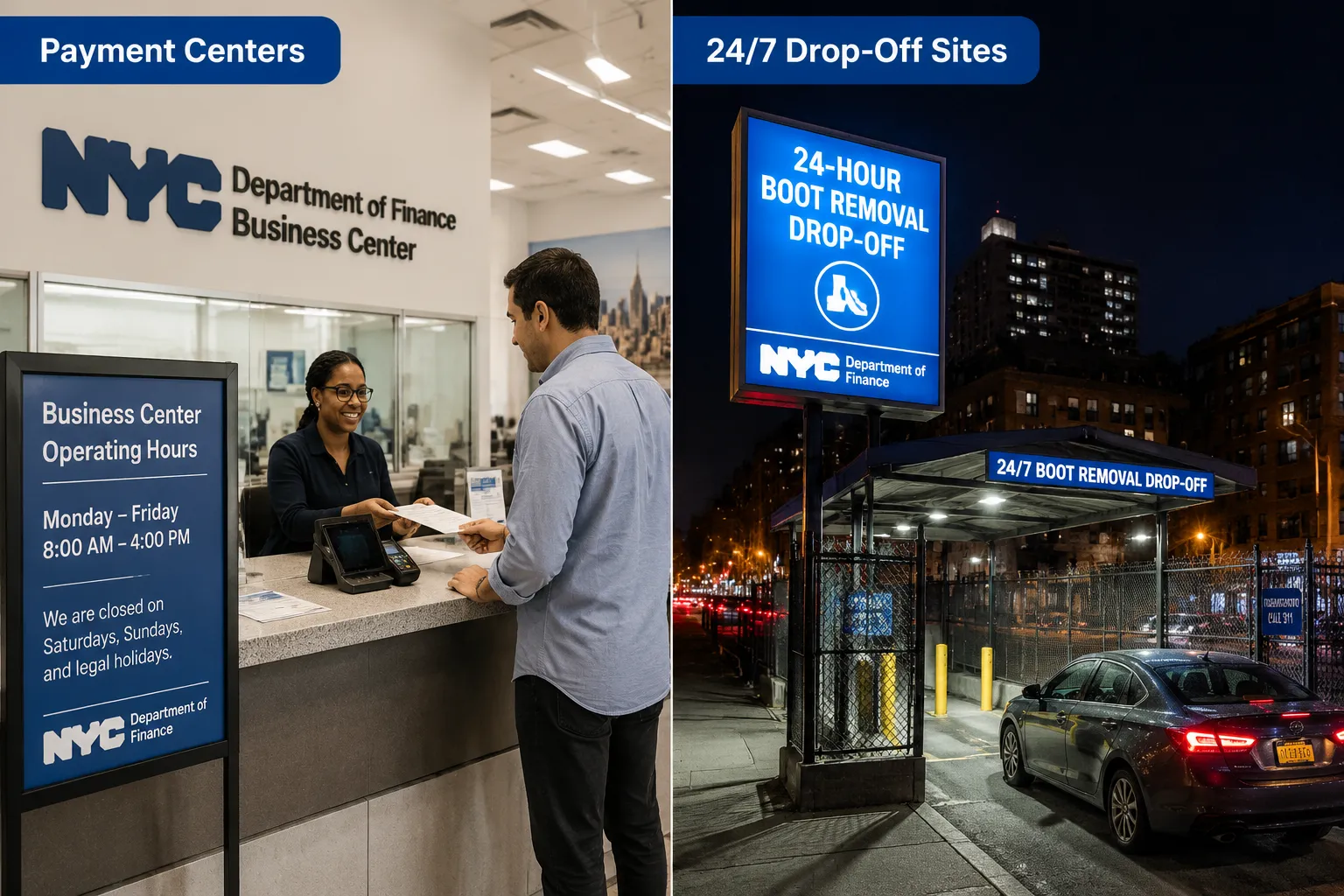
    • Payment and boot authorization are available 24/7 online and by phone; removal at drop-off sites operates around the clock at many locations [1]
    • In-person DOF Business Centers operate weekdays 8:30 AM, 4:30 PM for payment of boot and tow debt [7]
    • Check your vehicle’s violation status and Alternate Side Parking rules daily to stay ahead of judgment debt

    Understanding NYC’s Boot Program: No Fixed «Boot Time»

    Many drivers assume parking enforcement operates on a predictable clock. In reality, what time do they boot cars in NYC depends entirely on when enforcement officers encounter your vehicle during their patrol routes [1].

    The NYC Department of Finance contracts with Republic Immobilization Services to identify and immobilize vehicles with outstanding judgment debt. Enforcement personnel work standard business hours,typically 7 AM to 7 PM Monday through Friday,but boots can legally be placed anytime an authorized agent locates an eligible vehicle, including weekends and evenings [3].

    The $350 Judgment Debt Threshold

    Your vehicle becomes boot-eligible when:

    • Total unpaid parking tickets, camera violations, and related fees reach $350 or more in judgment debt [1]
    • Violations have entered judgment status (you missed the dispute window and payment deadline)
    • Your license plate is flagged in the city’s scofflaw database

    Judgment debt accumulates faster than many drivers realize. A single street-cleaning ticket ($65) combined with a few expired-meter violations can push you over the threshold within weeks if left unpaid.

    Peak Enforcement Windows

    While no official «boot time» exists, enforcement activity clusters during:

    • Morning hours (7 AM, 11 AM): Officers patrol Alternate Side Parking zones during street cleaning windows
    • Midday (11 AM, 3 PM): Residential and commercial district sweeps
    • Late afternoon (3 PM, 7 PM): Final patrol rounds before shift end

    Enforcement is lighter on weekends and holidays, but scofflaw vehicles remain eligible 24/7/365.

    Peak Enforcement Windows

    What Happens After Your Car Gets Booted in NYC

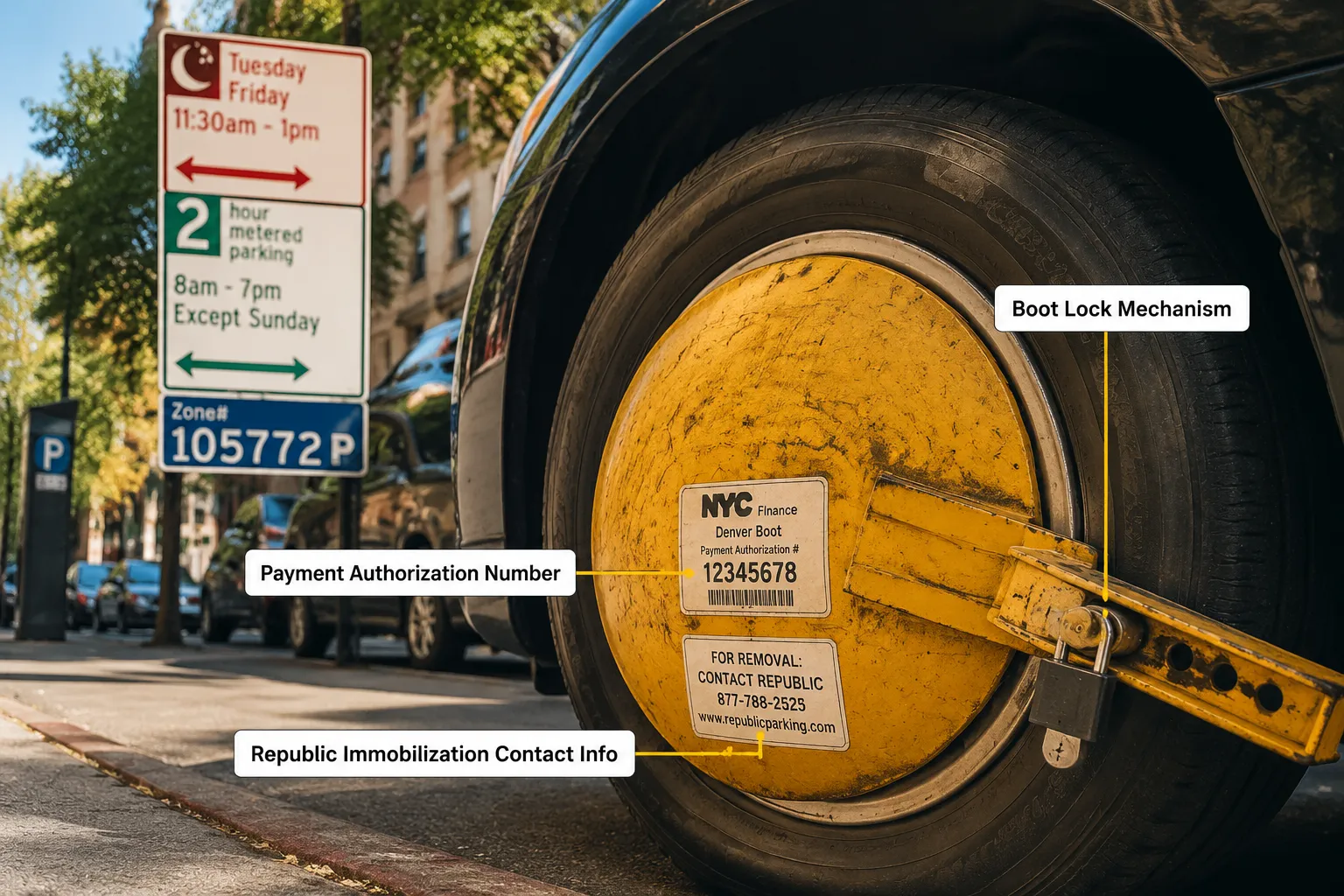
    Once a boot is installed, a bright yellow immobilization device locks onto your wheel, and a violation notice is affixed to your windshield [3]. The notice displays:

    • Your total judgment debt amount
    • Payment authorization phone number (646-517-1000)
    • Boot identification number
    • Warning: 48 hours to pay before towing [2]

    The 48-Hour Towing Window

    This is critical: you have 48 hours from the moment of booting to pay your debt and arrange boot removal [2]. After 48 hours, the city may tow your vehicle to an impound lot, adding:

    • Towing fees ($185+)
    • Daily storage charges ($20/day)
    • Additional administrative costs

    If your vehicle remains unclaimed for 10 days after towing, it becomes eligible for public auction [6].

    For help locating a towed vehicle, consult our comprehensive guide on how to find your towed car in NYC.

    24/7 Payment and Authorization

    Unlike many city services, boot payment and removal authorization operate around the clock [1]:

    Online Payment (24/7): Visit the NYC DOF website, enter your license plate, pay the full judgment debt plus boot fee ($136 as of 2026) [1]

    Phone Payment (24/7): Call 646-517-1000 to pay by credit/debit card and receive an authorization number immediately [1]

    In-Person Payment (Weekdays 8:30 AM, 4:30 PM): Visit any NYC Department of Finance Business Center to pay in person [7]

    Once payment clears, you receive a release authorization number. You must then drive (carefully, with the boot still attached) to an authorized drop-off location to have the boot physically removed.

    Boot Removal Drop-Off Locations and Hours

    After receiving your authorization number, you must visit a Republic Immobilization Services drop-off site to have the boot removed [3].

    Drop-Off Site Operating Hours

    24-Hour Locations (most common): Many drop-off sites operate continuously, allowing immediate removal any time of day or night [1]

    Limited-Hour Locations: Some sites maintain business-hour schedules (typically 8 AM, 6 PM weekdays) [3]

    Critical: Verify your nearest drop-off location’s hours before driving there. The authorization number you receive will include the closest site address and contact information.

    Removal Process

    1. Drive slowly to the drop-off location (the boot allows limited movement)
    2. Present your authorization number to the attendant
    3. Wait while the technician removes the boot (typically 5-15 minutes)
    4. Inspect your wheel for any damage before leaving

    Do not attempt to remove the boot yourself. Tampering with or damaging a boot is a criminal offense and will result in additional fines and potential arrest [2].

    Removal Process

    How to Avoid Getting Booted: Proactive Strategies

    Prevention is always cheaper than cure. Follow these strategies to stay off the boot list:

    Monitor Your Violation Status Weekly

    Check your parking ticket balance every week at the NYC DOF website. Set a calendar reminder. Judgment debt accumulates silently, by the time you notice, you may already be boot-eligible.

    Pay or Dispute Tickets Immediately

    You have 30 days to pay or dispute a parking ticket before it enters judgment [2]. Once in judgment, penalties increase and boot eligibility begins.

    For guidance on challenging unfair citations, visit our Tickets & Disputes resource hub.

    Use Real-Time Alternate Side Parking Alerts

    Street-cleaning violations are the most common path to boot eligibility. Stay informed with live ASP status:

    Consider Off-Street Parking for High-Risk Periods

    If you’re close to the $350 threshold and need time to resolve tickets, use secure off-street parking temporarily. Explore NYC Parking Directory for garage options across all boroughs.

    Understand No Standing Rules

    Many drivers confuse «No Parking» with «No Standing.» Learn the critical differences in our guide: What Does No Standing Mean in NYC?

    Boot vs. Tow: Understanding the Enforcement Escalation

    Booting is the first stage of NYC’s scofflaw enforcement ladder [6]:

    Stage 1: Boot Vehicle immobilized in place; 48-hour payment window; $136 boot fee

    Stage 2: Tow After 48 hours, vehicle towed to impound; $185+ towing fee plus $20/day storage

    Stage 3: Auction After 10 days unclaimed, vehicle sold at public auction; all debt transferred to owner’s record

    The city’s goal is revenue collection, not vehicle seizure. Pay within 48 hours and you’ll avoid the tow-and-storage cascade that can triple your total cost [6].

    For more on the towing process, see our Towing & Impounds articles.

    Frequently Asked Questions

    Can they boot my car on a Sunday? Yes. While enforcement is less common on weekends, boots can legally be placed any day if your vehicle is identified as a scofflaw [1].

    What if I’m in the car when they try to boot it? If you’re present and the boot is not yet installed, you may be able to drive away. Once the boot is locked, you cannot leave and must follow the payment process [2].

    Can I get booted for one unpaid ticket? No. You need $350 or more in judgment debt to become boot-eligible [1]. A single ticket will not trigger booting.

    How long does boot removal take after I pay? Online and phone payments post immediately, and you receive an authorization number within minutes. Physical removal at a drop-off site takes 5-15 minutes [1].

    What if I can’t afford to pay the full amount? NYC offers payment plans for judgment debt. Contact the Department of Finance at 646-517-1000 to discuss installment options. However, the boot will not be removed until full payment is made [9].

    Do boots damage my car? Properly installed boots should not damage your vehicle. If you notice wheel or tire damage after removal, document it immediately and file a claim with the Department of Finance [2].

    Conclusion

    What time do they boot cars in NYC? The answer is: anytime your vehicle is found with $350+ in judgment debt, though enforcement is most active 7 AM, 7 PM on weekdays. There is no fixed «boot time», only eligibility thresholds and patrol patterns.

    Take action now:

    1. Check your violation status at the NYC DOF website today
    2. Pay or dispute any outstanding tickets within 30 days
    3. Set up Alternate Side Parking alerts to avoid street-cleaning violations
    4. Bookmark payment and removal resources so you’re prepared if booted
    5. Explore off-street parking options if you’re close to the $350 threshold

    Stay ahead of judgment debt, monitor suspension calendars, and use real-time ASP status tools to avoid fines and towing. For more parking guidance, visit the Park Rules Live Blog and explore our New York City Articles for neighborhood-specific tips.

    References

    [1] Services Booting – https://www.nyc.gov/site/finance/vehicles/services-booting.page [2] Article – https://portal.311.nyc.gov/article/?kanumber=KA-02054 [3] Vehicle Booting – https://www.risnyc.com/vehicle-booting/ [6] Nyc Boot Tow Guide – https://clearplates.com/insights/nyc-boot-tow-guide [7] Contact Us By Visit – https://www.nyc.gov/site/finance/about/contact-us-by-visit.page [9] Contact Us – https://www.nyc.gov/site/finance/about/contact-us.page

  • How to Find a Towed Vehicle NYC: Official 2026 Lookup Guide

    How to Find a Towed Vehicle NYC: Official 2026 Lookup Guide

    Every year, over 200,000 vehicles are towed in New York City, and most drivers discover their car is missing at the worst possible moment. Whether you parked during Alternate Side Parking enforcement, violated street cleaning rules, or returned to an empty spot after a crash, knowing exactly how to find a towed vehicle NYC can save hours of frustration and hundreds of dollars in storage fees.

    This guide walks through the official 2026 process, pound locations, recovery requirements, and Real-Time Status tools to locate and retrieve your vehicle fast.

    Key Takeaways

    • Use the official NYCServ Find Towed Vehicle tool with your license plate, state, and vehicle type to confirm tow status and pound location instantly.
    • Call 311 or visit NYC311 online if your vehicle doesn’t appear in the system, it may have been relocated rather than impounded.
    • NYPD tow pounds operate in the Bronx, Brooklyn, Queens, and Manhattan (Pier 76), with varying hours; Manhattan’s Pier 76 is open nearly 24/7.
    • Bring your driver’s license, vehicle registration, and a credit card or cash to pay towing and storage fees at the pound.
    • Vehicles towed as evidence or after serious collisions go to separate NYPD Property Clerk auto pounds with restricted weekday-only access.

    Official NYC Towed Vehicle Lookup: Start Here to Find a Towed Vehicle NYC

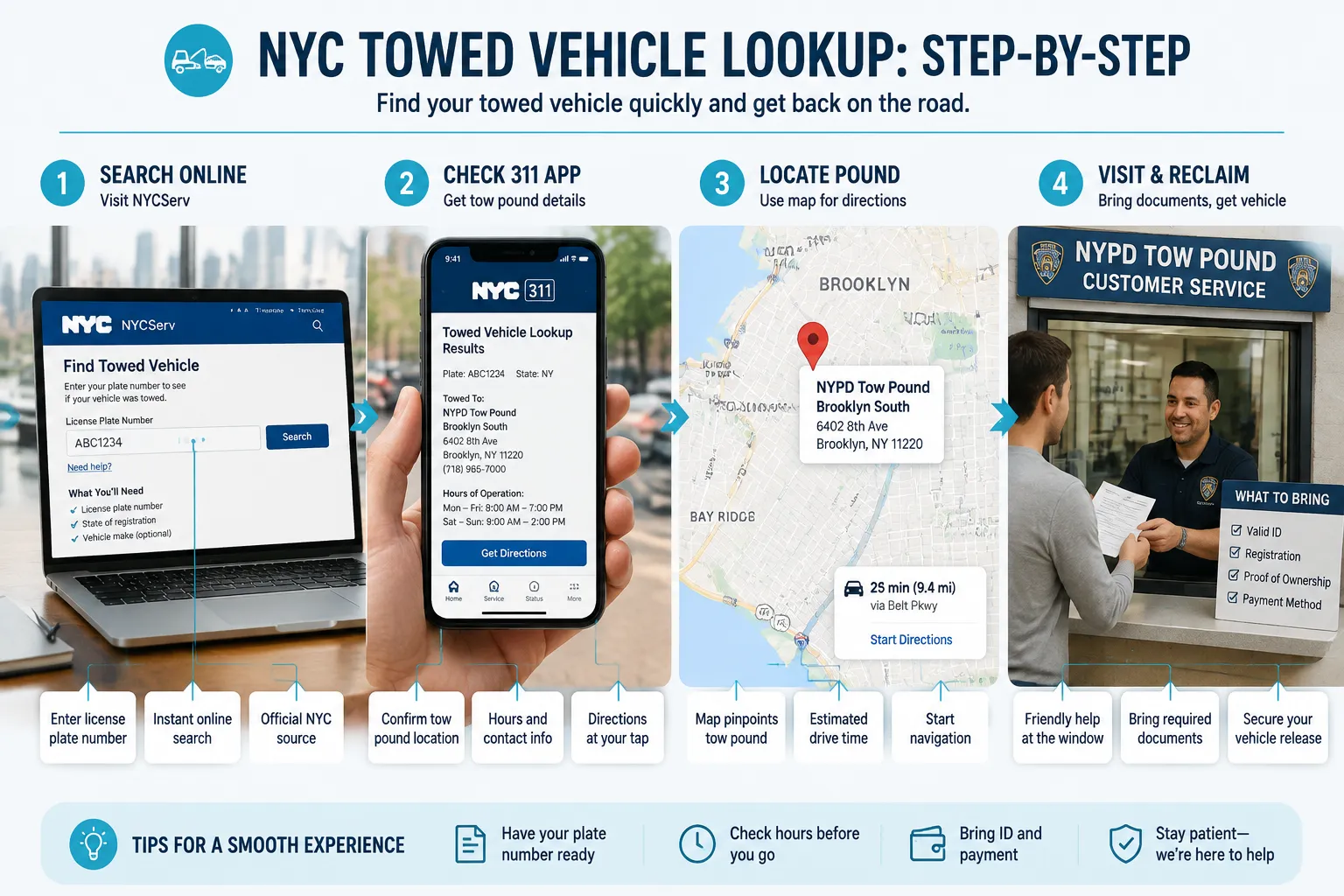
    The fastest, most reliable way to find a towed vehicle NYC is the NYCServ Find Towed Vehicle online tool.[1][2] This official city service searches all NYPD, Department of Finance, marshal, and sheriff tow records in real time.

    How to use the NYCServ tool:

    1. Visit the NYCServ Find Towed Vehicle page.
    2. Enter your license plate number exactly as it appears.
    3. Select your state of registration from the dropdown.
    4. Choose your vehicle type: passenger car, commercial vehicle, taxi, motorcycle, or other.
    5. Click «Search.»

    If your vehicle was towed, the results display which pound holds it, the pound’s address, phone number, and operating hours.[1][8] You can then call ahead to confirm fees and required documents.

    Official NYC Towed Vehicle Lookup: Start Here to Find a Towed Vehicle NYC

    If your vehicle doesn’t appear: Call 311 immediately or use the NYC311 mobile app.[3][7] Provide your plate number, state, exact cross streets where you parked, borough, and the approximate time you last saw the car. The 311 operator can check additional databases and confirm whether the vehicle was relocated (moved a few spaces by police) rather than towed to a pound.[3][15]

    For comprehensive parking guidance and Real-Time Status updates on Alternate Side Parking, check suspension calendars to avoid future towing.

    NYPD Tow Pound Locations, Hours, and What to Bring

    Once you confirm your vehicle’s pound location, plan your visit carefully. Each borough’s NYPD tow pound has distinct hours and procedures.[4][13]

    Borough-by-Borough Pound Details

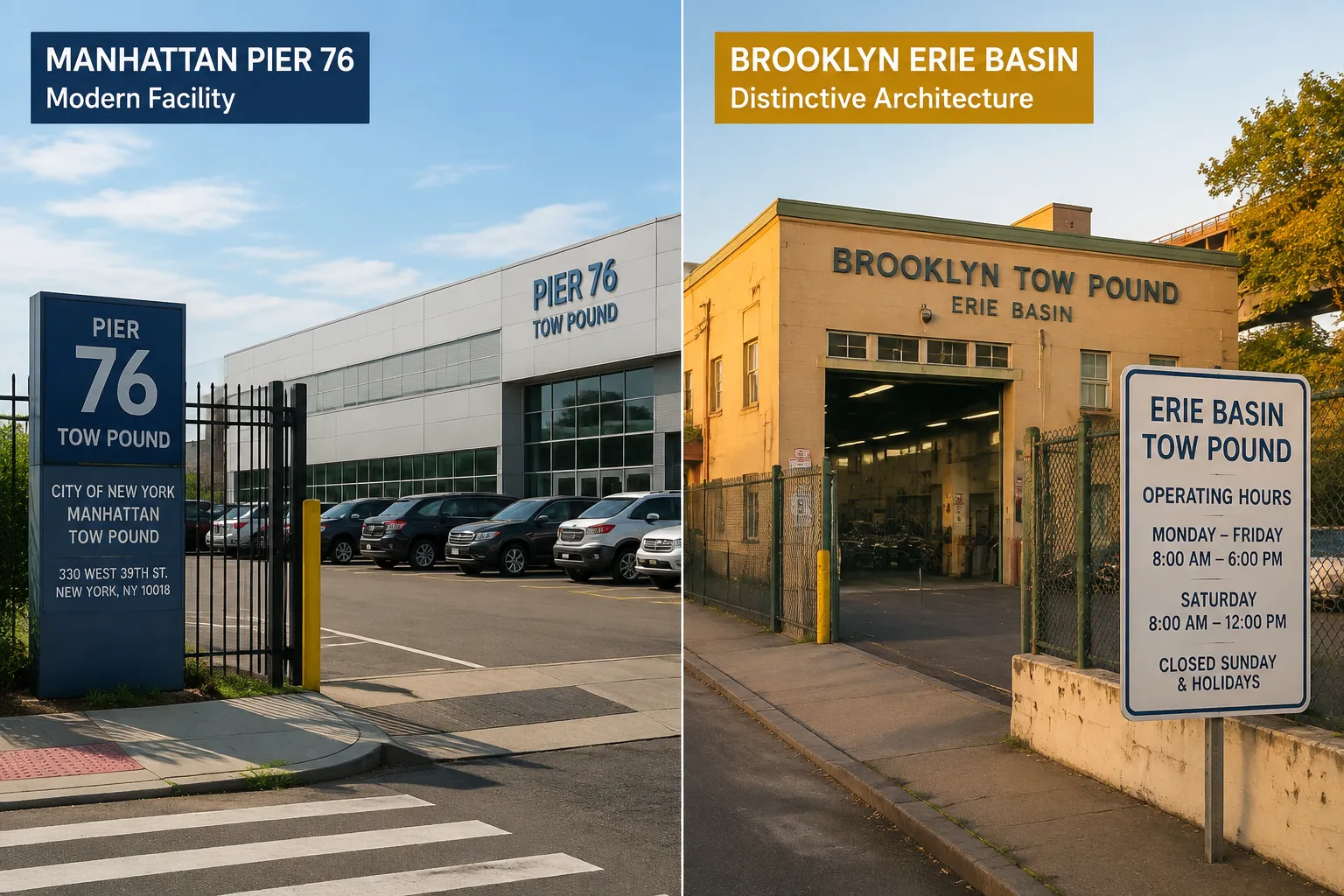
    Manhattan, Pier 76 (West 38th Street at 12th Avenue)

    • Hours: 7:00 a.m. Monday through 5:00 a.m. Sunday (essentially 24/6 operation; closed only 5:00 a.m. Sunday to 7:00 a.m. Monday).[13][8]
    • Phone: Check the official NYPD Towed Vehicles page for current contact.
    • Notes: Busiest pound; longest weekend hours; accessible by public transit and taxi.

    Bronx, 3880 Bronx Boulevard

    • Hours: Typically weekdays and Saturdays, daytime to early evening; closed Sundays.[13][9]
    • Phone: Listed on NYPD site.

    Brooklyn, Erie Basin Auto Pound (Columbia Street)

    • Hours: Weekdays and Saturdays, daytime hours; closed Sundays.[13][9]
    • Phone: Listed on NYPD site.

    Queens, 129-01 31st Avenue (College Point)

    • Hours: Weekdays and Saturdays, daytime hours; closed Sundays.[13][9]
    • Phone: Listed on NYPD site.

    For the most current addresses, phone numbers, and holiday closures, always consult the official NYPD Towed Vehicles page.[4]

    Borough-by-Borough Pound Details

    What to Bring to Retrieve Your Vehicle

    Required documents:[2][3][8]

    • Valid driver’s license (must match the name on the registration or rental agreement).
    • Vehicle registration or rental agreement.
    • Proof of insurance (often requested).
    • Payment method: credit card, debit card, or cash. Towing fees typically start around $185, plus $20 per day storage after the first day.[8][9]

    For rental cars: Bring your rental agreement and the credit card used to book the rental. The rental company may require you to notify them before retrieval.[15]

    For commercial vehicles: Additional paperwork (TLC license, commercial registration) may be required.

    Towing & Impounds: Evidence and Collision Vehicles

    Vehicles towed as evidence or after serious collisions are held at separate NYPD Property Clerk auto pounds, not the standard borough pounds.[4][14]

    Property Clerk Auto Pound Locations:

    • Brooklyn: Columbia Street facility (separate from the Erie Basin tow pound).
    • Queens: Springfield Gardens facility near JFK Airport.

    Hours: Monday through Friday, 8:00 a.m. to 3:00 p.m., excluding holidays.[14] Public access is restricted; you may need a release from the investigating officer or detective.

    If your vehicle was involved in an accident and doesn’t appear in the NYCServ tool, contact the precinct that handled the accident report to determine whether it was towed or relocated.[7] For more guidance on Towing & Impounds procedures, explore the Parking Education Hub.

    Avoid Fines and Towing: Real-Time Alternate Side Parking Status

    The best way to find a towed vehicle NYC is to never have it towed in the first place. Most NYC tows result from Alternate Side Parking violations during street cleaning.[6][9]

    Check Real-Time Status daily:

    • Visit Park Rules Live for live ASP suspension calendars and alerts.
    • Sign up for push notifications when street cleaning is suspended due to holidays or snow emergencies.
    • Review neighborhood-specific rules in Brooklyn, Queens, the Bronx, and Manhattan.

    Other common towing triggers:

    For hyper-local ASP rules, check Yonkers Alternate Side Parking and Mount Vernon Alternate Side Parking if you park outside the five boroughs.

    What to Do If Your Car Was Relocated, Not Towed

    Sometimes NYPD officers move a vehicle a few spaces or around the corner to facilitate emergency access, construction, or filming, without towing it to a pound.[3][6] This is called a «relocation.»

    Steps to find a relocated vehicle:

    1. Walk a two-block radius around where you parked, checking side streets and nearby blocks.
    2. Call 311 and provide your plate, state, exact cross streets, and borough. The operator can check relocation logs.[3][15]
    3. Contact the local precinct if 311 has no record. Precinct desk officers maintain relocation notes.[7]

    Relocated vehicles are not listed in the NYCServ towed-vehicle database, so always call 311 if the online search returns no results.[3][7]

    Tickets & Disputes: Challenge Unfair Parking Citations

    If you believe your vehicle was towed unjustly, for example, during a posted ASP suspension or from a spot with unclear signage, you can dispute both the towing fee and any associated parking tickets.[2][3]

    How to dispute:

    • Visit the NYC Department of Finance Parking Violations Bureau online portal.
    • Submit photos of signage, proof of ASP suspension, or evidence of a malfunctioning meter.
    • Reference the exact date, time, and location.
    • Request a hearing or submit a written appeal.

    For step-by-step guidance, explore the Tickets & Disputes section of the Parking Education Hub. Fighting unfair citations can save hundreds of dollars and prevent points on your license.

    Off-Street Parking: Avoid Future Tows with Garage Savings

    If street parking feels too risky, especially during ASP enforcement or snow emergencies, consider monthly garage rates or daily off-street parking.[6][9]

    Find garage deals:

    Monthly garage contracts often cost less than a single towing incident plus storage fees, and you’ll never worry about ASP again.

    Conclusion

    Knowing how to find a towed vehicle NYC starts with the official NYCServ lookup tool and 311 support. Enter your license plate, state, and vehicle type to confirm tow status and pound location instantly. If your car doesn’t appear, call 311 to check relocation logs or contact the precinct that handled any accident report. Always bring your driver’s license, registration, and payment to the pound, and verify hours before you go, Manhattan’s Pier 76 operates nearly 24/7, but other borough pounds close on Sundays.

    Next steps:

    Stay informed, act fast, and recover your vehicle with minimal hassle.

    References

    [1] Pvo Find Towed Vehicle – https://nycserv.nyc.gov/NYCServWeb/PVO_Find_Towed_Vehicle.jsp [2] Services Towed Vehicles – https://www.nyc.gov/site/finance/vehicles/services-towed-vehicles.page [3] Article – https://portal.311.nyc.gov/article/?kanumber=KA-02055 [4] Towed Vehicles – https://www.nyc.gov/site/nypd/services/vehicles-property/towed-vehicles.page [5] Where Is My Towed Car – https://www.brownstoner.com/queens/news/where-is-my-towed-car/ [6] Car Towed Nyc – https://secretnyc.co/car-towed-nyc/ [7] How To Find My Towed Car Nyc – https://www.njnylawyers.com/blog/how-to-find-my-towed-car-nyc/ [8] Towed Car Nyc – https://www.cartowed.com/find-car-towed-by-city/towed-car-nyc/ [9] What To Do If Your Car Is Towed In Nyc – https://towtruck.nyc/blog/what-to-do-if-your-car-is-towed-in-nyc/ [13] NYPD Tow Pound Hours – (referenced from source [4]) [14] NYPD Property Clerk Auto Pounds – (referenced from source [4]) [15] Rental Car Towing Guide – (referenced from source [7])